US Nonfarm Payrolls Down 23K in July 2026

Evening Analysis • Friday, August 07, 2026

The Gist View

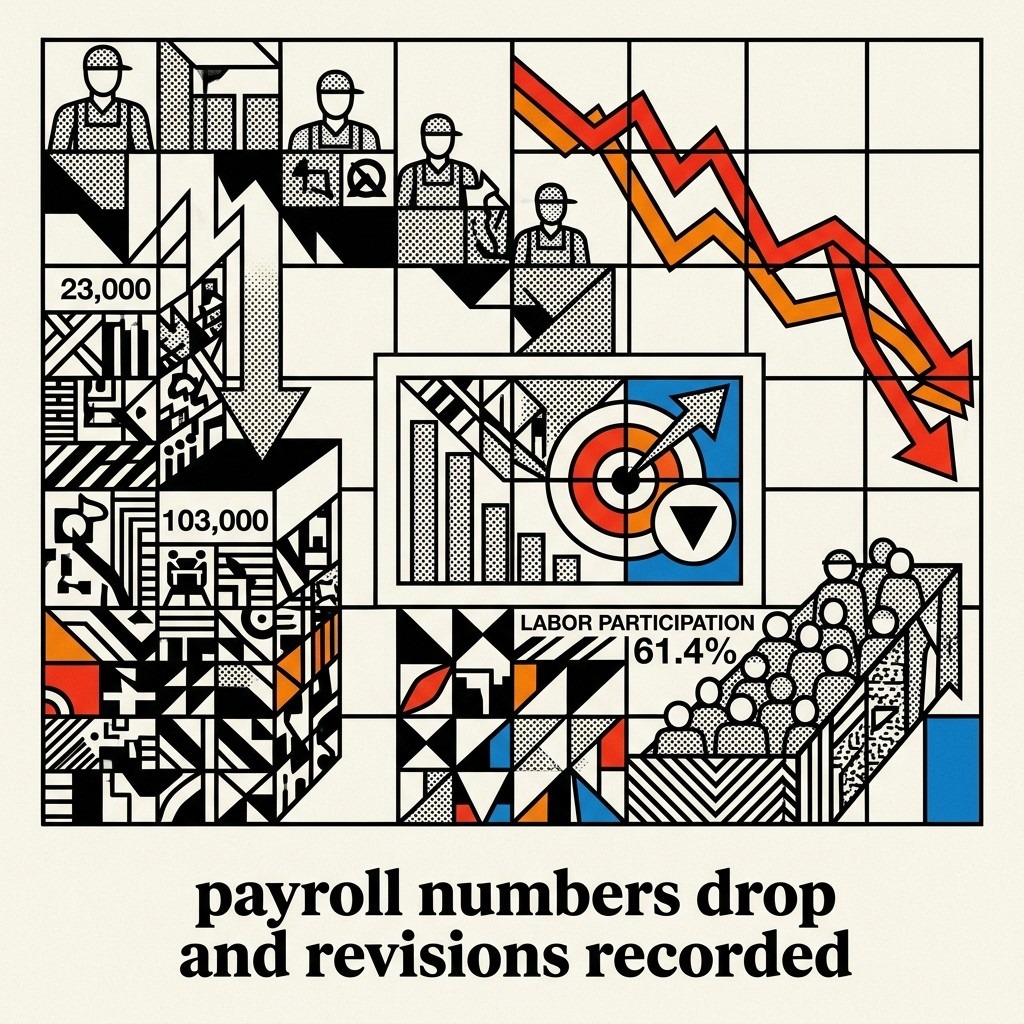
US nonfarm payrolls — a monthly measure of employment excluding agricultural, private household, and non-profit workers — shrank by 23,000 in July 2026. The US Bureau of Labor Statistics (BLS) compounded this by revising May and June estimates down by a combined 103,000 positions. This abrupt contraction shatters the soft-landing narrative, forcing the Federal Reserve to pivot from fighting inflation to arresting an economic slowdown.

The headline unemployment rate fell to 4.1% entirely because people abandoned the workforce, dragging labor force participation to a multi-year low of 61.4%. Wage growth remained resilient at 3.2% year-over-year, and the sharpest payroll declines hit seasonal local government education roles, but the broader signal holds. Central bankers stall on cutting rates because they gain institutional credibility by defeating inflation; now, that delay risks accelerating a labor collapse.

The last time the US economy posted a negative July payroll print without already being in a declared recession was in 2003, Bloomberg notes.

The Gist AI Editor

The Global Overview

US Labor Market Contraction

July’s negative payroll print ends post-pandemic labor resilience. The US Bureau of Labor Statistics (BLS) reports total nonfarm payrolls—monthly employment excluding agricultural, household, and non-profit workers—fell by 23,000 in July 2026. The BLS revised May and June down by a combined 103,000 positions, forcing the Federal Reserve to shift from fighting inflation to containing a slowdown (Bloomberg). The 4.1% unemployment drop masks deeper weakness, driven entirely by people leaving the workforce rather than new hiring, pushing labor force participation to a multi-year low of 61.4% (Seeking Alpha). However, wage growth remained resilient at 3.2% year-over-year, outpacing inflation, with sharpest drops concentrated in seasonal local government education roles. Both the US labor contraction and Germany’s struggle to reform early retirement underscore a structural exhaustion of workforce participation, forcing Western governments to finally price in the cost of their aging demographics.

DR Congo Uranium Export Probe

The Democratic Republic of Congo launched a government probe into the illicit export of up to 2,000 tonnes of uranium concealed within cobalt shipments destined for China (FT). On August 5, 2026, the Union of Chinese-Capital Mining Companies in the DRC formally denied their cobalt products contain excessive uranium. This investigation uses state regulatory oversight to control domestic extraction, introducing structural friction into the critical commodity chains supplying Chinese industry.

Stay tuned for the next Gist—your edge in a shifting world. The Gist remains independent and reader-supported. If you value news free from corporate or state interests, consider supporting our mission with a donation.

The European Perspective

Italy-Spain Schengen Standoff

By weaponizing border checks, Italy transforms freedom of movement within Schengen—the European Union’s passport-free travel zone—into a bargaining chip. After 72,000 people entered Ceuta—a Spanish autonomous city and enclave located on the north coast of Africa—in late July 2026 (International Rescue Committee), Rome suspended rules for Spanish arrivals from August 1 to at least August 15, 2026 (Politico). Madrid threatens proportional measures unless checks end by August 9 (Arab News), confirming our warning that the Ceuta breach would quickly metastasize into an institutional crisis. While Schengen allows temporary internal controls during severe security threats, Madrid’s ultimatum shows Mediterranean nations will inflict economic damage on each other’s tourism sectors to force compliance on migration burdens.

Berlin Nightlife Economic Shift

A 2026 survey reveals ticket sales provide 59% of Berlin club revenue, up from 21% in 2017 (DW). As alcohol consumption drops and stays shorten, food and drink yield just 20%, down from 60%.

German Pension Reform Dispute

Plans to abolish the ‘Rente mit 63’ early retirement scheme face intense resistance (ZDF). The abolition aims to relieve federal budget pressures and keep older workers in the labor force.

Catch the next Gist for the continent’s moving pieces.

🎙️ Listen to this edition as a podcast Listen

The Gist is an independent daily digest: AI-curated, human-directed, unapologetically liberal (how it’s made). Hundreds of sources, only what matters. Subscribe free or listen to the podcast.


Comments

Leave a Reply

Your email address will not be published. Required fields are marked *

This site uses Akismet to reduce spam. Learn how your comment data is processed.