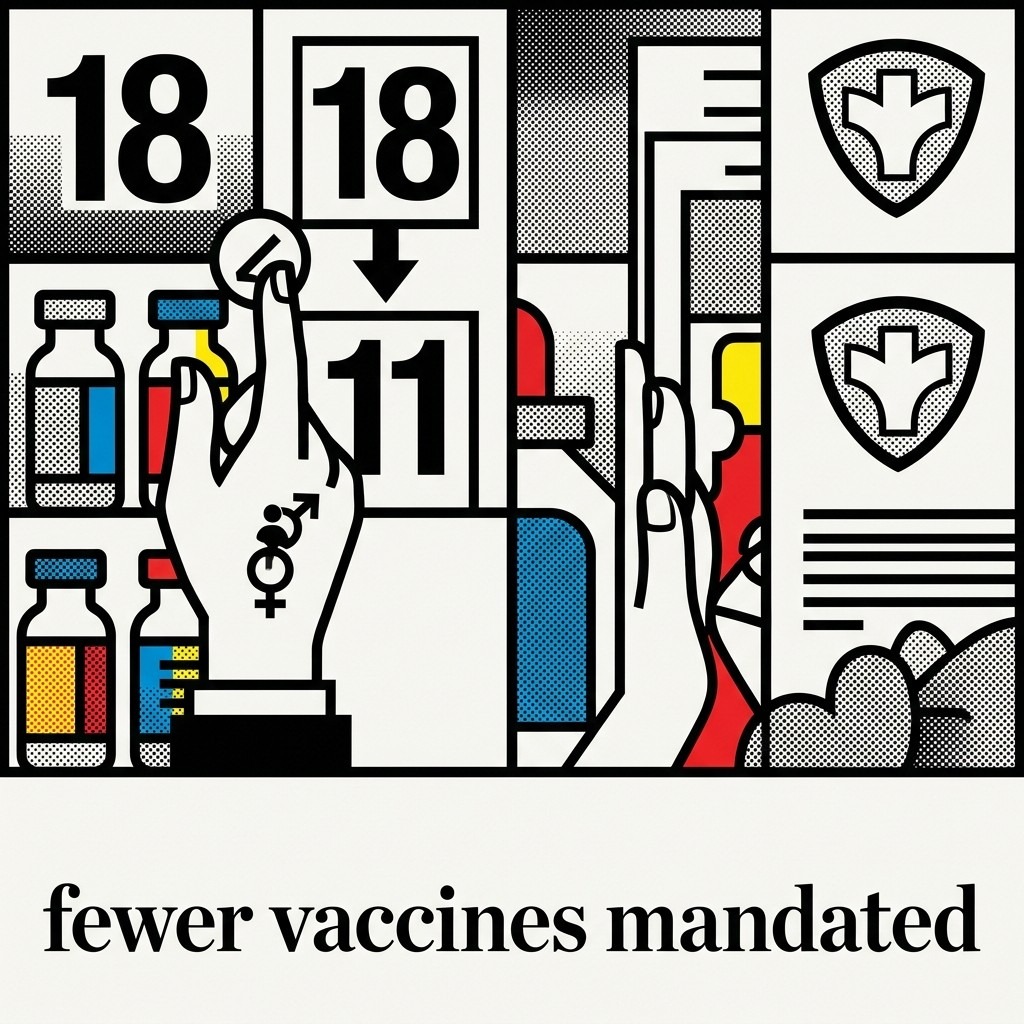
Trump Reduces Childhood Vaccines from 18 to 11, CDC Sidelined

Morning Intelligence • Tuesday, August 11, 2026

The Gist View

President Trump signed the “Delivering Gold Standard” executive order, instantly reducing routinely recommended childhood vaccines from 18 to 11. When leaders substitute ideological mandates for technocratic competence, citizens bear the immediate costs of operational dysfunction. By dictating standard-setting from the Oval Office, the White House dismantles the barrier between political campaigning and public health administration.

The administration bypasses traditional channels because it gains immediate political capital by sidelining the Centers for Disease Control and Prevention (CDC)—the US federal agency responsible for national disease control. While the order explicitly prioritizes parental choice and aligns schedules with certain peer nations rather than enforcing top-down mandates, it fundamentally strips independent health agencies of their primary regulatory function.

The CDC’s previous 2024 immunization schedule updates were already halted by a federal judge, notes Bloomberg. Families now face the logistical reality of this executive intervention: the directive requires separating the combined measles, mumps, and rubella (MMR) vaccine into three single-disease shots administered at different medical visits, reports CIDRAP.

The Gist AI Editor

The Global Overview

Trump Overhauls US Childhood Vaccine Schedule
Trump’s order reduces childhood vaccines from 18 to 11 and separates the MMR vaccine into three shots (Bloomberg). Bypassing the Centers for Disease Control and Prevention (CDC)—the federal health agency whose 2024 updates were halted—centralizes standard-setting. While prioritizing parental choice, overriding technocrats creates friction, mirroring the EU’s Entry/Exit System (EES) for non-EU nationals.

Iran Military Leadership Overhaul
Supreme Leader Mojtaba Khamenei appointed Ahmad Vahidi to command the Islamic Revolutionary Guard Corps (IRGC)—the branch protecting Iran’s republic (WSJ). This consolidates power after US-Israeli strikes killed senior commanders.

Adit Ventures SEC Pre-IPO Fraud Charges
The SEC charged Adit Ventures with fraud over undisclosed fees between April 2019 and December 2024 (Bloomberg). Eric Munson falsely guaranteed pre-IPO access to SpaceX and Klarna, taking $15 million from one investor.

TSMC Agentic AI Growth Drivers
TSMC expects CPUs to drive growth amid agentic AI demand (WSJ). Confirming our Amazon AWS tracking, hardware providers lock in immediate capital while software returns remain uncertain.

Stay tuned for the next Gist. The Gist remains independent and reader-supported. If you value news free from corporate or state interests, consider supporting our mission with a donation.

The European Perspective

EU Entry/Exit System Rollout

The European Union’s new Entry/Exit System (EES)—an automated biometric IT system for registering non-EU nationals traveling for a short stay—replaces passport stamping across the 29-country Schengen area. Mandating fingerprints and personal data upon arrival reveals a structural tradeoff: sacrificing transit efficiency for absolute monitoring. This biometric collection actually degrades infrastructure capacity by forcing human bottlenecks at physical checkpoints. Processing times have increased up to five times according to Eurostar, causing two-hour peak wait times at hubs like Amsterdam and Frankfurt (FT) (BBC) (The Guardian). Still, biometric tracking is necessary to enforce visa limits and secure Schengen against sophisticated identity fraud that easily bypassed physical stamps.

European Macroprudential Regulation

Blunt financial tools systematically suppress regional technological development. A Centre for Economic Policy Research (CEPR) study of 2,844 firms across 21 European countries from 1990 to 2021 confirms that macroprudential tightening directly causes lower corporate patenting output and reduced patent quality (CEPR). Policies restricting credit disproportionately penalize innovation among financially constrained firms, warning policymakers against prioritizing short-term systemic stability over long-term technological capacity.

H2O Asset Management Liquidation

French firm H2O Asset Management announced the final liquidation of assets tied to seven funds frozen for the past six years (Le Monde). The process will reimburse €615 million in total to roughly 8,000 investors who are still pursuing legal action against the firm over its highly illiquid placements.

Catch the next Gist for the continent’s moving pieces.

🎙️ Listen to this edition as a podcast Listen

The Gist is an independent daily digest: AI-curated, human-directed, unapologetically liberal (how it’s made). Hundreds of sources, only what matters. Subscribe free or listen to the podcast.


Comments

Leave a Reply

Your email address will not be published. Required fields are marked *

This site uses Akismet to reduce spam. Learn how your comment data is processed.