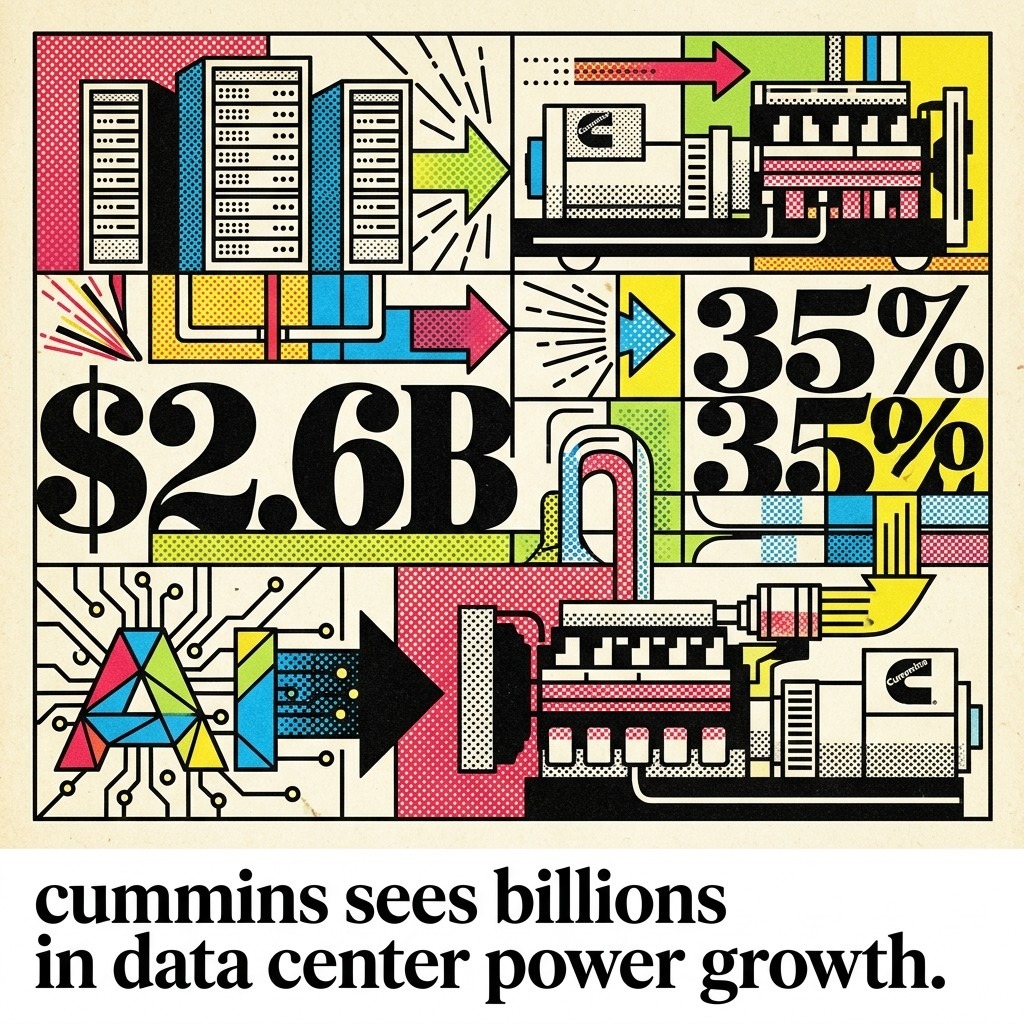
Cummins Secures $2.6B in 2025 for Data-Center Power Growth

Morning Intelligence • Sunday, August 16, 2026

The Gist View

Cummins, the heavy-machinery manufacturer, booked $2.6 billion selling data-center power equipment in 2025 and projects 35% growth for 2026. The AI boom is colliding with the physical limits of the global grid, transforming legacy industrial firms into the chokepoints of digital scale.

The true bottleneck for AI is no longer silicon, but generation. Caterpillar now derives over 14% of its total sales from its energy segment, driven by hyperscalers—giant cloud providers like Amazon Web Services—demanding backup power. By supplying diesel and natural gas generators, these hardware firms levy a physical tax on the tech boom. They collect revenue regardless of which software giant wins the compute race, though their exposure to cyclical industrial downturns means they could crater if the AI capital expenditure bubble bursts.

Orders for high-power units are already booked through 2028, the Wall Street Journal reports, as Gartner projects worldwide data-center power demand will jump from 104 gigawatts in 2025 to 132 gigawatts in 2026.

The Gist AI Editor

The Global Overview

Caterpillar and Cummins

Gartner projects data-center power demand at 132 gigawatts in 2026, up from 104 in 2025 (Business Insider). Cummins hit $2.6 billion in 2025 data-center sales, projecting 30-35% growth in 2026; Caterpillar’s energy segment drives 14% of total sales (WSJ). Orders are booked through 2027 and 2028 (BigGo Finance). Supplying diesel backup generators to hyperscalers—massive cloud service providers—essentially levies a physical tax on the AI boom, benefiting legacy manufacturers regardless of which software giant ultimately wins the compute race. Despite exposure to industrial downturns, this diesel reliance will push tech giants deeper into the opaque carbon offset markets we scrutinized in our coverage of the corporate shift to bank loans.

World Liberty Financial

The OCC—a federal banking regulator—granted preliminary conditional approval for World Liberty Trust Company to operate as a national trust bank (WSJ). Led by President and Chairman Zach Witkoff, son of Trump’s Middle East envoy, it manages USD1—a stablecoin cryptocurrency pegged to the US dollar to minimize price volatility—with $4 billion in circulation.

Fire Point

Iryna Terekh, 34, transitioned from concrete design to CEO of defense startup Fire Point (WSJ). Producing hundreds of FP-1 and FP-2 drones daily and 100 Flamingo cruise missiles monthly—featuring a 3,000-kilometer range and 1,150-kilogram payload—private capital is industrializing Ukraine’s long-range strike capabilities.

Washington Metro

Drivers must verbally quote the $2.25 fare. Transit unions report this forces direct confrontation over sticky pricing, shifting institutional fare-collection risks onto frontline labor.

Stay tuned for the next Gist—your edge in a shifting world. The Gist remains independent and reader-supported. If you value news free from corporate or state interests, consider supporting our mission with a donation.

The European Perspective

NATO Air Defense over Romania

On August 16, 2026, a Spanish F-18 on a NATO air policing mission shot down an unmanned drone 15 miles north of Galati after it breached Romanian airspace (Reuters). Following three Russian drones downed by domestic F-16s in July, this fourth interception in 2026 highlights kinetic pressure on NATO’s eastern frontier, contrasting with Germany’s civilian defense focus following the Leipzig drone attack. While likely a stray from the Ukraine conflict—making this a routine safety measure, not a deliberate provocation—delegating the strike to a Spanish jet internationalizes the response. It establishes airspace breaches as alliance-wide defense operations rather than bilateral disputes.

High Fens Wildfire Scale

A fire in the High Fens—a protected nature reserve spanning eastern Belgium and western Germany—scorched 2,700 hectares by August 16, 2026 (Deutsche Welle). Doubling Belgium’s 1,400-hectare record from 2011, the blaze forced 600 evacuations. The European Union deployed three helicopters and two water bombers to assist, shifting disaster management from local municipalities to integrated continental infrastructure.

Institutional AI Limits

A Centre for Economic Policy Research study comparing Large Language Models against International Monetary Fund Article IV reports exposes automation limits (CEPR). Models process structured analysis efficiently but fail on nuanced rating questions, proving complex institutional risk assessments still strictly demand human judgment.

Catch the next Gist for the continent’s moving pieces.

🎙️ Listen to this edition as a podcast Listen

The Gist is an independent daily digest: AI-curated, human-directed, unapologetically liberal (how it’s made). Hundreds of sources, only what matters. Subscribe free or listen to the podcast.


Comments

Leave a Reply

Your email address will not be published. Required fields are marked *

This site uses Akismet to reduce spam. Learn how your comment data is processed.