Geely’s 2026 Revenue Up 15%, Exports Surge 158%

Morning Intelligence • Monday, August 17, 2026

The Gist View

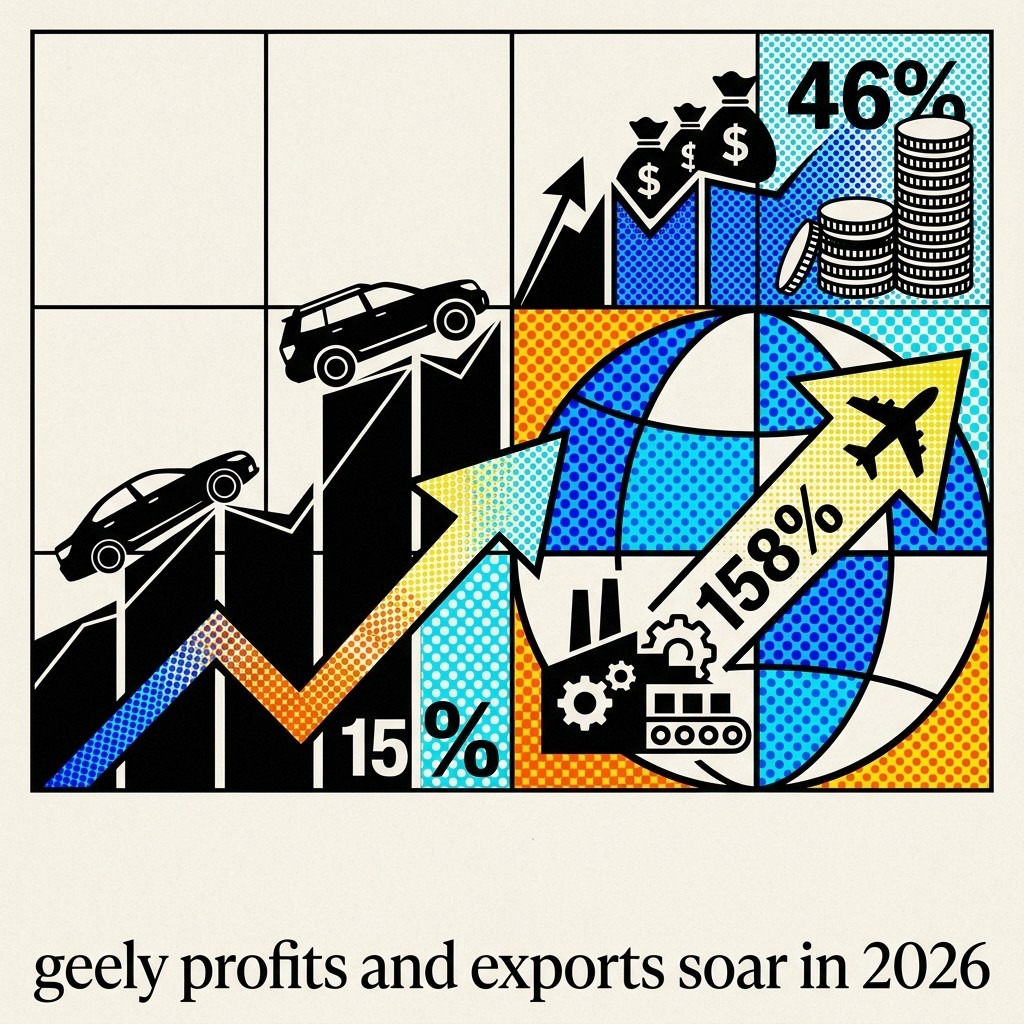
Geely Automobile Holdings, China’s second-largest electric-vehicle manufacturer, reported first-half 2026 revenue of 173.6 billion Renminbi (RMB)—the official currency of China—or roughly $24 billion. This 15% increase reveals how Chinese automakers utilize international markets to bail out their margins amid a cutthroat domestic price war.

Geely aggressively exports because foreign sales rescue profitability; overseas shipments rocketed 158% to 474,228 vehicles, expanding the company’s core net profit margin to 5.6%. While this success stems from a genuine comparative advantage in electric vehicles that directly benefits global consumers, it turns international buyers into an industrial backstop. These consumers effectively subsidize the consolidation of China’s auto industry, testing the tolerance of Western trade regimes.

The export surge proves foreign markets no longer just absorb excess inventory, but act as the fundamental driver of survival. Driven by overseas sales, Geely’s core net profit surged 46% to 9.68 billion RMB, explicitly offsetting sluggish domestic demand, notes Investing.com.

The Gist AI Editor

The Global Overview

Geely Automobile Holdings

Chinese automakers are pivoting aggressively to exports to rescue their margins from a brutal domestic price war. China’s second-largest electric-vehicle manufacturer reported first-half 2026 revenue of RMB 173.6 billion (Renminbi, the official currency of China, approximately $24 billion), a 15% year-over-year increase (WSJ; Investing.com; Gasgoo). Core net profit surged 46% to RMB 9.68 billion, allowing Geely to expand its core net profit margin to 5.6%. This financial performance is explicitly offsetting sluggish domestic demand, driven by overseas sales that rocketed 158% to 474,228 vehicles. The export surge is no longer just about offloading excess inventory; it is the primary profitability driver keeping these manufacturers afloat. Still, Geely’s success abroad is heavily driven by genuine comparative advantage and competitive pricing in the electric vehicle segment, which directly benefits global consumers.

Multinational Restructuring and Alibaba Group

A CEPR (Centre for Economic Policy Research, a network of European economists) study reveals that multinational firms routinely fragment their supply chains across multiple countries specifically to ensure no single supplier learns enough to imitate their intellectual property. Geely’s export pivot and this global production slicing both demonstrate how domestic institutional weaknesses—subsidized overcapacity in China and weak intellectual property rights elsewhere—force multinational firms to offensively and defensively restructure their global trade flows. Meanwhile, Alibaba Group is divesting its videogame business in a transaction valued at a minimum of $1.5 billion (WSJ). The Chinese technology conglomerate is liquidating these non-core entertainment assets to aggressively redirect capital toward its artificial intelligence initiatives.

Stay tuned for the next Gist—your edge in a shifting world. The Gist remains independent and reader-supported. If you value news free from corporate or state interests, consider supporting our mission with a donation.

The European Perspective

Iberian Housing Shortages

Property deficits in Spain and Portugal stem from permitting bureaucracy and rent interventions that structurally deter developers from building new supply (FT). Public anger targets immigrants and tourists, but the primary driver is regulatory friction preventing supply from matching new demand. Unprecedented spikes in immigration and explosive growth in highly lucrative tourist short-term rentals have created immediate demand shocks that would strain even a perfectly deregulated construction market. Still, high construction costs compound this supply deficit.

German Startup Tax Reform

Finance Minister Lars Klingbeil will reform taxes to mobilize private capital for growth-stage companies (ZDF). This aligns with an August 17 meeting of 70 East German startups addressing regional funding shortfalls. The SPD—Germany’s center-left governing party—aims to incentivize private equity over state subsidies.

EU Russian Sanctions Expansion

While Ukraine continues its kinetic drone strikes on Russian logistics, Brussels prepares a parallel economic offensive. Kaja Kallas, the designated High Representative of the European Union for Foreign Affairs and Security Policy, announced the most expansive sanctions package since the February 2022 invasion (ZDF). Arriving this autumn, it expands sanctioned Russian individuals and corporate entities by one third.

Catch the next Gist for the continent’s moving pieces.

🎙️ Listen to this edition as a podcast Listen

The Gist is an independent daily digest: AI-curated, human-directed, unapologetically liberal (how it’s made). Hundreds of sources, only what matters. Subscribe free or listen to the podcast.


Comments

Leave a Reply

Your email address will not be published. Required fields are marked *

This site uses Akismet to reduce spam. Learn how your comment data is processed.