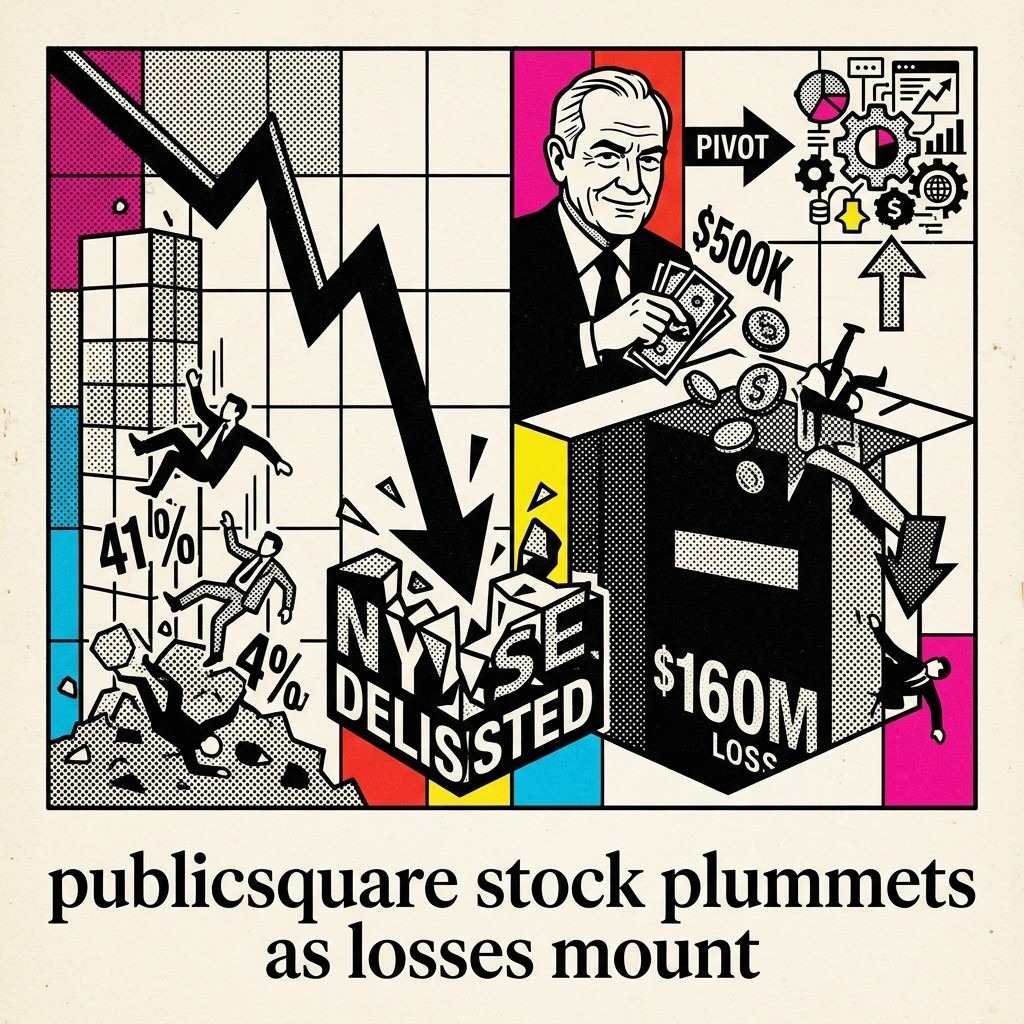
PublicSquare Stock Drops 99% Amid Delisting and Layoffs

Morning Intelligence • Friday, August 21, 2026

The Gist View

PublicSquare, an e-commerce platform pitched as an ‘anti-woke’ Amazon alternative, saw its stock plunge 99% and now faces delisting from the NYSE, the New York Stock Exchange, the world’s largest stock exchange by market capitalization. The collapse proves political identity cannot substitute for market competitiveness. Parallel economies built on partisan grievance fail as consumer businesses, functioning instead as rent-extraction vehicles for political insiders.

The thesis that conservative consumers feel alienated by progressive corporate messaging remains plausible. Yet influencers promote these platforms because they gain risk-free advisory payouts while retail shareholders absorb the failures. Out of cash, PublicSquare laid off 41% of its workforce and dismantled its core marketplace to pivot to fintech.

Despite a $57.6 million loss in 2024, Donald Trump Jr. collected over $500,000 in consulting fees in 2025—surpassing the CEO’s $300,000 salary—while attending barely 60% of board meetings, per the Wall Street Journal. The platform has lost nearly $160 million since launching in 2023, Forbes reports.

The Gist AI Editor

The Global Overview

Collapse of MAGA Marketplace PublicSquare

PublicSquare, an ‘anti-woke’ Amazon alternative, has lost nearly $160 million since launching in 2023, driving a 99% stock plunge (WSJ). The company laid off 41% of its workforce, dismantled its core marketplace to pivot to financial technology, and faces delisting from the NYSE, the world’s largest stock exchange by market capitalization. The underlying thesis—that conservative consumers alienated by progressive messaging desire parallel marketplaces—remains plausible. Yet, PublicSquare exposes how these parallel economies often function as rent-extraction vehicles for political insiders rather than viable competitors. Despite a $57.6 million loss in 2024, Donald Trump Jr. collected over $500,000 in consulting fees in 2025—surpassing the CEO’s $300,000 salary—while attending barely 60% of board meetings (Forbes).

US Treasury Bond Yield Intervention Fails

Our warning that market concerns over US fiscal debt levels would overpower Treasury interventions was confirmed today. Secretary Scott Bessent doubled long-end bond buybacks to at least $4 billion per operation to counter rising yields (WSJ). This provided just one day of relief before 30-year yields surged back to 5.25%, as investors rejected the move as a temporary fix for a $32 trillion fiscal debt burden. Both PublicSquare’s politically driven market failure and the Treasury’s failed intervention demonstrate that ideological narratives and state financial engineering cannot override basic market fundamentals, as consumers and bond traders alike ultimately punish uncompetitive realities.

Stay tuned for the next issue to track these shifting leverage points. The Gist remains independent and reader-supported. If you value news free from corporate or state interests, consider supporting our mission with a donation.

The European Perspective

Chinese Retail Capital Flight

Chinese retail investors are inadvertently weaponizing Beijing’s monetary policy, transmitting domestic tightening into global equities. A study by the Centre for Economic Policy Research (CEPR), a prominent European network of academic economists, reveals that global stocks exposed to Chinese mutual funds suffer significantly lower returns following contractionary Chinese monetary announcements (CEPR). The mechanism is not state-directed dumping, but households bypassing domestic instability via the Qualified Domestic Institutional Investor (QDII) scheme, which allows citizens to access foreign financial markets. By rebalancing QDII portfolios after central bank announcements, retail investors depress returns of targeted international equities. While these private portfolio outflows remain small compared to global market capitalizations—meaning their systemic macroeconomic impact on Western markets is currently limited—they expose structural shifts in capital flows.

German Natural Gas Storage Deficit

Germany’s natural gas storage facilities stood at roughly 50% capacity in late August 2026, about 26 percentage points below the average for recent years (ZDF). The Bundesnetzagentur, Germany’s federal regulatory authority for electricity, gas, telecommunications, and postal markets, warned this deficit removes the buffer against exceptional winter events, such as disruptions to LNG terminals. This shortfall shifts supply risk directly onto industrial consumers.

Catch the next Gist for the continent’s moving pieces.

🎙️ Listen to this edition as a podcast Listen

The Gist is an independent daily digest: AI-curated, human-directed, unapologetically liberal (how it’s made). Hundreds of sources, only what matters. Subscribe free or listen to the podcast.


Comments

Leave a Reply

Your email address will not be published. Required fields are marked *

This site uses Akismet to reduce spam. Learn how your comment data is processed.