Trump Proposes 25% Discount on Beef Import Tariffs

Evening Analysis • Friday, August 21, 2026

The Gist View

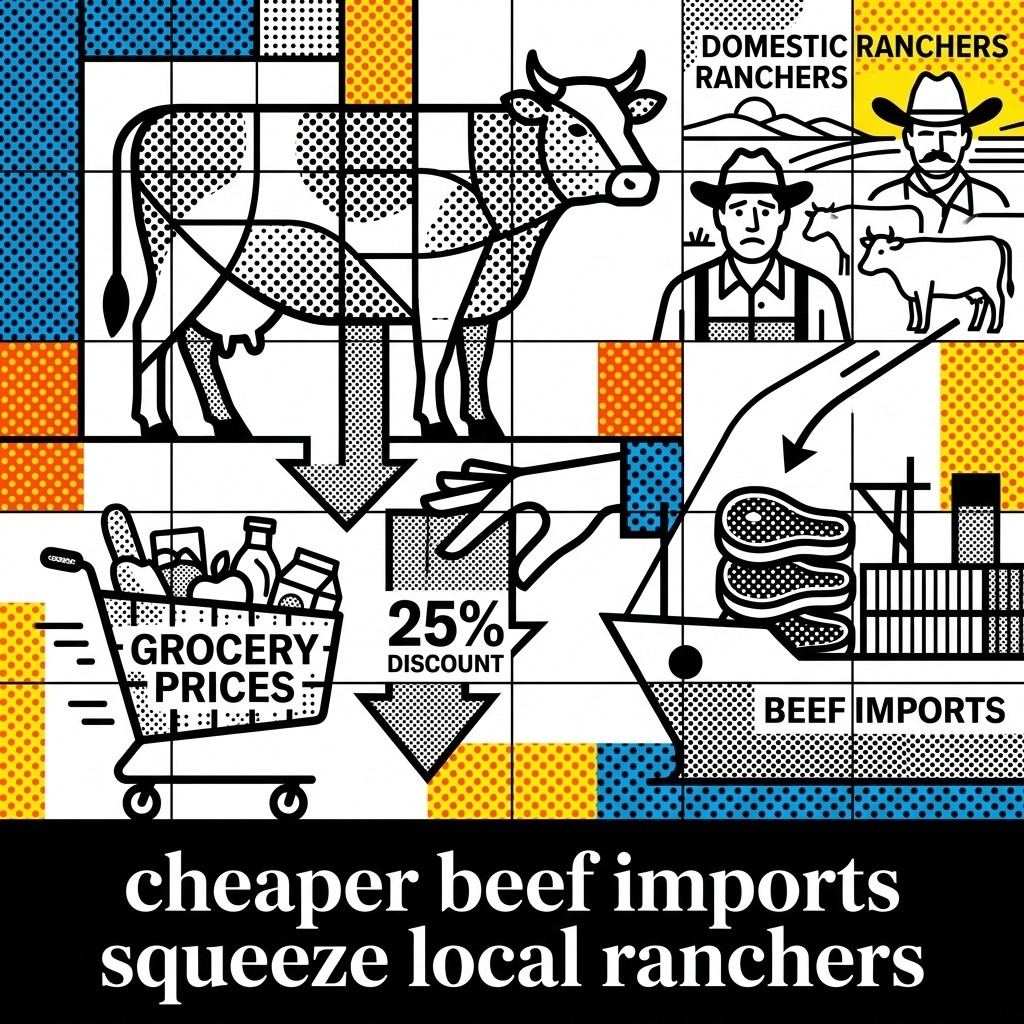
Donald Trump proposes slashing US beef import tariffs to secure a 25% discount from unnamed foreign suppliers for three months, aiming to curb grocery prices ahead of the November midterm elections. By floating arbitrary duty waivers to suppress inflation, he inadvertently concedes that protectionism operates as a punishing domestic tax.

While a temporary suspension provides immediate consumer relief without permanently dismantling the trade barriers shielding domestic agriculture, it replaces market pricing with executive caprice. Politicians float these waivers because they gain short-term voter approval, leaving domestic producers to absorb the financial shock. US ranchers are managing a cattle herd that has shrunk to its smallest size since 1951, pushing prices up over 25% over the past year.

Live cattle futures fell sharply on the announcement. Using executive decrees to manage inflation turns trade policy into an electioneering tool, an approach CBS News reports will penalize American agriculture with state-driven volatility long after the proposed discount expires.

The Gist AI Editor

The Global Overview

Trump Proposes Discretionary Beef Tariff Waivers

Donald Trump claims unnamed foreign suppliers will provide a 25% discount for three months on beef imports to curb consumer prices (FT). Live cattle futures fell sharply, injecting volatility into a market facing its smallest US herd since 1951 and severe pre-election supply constraints. A temporary tariff suspension provides immediate, targeted relief to consumers battling high inflation without permanently dismantling the long-term trade barriers shielding domestic agriculture. Still, using executive decrees to manage inflation turns tariff policy into electioneering. It proves protectionism operates as a domestic tax, while arbitrary waivers replace market pricing with state-driven volatility.

Private Equity Embeds AI Amid Data Breaches

Wall Street private equity firms are rapidly hiring artificial intelligence specialists to embed in their portfolio companies, scaling automated services across the corporate sector (WSJ). This operational shift requires massive data aggregation, which concentrates systemic security risks. Underscoring this vulnerability, alternative asset manager Apollo Global Management confirmed hackers stole personal data, including names and Social Security numbers, during a cyberattack last month (FT).

Stay tuned for the next Gist—your edge in a shifting world. The Gist remains independent and reader-supported. If you value news free from corporate or state interests, consider supporting our mission with a donation.

The European Perspective

Beijing Blocks EU Probe into JD.com

The European Commission opened a May 2026 investigation under the Foreign Subsidies Regulation (FSR)—a tool designed to block foreign state-backed firms from distorting internal markets—into JD.com’s €2.5 billion takeover of Ceconomy, a German retail group. China’s Ministry of Justice barred JD.com from complying, declaring the probe ‘unlawful extraterritorial jurisdiction’ (Politico). Following a similar May order for Nuctech, Beijing weaponized domestic law to force the EU to abandon the probe or kill the deal, demonstrating that Chinese corporate expansion remains functionally inseparable from state power. Still, the FSR demands broad extraterritorial data, including unrelated domestic banking records, effectively forcing Chinese firms to violate domestic privacy laws to compete in Europe (Caixin Global).

Russian Sabotage Network Disrupted in Germany

German security authorities discovered a hidden firearms cache near Berlin, suspecting Russian intelligence involvement. A suspect was detained in Romania (Reuters). Following the Leipzig Airport drone breach, this confirms a coordinated, escalating campaign of hybrid sabotage across European infrastructure.

Uber Penalized for Algorithmic Management

The Dutch Data Protection Authority fined Uber €825 million for violating the General Data Protection Regulation (GDPR), which governs data privacy and algorithmic decision-making (Il Sole 24 Ore). Between 2020 and 2022, Uber permanently deactivated driver accounts using automated systems without adequate human oversight.

Catch the next Gist for the continent’s moving pieces.

🎙️ Listen to this edition as a podcast Listen

The Gist is an independent daily digest: AI-curated, human-directed, unapologetically liberal (how it’s made). Hundreds of sources, only what matters. Subscribe free or listen to the podcast.


Comments

Leave a Reply

Your email address will not be published. Required fields are marked *

This site uses Akismet to reduce spam. Learn how your comment data is processed.