Scott Bessent Doubles Debt Buybacks, Yields Ease to 4.70%

Evening Analysis • Monday, August 24, 2026

The Gist View

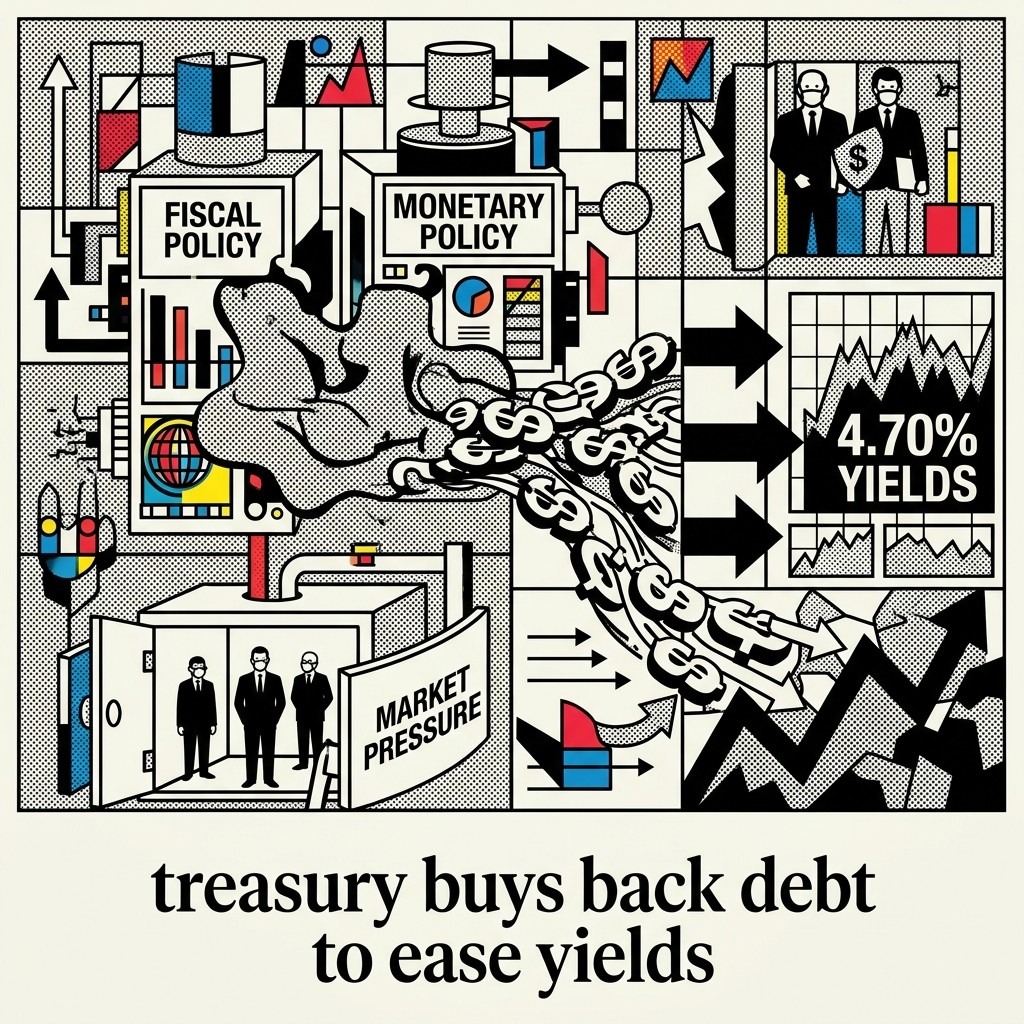
US Treasury Secretary Scott Bessent is doubling long-term debt buybacks to at least $4 billion per operation. The intervention worked: on August 24, 2026, the 10-year US Treasury yield—the global benchmark for borrowing costs—eased to 4.70% after nearing multi-year highs. This exposes the cost of permanent government borrowing: when deficits push rates too high, the state bends market mechanics to avert a crisis.

While the buybacks explicitly target older, illiquid bonds to keep market plumbing functional, they operate as a soft cap on yields. By financing purchases through the General Account—its primary operating account at the Federal Reserve—the Treasury blurs fiscal management with monetary policy. Politicians sustain huge deficits because spending buys votes; the Treasury protects them from market discipline by absorbing the resulting pressure.

As BNN Bloomberg reports, using federal operating cash to purchase federal debt effectively makes the state the buyer of last resort for its own obligations.

The Gist AI Editor

The Global Overview

US Treasury Interventions

On August 24, 2026, the 10-year US Treasury yield—the benchmark return on government debt—eased to 4.70% after Secretary Scott Bessent doubled buybacks to $4 billion (BNN Bloomberg). By attempting yield curve control via its General Account—the primary Federal Reserve account for paying government obligations—the Treasury bends monetary mechanics to shield politicians from overspending. While targeting illiquid bonds to maintain market plumbing, this exposes a bizarre symbiosis: the Treasury manipulates markets to fund deficits, while Tether—a US dollar-pegged stablecoin outside traditional banking—profits entirely from these yields. Meanwhile, the protracted US-Canada trade stalemate under Mark Carney proves tariffs inflict lasting volatility.

AI Assessment Frameworks

South Australia schools and the University of Sydney adopted ‘two-lane’ systems explicitly defining permitted generative AI use (FT). These frameworks shift educators away from absolute bans—which fail because AI text lacks an original plagiarized source—toward separately measuring student capability.

NASA Telescopic Expansion

NASA’s Nancy Grace Roman Space Telescope readies for an August 30, 2026, Falcon Heavy launch (Wired). It will discover 200,000 exoplanets, surveying 12% of the sky in 17 months with a field 100 times larger than Hubble.

Join us next time. The Gist remains independent and reader-supported. If you value news free from corporate or state interests, consider supporting our mission with a donation.

The European Perspective

Tether Monetizes US Debt

Bitcoin nearing $80,000 in August 2026 spotlights Giancarlo Devasini, now one of Italy’s wealthiest individuals (Euronews). His firm Tether—a cryptocurrency stablecoin pegged to the US dollar outside traditional banking—operates as an unregulated hedge fund. It captures the spread between zero-interest deposits and 5% US Treasury yields, the benchmark return on US government debt. Generating $6.2 billion in profit last year with under 100 employees, Tether out-earned asset managers like BlackRock (WSJ). Holding $120 billion in assets, predominantly US Treasury bills, and freezing illicit wallets, Tether reinforces dollar hegemony rather than subverting it.

Greece Redeploys Air Defenses

Greece moved a Patriot system—an advanced US-manufactured surface-to-air missile defense system—to Crete (Euronews). This counters intelligence that Tehran will target US assets if President Donald Trump intensifies military pressure over the Strait of Hormuz (FT). The deployment dictates Mediterranean military posturing, forcing European hosts to physically absorb the retaliatory risks of foreign policy containment.

Healthcare Security Reclassification

With 351 significant cyberattacks on healthcare facilities recorded between 2022 and 2025, analysts urge the National Security Council to implement integrated international situational assessments (SWP Berlin). Shielding the sector requires transferring capital from fragmented hospital IT budgets to centralized, transnational security frameworks.

Catch the next Gist for the continent’s moving pieces.

🎙️ Listen to this edition as a podcast Listen

The Gist is an independent daily digest: AI-curated, human-directed, unapologetically liberal (how it’s made). Hundreds of sources, only what matters. Subscribe free or listen to the podcast.


Comments

Leave a Reply

Your email address will not be published. Required fields are marked *

This site uses Akismet to reduce spam. Learn how your comment data is processed.