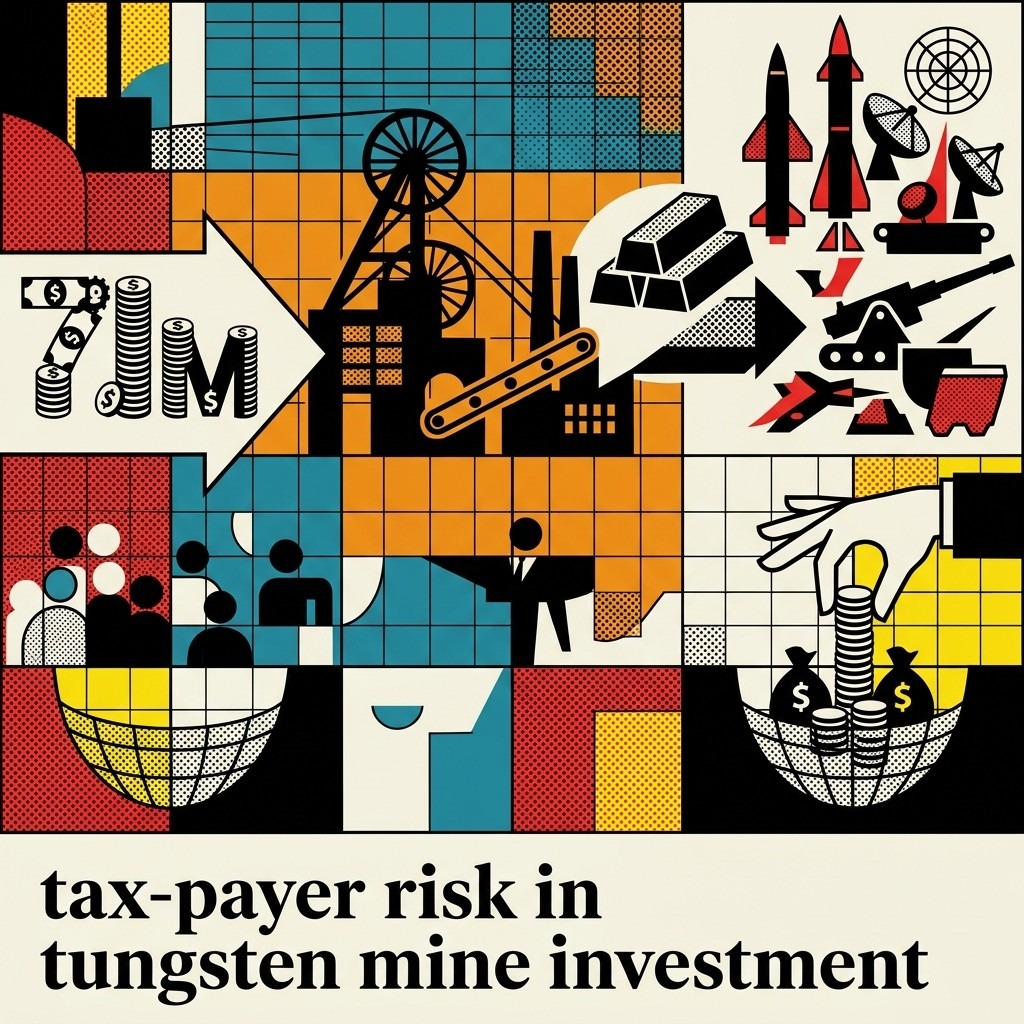
UK Wealth Fund Invests £71M in Devon’s Hemerdon Mine

Evening Analysis • Tuesday, August 25, 2026

The Gist View

The UK’s National Wealth Fund—a state-owned investment vehicle—is injecting £71 million into the dormant Hemerdon tungsten mine in Devon. By underwriting a project that halted production in 2018 due to commercial failures, the British government is effectively transforming industrial subsidies into a permanent national security tax.

Private capital abandoned the site because investors refused to absorb the operational risks of commodity volatility. London now assumes those liabilities directly, accepting poor financial returns because the state gains a captive supply chain for aerospace and defense. Overreliance on geopolitical rivals for critical minerals presents a genuine vulnerability that free markets will not correct, but treating a domestic mine as sovereign defense shifts the financial burden entirely onto taxpayers.

Tungsten’s melting point of 3,422 degrees Celsius makes it irreplaceable in ballistic munitions, a physical reality the Financial Times notes is forcing Western capitals to bankroll excavations that commercial markets long ago priced as unviable.

The Gist AI Editor

The Global Overview

UK National Wealth Fund Backs Hemerdon Tungsten Mine

The UK’s National Wealth Fund—a state-owned vehicle directing public capital into domestic infrastructure and strategic industries—is injecting £71 million into Devon’s dormant Hemerdon tungsten project (FT). The mine halted production in 2018 due to commercial failure. State funding is stepping in precisely because private capital priced the operational risks as unviable, effectively treating industrial subsidy as national security and transferring the financial risks of commodity volatility directly onto taxpayers. Still, tungsten is critical for aerospace and defense; relying on geopolitical rivals for such materials presents a genuine national security vulnerability that markets alone will not correct.

US Treasury Launches Operation Economic Outcast

US Treasury Secretary Scott Bessent launched ‘Operation Economic Outcast,’ targeting third-country entities trading with Iran in technology, gold, and digital assets, threatening removal from the US dollar system (WSJ). Beijing countered that international law protects its Iranian trade. As previously noted, sweeping financial coercion accelerates global friction. Separately, President Trump’s public denial of demanding French language concessions does little to resolve the protracted stalemate following last week’s abrupt collapse of US-Canada tariff negotiations.

NASA and UN Address Autonomous AI Deployment

NASA is advancing fully autonomous space missions using model-based systems engineering, enabling spacecraft to manage faults without human intervention (NASA). Conversely, UN Secretary-General António Guterres urged member states to restrict AI-driven autonomous weapons systems ahead of November talks (Politico). Institutions actively fund AI autonomy to bypass human limitations in complex environments, while simultaneously struggling to establish regulatory constraints on lethal force applications.

Join us in the next edition of The Gist for further developments on these structural global shifts. The Gist remains independent and reader-supported. If you value news free from corporate or state interests, consider supporting our mission with a donation.

The European Perspective

Rhine Group Launch in Geneva

The creation of the Rhine Group—a newly formed Geneva-based think tank co-chaired by Mario Draghi and Patrick Collison to advocate for European market reforms—underscores EU governance sclerosis. When formal institutions paralyze, parallel technocratic networks emerge to bypass legislative inertia. The group translates the 2024 Draghi report into policy (Il Sole 24 Ore). By operating in non-EU Switzerland under the Chatham House Rule—a confidentiality protocol where attendees may use the information discussed but cannot reveal who said it, encouraging frank debate—they explicitly isolate their competitiveness agenda from the Brussels bureaucracy. However, the Rhine Group possesses no formal legislative power and relies entirely on voluntary persuasion, acting as a vital catalyst for debate rather than subverting democratic processes.

Leipzig Airport Explosives Discovery

Our warnings about European logistics’ vulnerability to state-backed sabotage are confirmed by a third drone near Leipzig airport, escalating the August 4 attack narrative (The Guardian). On August 14, investigators found the device alongside 50 grams of RDX / hexogen—a highly stable, military-grade explosive compound frequently used in controlled munitions and state-level sabotage. Targeting NATO cargo nodes proves adversaries systematically deploy deniable strikes to disrupt the physical supply chains sustaining wartime statecraft.

Catch the next Gist for the continent’s moving pieces.

🎙️ Listen to this edition as a podcast Listen

The Gist is an independent daily digest: AI-curated, human-directed, unapologetically liberal (how it’s made). Hundreds of sources, only what matters. Subscribe free or listen to the podcast.


Comments

Leave a Reply

Your email address will not be published. Required fields are marked *

This site uses Akismet to reduce spam. Learn how your comment data is processed.