Vietnam’s $114B Trade Surplus with U.S. Defies Tariffs

Evening Analysis • Wednesday, August 26, 2026

The Gist View

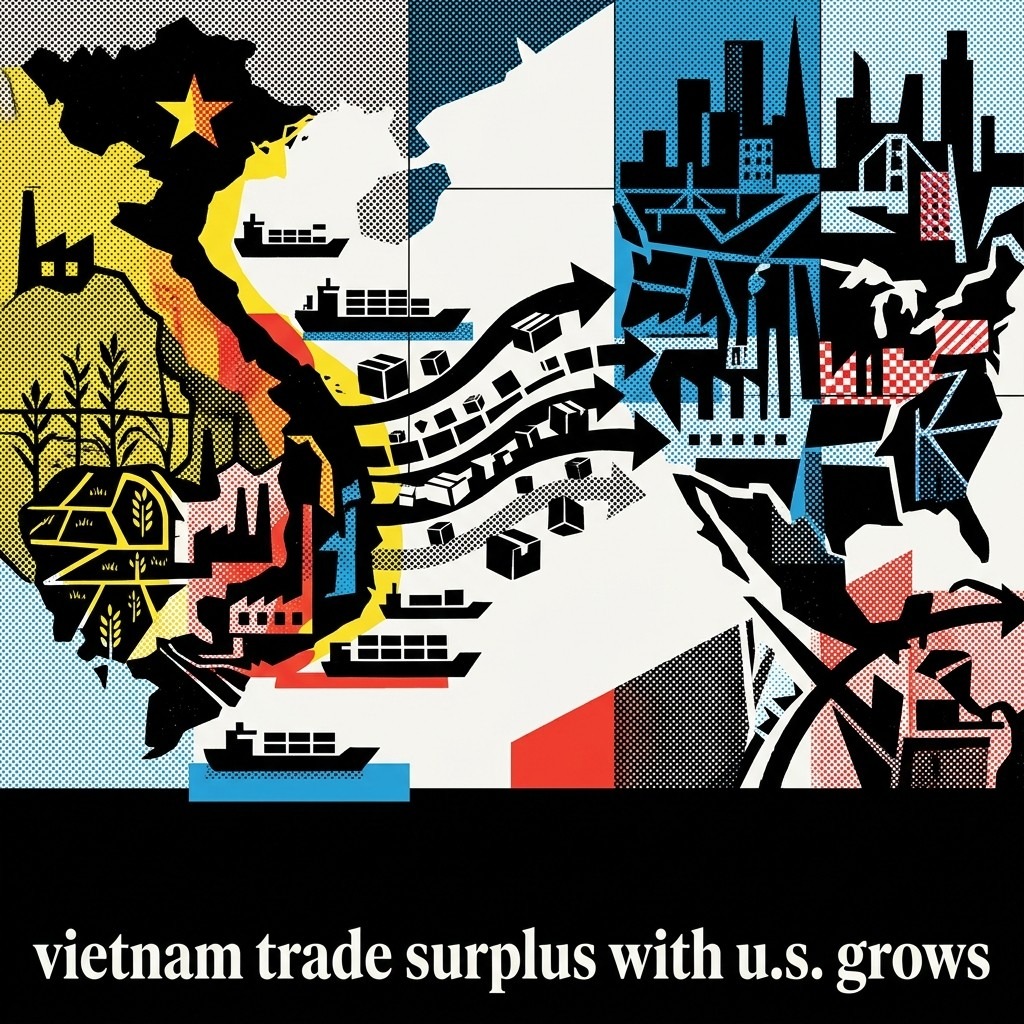
Vietnam’s trade surplus with the U.S. reached $114 billion in the first half of 2026. This shift proves Washington’s attempt to tariff its way to industrial independence has merely birthed a lucrative geographic loophole. American politicians maintain import penalties because confronting Beijing secures domestic votes, while Chinese manufacturers route components south to preserve their export margins.

Moving final production across a border does not erase the reliance on mainland materials. It just adds a logistics fee to the invoice. Pushing assembly out of Beijing’s direct jurisdiction genuinely dilutes the threat of immediate state embargoes. Yet that physical friction carries a strict price, paid entirely at the American cash register.

Washington attempted a similar maneuver in 2018 by levying a 25 percent duty on foreign steel, only to watch shipments surge from unpenalized partners. The policy cost American buyers roughly $900,000 for every domestic job it protected, the Wall Street Journal reported.

The Gist AI Editor

The Global Overview

Meta’s $18 Billion Settlement

Meta, the U.S. tech conglomerate owning Facebook, Instagram, and WhatsApp, will pay $18 billion to settle a California child protection case (FT). This massive payout exposes how state governments use litigation to extract tech capital for revenue without altering the underlying algorithmic architectures that drive corporate profits.

Vietnam’s Record U.S. Trade Surplus

Washington’s tariffs simply added intermediaries to global supply chains. Vietnam, a Southeast Asian hub absorbing final-assembly operations, recorded a $114 billion U.S. trade surplus in the first half of 2026, overtaking Taiwan, Mexico, and China (WSJ). This trade diversion means the U.S. still indirectly imports Chinese components. While diversifying assembly reduces vulnerability to Chinese state leverage, buying strategic security, it exacts a hidden tax on domestic consumers.

Consumer Pullback and Energy Markets

Kohl’s reported lower second-quarter sales as middle-income shoppers retreat (WSJ). The hidden inflation embedded in rerouting supply chains directly reduces these domestic consumers’ purchasing power. Separately, oil futures dropped on diplomatic optimism regarding the Strait of Hormuz, a critical maritime chokepoint between the Persian Gulf and the Gulf of Oman (WSJ). Despite tighter U.S. sanctions on Iran, this price decline confirms that total financial coercion yields diminishing geopolitical impact.

Stay tuned for the next Gist. The Gist remains independent and reader-supported. If you value news free from corporate or state interests, consider supporting our mission with a donation.

The European Perspective

Hungary Formally Realigns Against Russia Under Magyar

Policy guidelines signed by Péter Magyar—Hungary’s current Prime Minister, who ousted Viktor Orbán—formally declare that “Russia’s conduct poses a threat to Hungary, Europe and the global order.” (Politico). This backs Ukraine’s territorial integrity and recognizes its right to self-defense, dismantling Orbán’s pro-Moscow policies. (Politico). This shift reveals how Hungary’s geopolitical alignment remains hostage to the executive pen. The reversal signals that the economic penalties of isolationism finally outweighed the benefits of cheap Russian energy, forcing a populist pivot. Still, Magyar’s swift policy reversal is evidence of democratic correction, proving that voters can successfully punish and replace leaders who drift too far from the European mainstream.

Iceland EU Accession Vote

Icelanders will vote on Saturday on whether to formally resume negotiations to join the European Union. (Euronews). A ‘Yes’ vote is expected to pressure neighboring Norway to reconsider its relationship with Brussels and its status in the EEA, the European Economic Area, which allows non-EU countries to participate in the EU’s internal market. (Euronews).

UK Healthcare Co-Payment Debate

Britain is debating the introduction of patient co-payments to address severe funding shortfalls in its predominantly free-at-the-point-of-use healthcare system. (FT). Advocates argue that bringing co-payments into the UK system would align it with the financially sustainable models used by other wealthy peers. (FT).

Catch the next Gist for the continent’s moving pieces.

🎙️ Listen to this edition as a podcast Listen

The Gist is an independent daily digest: AI-curated, human-directed, unapologetically liberal (how it’s made). Hundreds of sources, only what matters. Subscribe free or listen to the podcast.


Comments

Leave a Reply

Your email address will not be published. Required fields are marked *

This site uses Akismet to reduce spam. Learn how your comment data is processed.