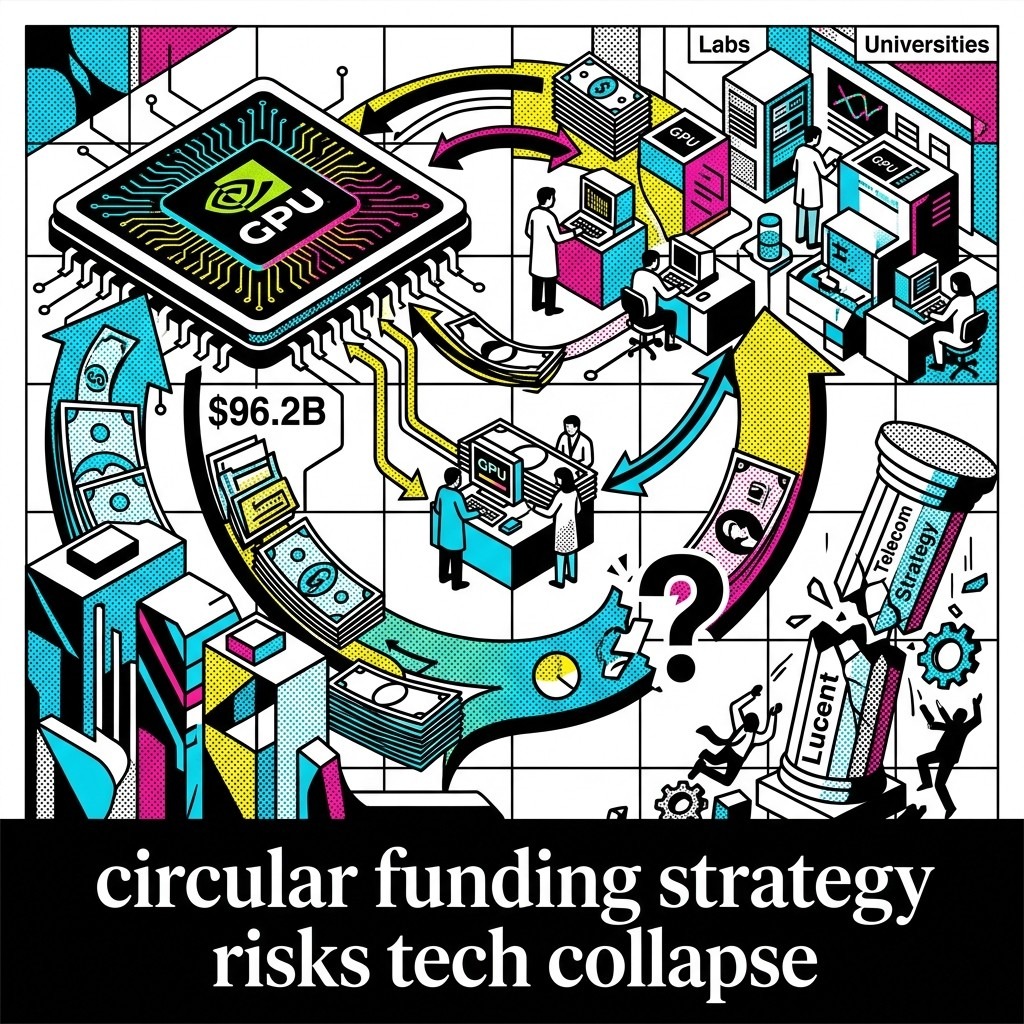
Nvidia’s $96.2B Revenue Mirrors Lucent’s Risky Strategy

Morning Intelligence • Friday, August 28, 2026

The Gist View

Nvidia posted $96.2 billion in quarterly revenue, masking a circular economy where the hardware giant acts as its own best customer. By funneling cash into the frontier labs purchasing its Graphics Processing Units (GPUs)—specialized artificial intelligence chips—the company functions more like a central bank than a conventional supplier.

Nvidia funds these buyers because it profits by accelerating an ecosystem that venture capital is too undercapitalized to support. While this speeds early development, it distorts genuine price discovery. The core threat is no longer a competitor designing a faster chip, but a collapse in rental yields at the exact labs Nvidia subsidizes. This leaves the firm highly exposed to massive capital expenditure (capex)—the money a company spends to buy or improve fixed assets like data centers.

Infrastructure builders that underwrite their buyers chain their equity to downstream defaults. Lucent Technologies deployed a remarkably similar financing strategy during the telecom boom, ultimately writing off $2.7 billion in bad customer loans when the market collapsed in 2001 (WSJ).

The Gist AI Editor

The Global Overview

Nvidia Q2 Revenue and AI Vendor Financing

On August 26, 2026, Nvidia reported Q2 FY2027 revenue of $96.2 billion, a 106% year-over-year increase (WSJ). The company confirmed its strategy of providing financial support to the frontier AI labs that purchase its Graphics Processing Unit (GPU), a specialized computer chip heavily used for artificial intelligence computation (Kiplinger). By funding its buyers, Nvidia vendor-finances demand and shifts capital expenditure (capex)—money a company spends to buy or improve fixed assets like data centers—onto its own balance sheet. Nvidia explicitly forecast 70% year-over-year revenue growth for fiscal 2028, citing supply constraints rather than demand limits (Forbes).

US Oil Leases and Venezuela OPEC Exit

US and Venezuelan negotiators are discussing potential 100-year leases on key Venezuelan oil fields, marking a historic policy reversal for Washington (WSJ). Concurrently, Venezuela is actively considering leaving OPEC, an organization it co-founded in 1960. As the US Treasury escalates ‘Operation Economic Outcast’ against Iran, Washington’s parallel negotiations for 100-year oil leases in Venezuela reveal a pragmatic shift: isolating Tehran now requires securing long-term crude alternatives elsewhere.

Consulting Firms Pivot to Soft Skills

Major consulting executives are ordering junior staff back to the office to focus on relationship-building and reskilling (FT). This shift is driven by AI systems taking over the technical and data-processing tasks that traditionally occupied entry-level consulting roles, forcing a reallocation of corporate investment away from basic data synthesis and toward institutional relationship management.

Stay tuned for the next Gist—your edge in a shifting world. The Gist remains independent and reader-supported. If you value news free from corporate or state interests, consider supporting our mission with a donation.

The European Perspective

Mélenchon Pressures French Greens

France Unbowed (LFI) leader Jean-Luc Mélenchon is courting the French Greens for a unified left-wing alliance (Politico). Capitalizing on strong polling, Mélenchon pressures the Greens into an electoral pact ahead of a presidential bid to consolidate political capital.

AfD Leverages Thuringian Vote

On August 28, 2026, Thuringia’s parliament faces a constructive vote of no confidence against Christian Democratic Union (CDU) Premier Mario Voigt, initiated by the Alternative für Deutschland (AfD) (ZDF). The AfD holds 32 of 88 seats, lacking the 45 required to install Björn Höcke. Voigt’s lost doctoral title over plagiarism offers a legitimate pretext to test his majority. Ultimately, the maneuver converts a constitutional fail-safe into a media instrument. The structural target is the populist BSW party, which must vote against Höcke, forcing visible alignment with the establishment it opposes.

Marseille Surpasses Paris Tourism Demand

Marseille expects nearly 7 million tourists in 2026, officially surpassing Paris and Nice in Booking.com domestic search volume (The Guardian). This influx strains infrastructure and triggers backlash over the commodification of historically disadvantaged neighborhoods for short-term rentals.

Monza F1 Drives €350 Million Impact

The September 6, 2026, Formula 1 Italian Grand Prix at Monza will generate €350 million in local business revenue (Il Sole 24 Ore). The debut of Italian driver Kimi Antonelli amplifies this capital injection into regional service sectors.

Catch the next Gist for the continent’s moving pieces.

🎙️ Listen to this edition as a podcast Listen

The Gist is an independent daily digest: AI-curated, human-directed, unapologetically liberal (how it’s made). Hundreds of sources, only what matters. Subscribe free or listen to the podcast.


Comments

Leave a Reply

Your email address will not be published. Required fields are marked *

This site uses Akismet to reduce spam. Learn how your comment data is processed.