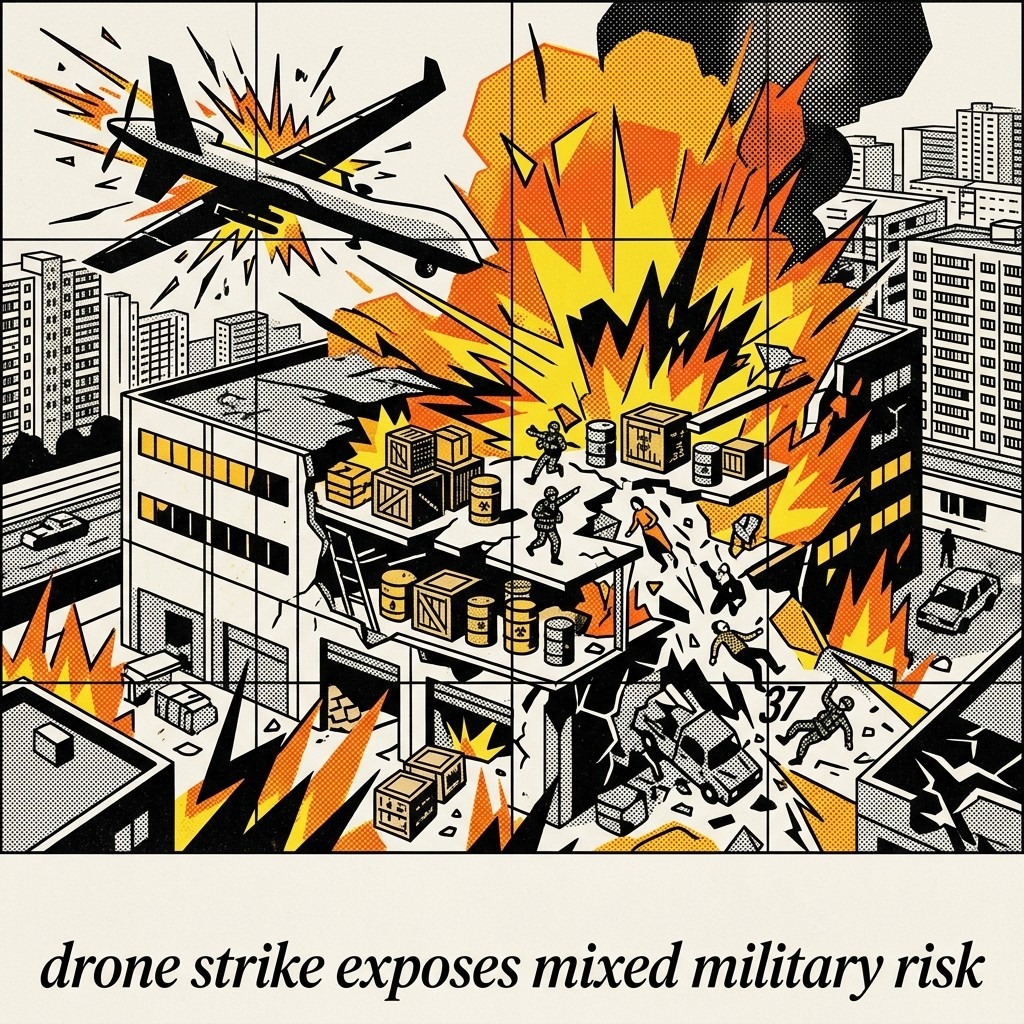
Russian Drone Strike Kills 37 in Ukrainian Warehouse Attack

Evening Analysis • Saturday, August 29, 2026

The Gist View

A Russian drone strike on a Ukrainian military warehouse in Myla on Friday, August 28, 2026, killed 37 people after triggering massive secondary detonations. The devastating blast exposes the fatal cost of decentralized logistics. Grouping munitions in isolated military bases makes them easy targets for long-range precision weapons, so Kyiv’s commanders disperse explosives near residential infrastructure to preserve their frontline supply.

Prosecuting local officials for negligence treats a calculated tactical adaptation as an administrative error. Military planners blend assets into residential zones because they gain a vital shield against air superiority. That survival mechanism forces a grim exchange, steadily erasing the required physical boundary between legitimate combat targets and non-combatants.

During the 1999 Kosovo War, the Yugoslav army similarly dispersed its hardware into civilian villages to survive 78 days of NATO bombing, deliberately passing the risk of precision strikes onto the local population (Human Rights Watch).

The Gist AI Editor

The Global Overview

Russian Drone Strike on Myla Ammunition Depot

On Friday evening, August 28, 2026, a Russian drone strike hit a military warehouse in the village of Myla near Kyiv, triggering massive secondary detonations (Reuters). The blast killed at least 37 people, including 34 residents of a nearby care home, and injured over 42 others (AP). Ukrainian President Volodymyr Zelensky condemned the placement of explosives near residential areas, and authorities have opened a criminal probe into official negligence (The Guardian). Decentralizing logistics to hide munitions from precision attacks forces a structural tradeoff, steadily eroding the required physical separation between legitimate military assets and civilian populations.

NASA Nancy Grace Roman Space Telescope Launch

The $4.3 billion Nancy Grace Roman Space Telescope is scheduled to launch on August 30, 2026, aboard a SpaceX Falcon Heavy rocket from Kennedy Space Center (Wired). The telescope carries a specialized coronagraph instrument designed to actively block starlight. This tests the specific hardware necessary to directly image mature, Earth-like exoplanets rather than deducing their presence via transit shadows.

Join us for the next edition of The Gist to track these structural shifts. The Gist remains independent and reader-supported. If you value news free from corporate or state interests, consider supporting our mission with a donation.

The European Perspective

Pension Reform Transition

Federal Labor Minister Bärbel Bas supports a five-year transition to abolish ‘Rente mit 63’—Germany’s policy allowing workers to retire without financial penalties at age 63 after 45 years of contributions (ZDF). The phase-out anchors pension plans for the SPD (the Social Democratic Party of Germany, a center-left political party) and the CDU (the Christian Democratic Union, Germany’s center-right conservative party). SPD leadership effectively grandfathers in the Boomer voting bloc, shifting structural demographic costs onto younger workers. Bas cites ‘Vertrauensschutz’ (protection of legitimate expectations), an appeal deployed politically to protect a demographic’s benefits precisely when demographic math makes them unsustainable. Abruptly changing the retirement age unfairly penalizes older workers who made irreversible financial plans based on existing law. Yet, while the coalition expends political capital shielding older voters, Germany’s €8 billion healthcare funding shortfall remains structurally unaddressed.

Caucasus TRIPP Corridor Funding

US funding for the TRIPP+ Enterprise Fund recently doubled from $201 million to $402 million to finance a transport corridor through southern Armenia, connecting Azerbaijan to Nakhchivan (Deutsche Welle). TRIPP—the Trump Route for International Peace and Prosperity—is a proposed US-backed transport corridor in the South Caucasus. The state-backed fund is led by Konstantin Sokolov, a Russian-born American private equity investor and major donor to US President Donald Trump. This capital allocation operates as a strategic private-equity geopolitical maneuver.

Catch the next Gist for the continent’s moving pieces.

🎙️ Listen to this edition as a podcast Listen

The Gist is an independent daily digest: AI-curated, human-directed, unapologetically liberal (how it’s made). Hundreds of sources, only what matters. Subscribe free or listen to the podcast.


Comments

Leave a Reply

Your email address will not be published. Required fields are marked *

This site uses Akismet to reduce spam. Learn how your comment data is processed.