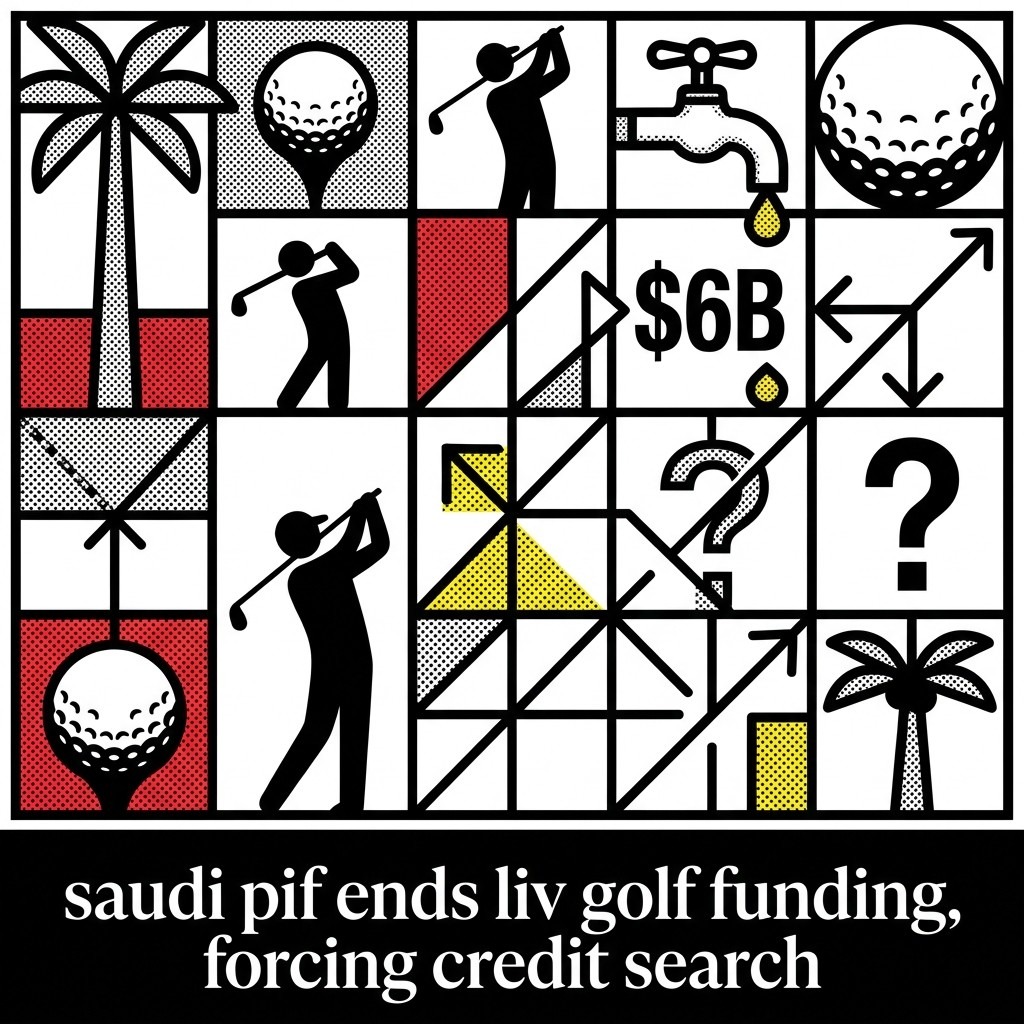
Saudi PIF Halts LIV Golf Funding After $6B Investment

Morning Intelligence • Monday, August 31, 2026

The Gist View

The Public Investment Fund—Saudi Arabia’s sovereign wealth fund—is terminating its subsidy of LIV Golf after sinking $6 billion into the venture since 2022, forcing the league to seek credit from BC Partners, a British international investment firm focused on private equity.

That retreat exposes the hard limit of state-directed sportswashing: an actor can buy a monopoly on elite talent, but it cannot mandate the legacy broadcast distribution required to build an audience. LIV successfully broke the PGA Tour’s monopoly and permanently changed the sport’s economics by forcing a massive increase in player compensation. Yet those golfers extracted their wealth from a political budget, not from organic consumer demand. Because the league relied entirely on unilateral subsidies rather than gate receipts or television rights to cover its operating losses, its executives inevitably lost their leverage the moment their patron lost its patience.

The collapse mirrors the demise of the United States Football League in 1986, which outbid the NFL for premium talent but rapidly went bankrupt after failing to secure a major television contract (Forbes).

The Gist AI Editor

The Global Overview

LIV Golf Faces Bankruptcy

The Public Investment Fund—Saudi Arabia’s sovereign wealth fund, the primary financial engine behind the country’s global investments—ends support for LIV Golf after spending $5 billion to $6 billion since 2022 (FT). Most staff face layoffs in the first week of September 2026 (Forbes). LIV seeks rescue funding from BC Partners, a British international investment firm focused on private equity and credit, via a potential pre-packaged bankruptcy by September 7 (Golf Digest). This proves sovereign wealth cannot permanently override market reality; buying supply without organic consumer demand fails.

SK Hynix Pursues Japanese Joint Venture

SK Group is scouting Japan for a joint venture chip plant (Bloomberg). The firm controls 50% to 60% of the market for HBM—High Bandwidth Memory, a high-performance RAM architecture essential for artificial intelligence processing. Both LIV Golf and SK Hynix reflect a tightening global capital environment where the staggering costs of establishing market dominance are forcing even the most deep-pocketed unilateral actors to seek external financing or joint ventures.

Modeling Artificial Intelligence

Economists aligned with the CEPR—the Centre for Economic Policy Research, a network of European economists and researchers—argue anthropomorphizing AI is methodologically necessary to anticipate misaligned reinforcement learning agents (Marginal Revolution). Applying human intent to models helps institutions predict how autonomous systems exploit information asymmetries.

Stay tuned for the next Gist—your edge in a shifting world. The Gist remains independent and reader-supported. If you value news free from corporate or state interests, consider supporting our mission with a donation.

The European Perspective

Germany Attributes Leipzig Drone Plot to Russian State

Chancellor Friedrich Merz will officially hold Russia responsible for the August 4, 2026, explosive-drone plot at Leipzig/Halle Airport (WELT am Sonntag). The device was found near a Ukrainian Antonov military transport (ZDF). Dubbed ‘Zeitenwende 2.0’, Berlin’s response combines national measures with new EU sanctions, ending prior strategic ambiguity to pursue direct economic retaliation (Politico). Linking physical sabotage directly to Moscow establishes a precarious precedent, forcing European allies to treat future infrastructure incidents as overt state aggression. Still, direct attribution and unilateral escalation risk a retaliatory cycle with a nuclear-armed power over a thwarted attack causing no physical damage.

Dollar Hedging Dictates Spot Market Volatility

Foreign investors’ growing holdings of US dollar-denominated bonds have created massive structural demand for currency hedging, according to the Centre for Economic Policy Research (CEPR), a network of European economists (CEPR). Investors systematically hedge less after the dollar appreciates. Dealer banks transmit this behavioral shift directly to the spot market, significantly amplifying currency movements and demonstrating how institutional risk-management protocols dictate macroeconomic outcomes.

Climate Shifts Threaten European Food Prices

The anticipated 2026 return of the El Niño climate phenomenon is projected to severely disrupt global agricultural yields, raising alarms over a secondary wave of food price inflation in Europe (Le Monde). Meanwhile, confirming our assessment that sovereignty concerns would outweigh economic integration, Iceland definitively voted ‘no’ in the weekend referendum on restarting EU membership talks (Politico).

Catch the next Gist for the continent’s moving pieces.

🎙️ Listen to this edition as a podcast Listen

The Gist is an independent daily digest: AI-curated, human-directed, unapologetically liberal (how it’s made). Hundreds of sources, only what matters. Subscribe free or listen to the podcast.


Comments

Leave a Reply

Your email address will not be published. Required fields are marked *

This site uses Akismet to reduce spam. Learn how your comment data is processed.