US Ends Moscow’s Isolation, Russia Joins G20 Summit

Morning Intelligence • Tuesday, September 01, 2026

The Gist View

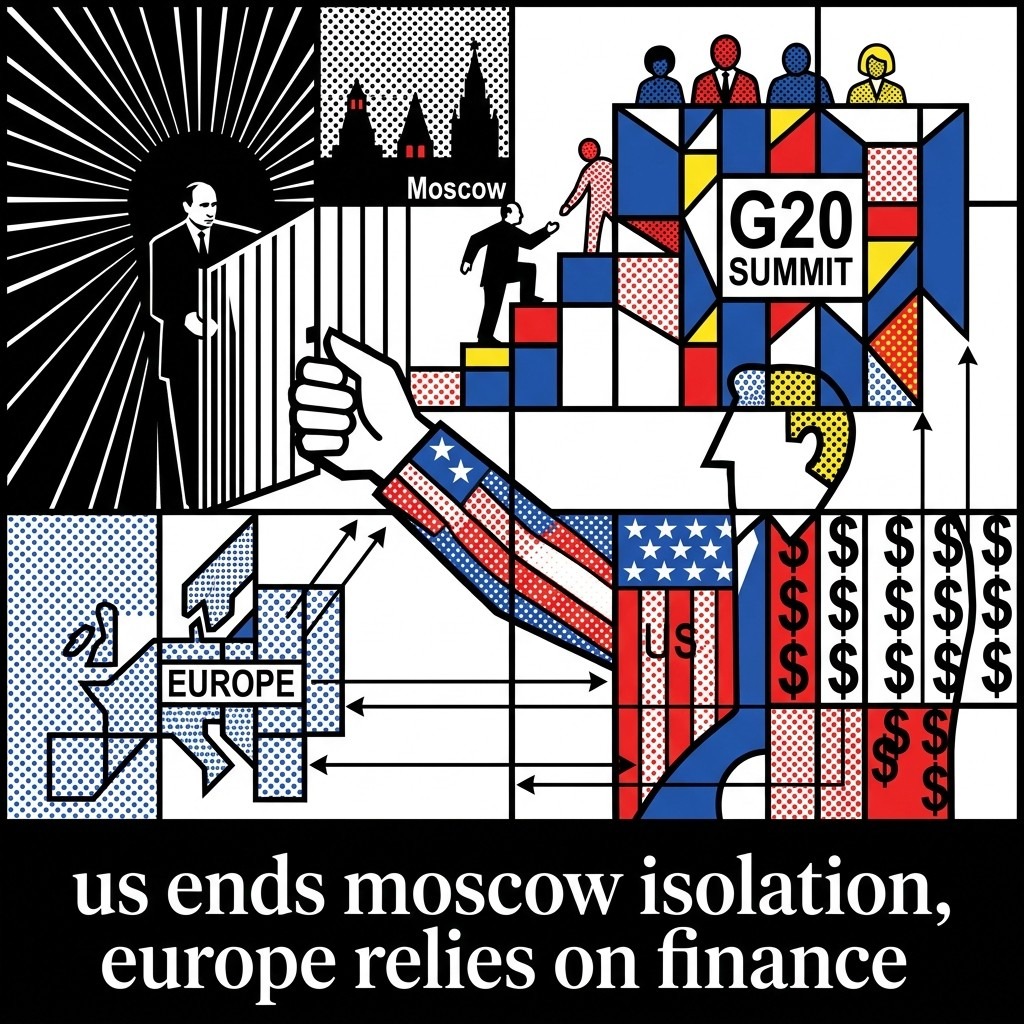
By validating Russian Finance Minister Anton Siluanov’s entry to the September 1, 2026 summit of the Group of Twenty (G20)—an intergovernmental forum of major economies—the US has unilaterally dismantled Moscow’s diplomatic quarantine. This pivot forces European capitals to realize a harsh truth: their geopolitical leverage is wholly downstream of American financial enforcement.

Institutional boycotts disintegrate without active secondary sanctions. German Finance Minister Lars Klingbeil of the Social Democratic Party of Germany (SPD) led European delegates in boycotting a joint photograph, substituting optical disapproval for hard power. Europe stages walkouts because it gains domestic political capital, while Washington breaks the freeze because coordinating global macroeconomic stability is objectively impossible to manage while formally excluding one of the world’s largest commodity exporters.

A fiat anchor ultimately dictates who sits at the table. Abandoning four years of diplomatic shunning, the US administration explicitly dismissed the continued exclusion of Moscow from groups like the G8 as an “unwise idea” (Politico Europe).

The Gist AI Editor

The Global Overview

US invites Russian finance minister to G20 meeting

On September 1, 2026, the US Trump administration permitted Russian Finance Minister Anton Siluanov to attend an in-person meeting of the Group of Twenty (G20)—an intergovernmental forum of major economies—in Asheville, North Carolina (Politico Europe). German Finance Minister Lars Klingbeil of the Social Democratic Party of Germany (SPD) and other European delegates boycotted a joint photograph in protest (ZDF). President Donald Trump defended the invitation, stating that excluding Russia from forums like the G8 is an “unwise idea.” This unilateral move proves that Western institutional boycotts fail without active US financial enforcement.

Bank of Japan bond yields hit 3 percent amid inflation fears

Japan’s benchmark government bond yield reached 3 percent for the first time since 1996, driven by inflation fears stemming from Middle East oil price spikes (WSJ). US Treasury Secretary Scott Bessent publicly signaled expectations that the Bank of Japan (BoJ), the country’s central bank, will continue raising interest rates (FT). With rising oil prices directly lifting US and Asian bond yields, the optimistic narrative of a contained Middle East conflict is fracturing under the weight of sustained inflation pressures.

Nvidia invests 3.5 billion dollars in MediaTek

Nvidia is executing a $3.5 billion strategic investment in Taiwanese chipmaker MediaTek (Bloomberg). Simultaneously, institutional investors are preparing for a potentially record-breaking initial public offering from AI lab Anthropic. This capital deployment indicates the artificial intelligence sector is shifting to secure physical hardware supply chains and consolidate institutional market share.

Stay tuned for the next Gist—your edge in a shifting world. The Gist remains independent and reader-supported. If you value news free from corporate or state interests, consider supporting our mission with a donation.

The European Perspective

Sweden Mass-Casualty War Simulations
The Swedish military and civil organizations are conducting full-scale exercises to practice managing the bodies of 5% of expected conflict casualties (Le Monde). This reconstruction of the Scandinavian kingdom’s total national defense strategy shows European states internalizing the physical costs of sovereign defense. The US invitation for Russia to rejoin the Group of Twenty (G20, an intergovernmental forum of major economies) and Sweden’s drills both reflect Europe’s sudden exposure to a multipolar reality where the United States no longer unconditionally underwrites the continent’s physical security. This normalizes the militarization of civilian administration by treating wartime mortuary logistics as a standard municipal function. However, publicizing mass-casualty simulations risks inciting the exact civilian panic and capital flight that adversary states seek to provoke.

EU Defensive Trade Instruments
EU Trade Commissioner Maroš Šefčovič is developing a new regulatory tool to specifically address Chinese industrial overcapacity (Politico). Concurrently, EU defense ministers are meeting in Ireland to address Kyiv’s critical shortage of missile interceptors. This dual mandate attempts to shield domestic industrial bases from subsidized imports while managing urgent continental security deficits.

UK Labour Adopts California Housing Deregulation
The UK Labour party is looking to California’s housing model to boost supply. Data analysis shows that Accessory Dwelling Units (ADUs, secondary housing units on a residential lot) constituted 25% of all homes approved in California in 2025. By importing this deregulatory mechanism, Labour aims to bypass municipal planning bottlenecks and direct private capital into immediate residential construction.

Catch the next Gist for the continent’s moving pieces.

🎙️ Listen to this edition as a podcast Listen

The Gist is an independent daily digest: AI-curated, human-directed, unapologetically liberal (how it’s made). Hundreds of sources, only what matters. Subscribe free or listen to the podcast.


Comments

Leave a Reply

Your email address will not be published. Required fields are marked *

This site uses Akismet to reduce spam. Learn how your comment data is processed.