Generative AI Lowers U.S. College Wage Premium

Morning Intelligence • Wednesday, September 02, 2026

The Gist View

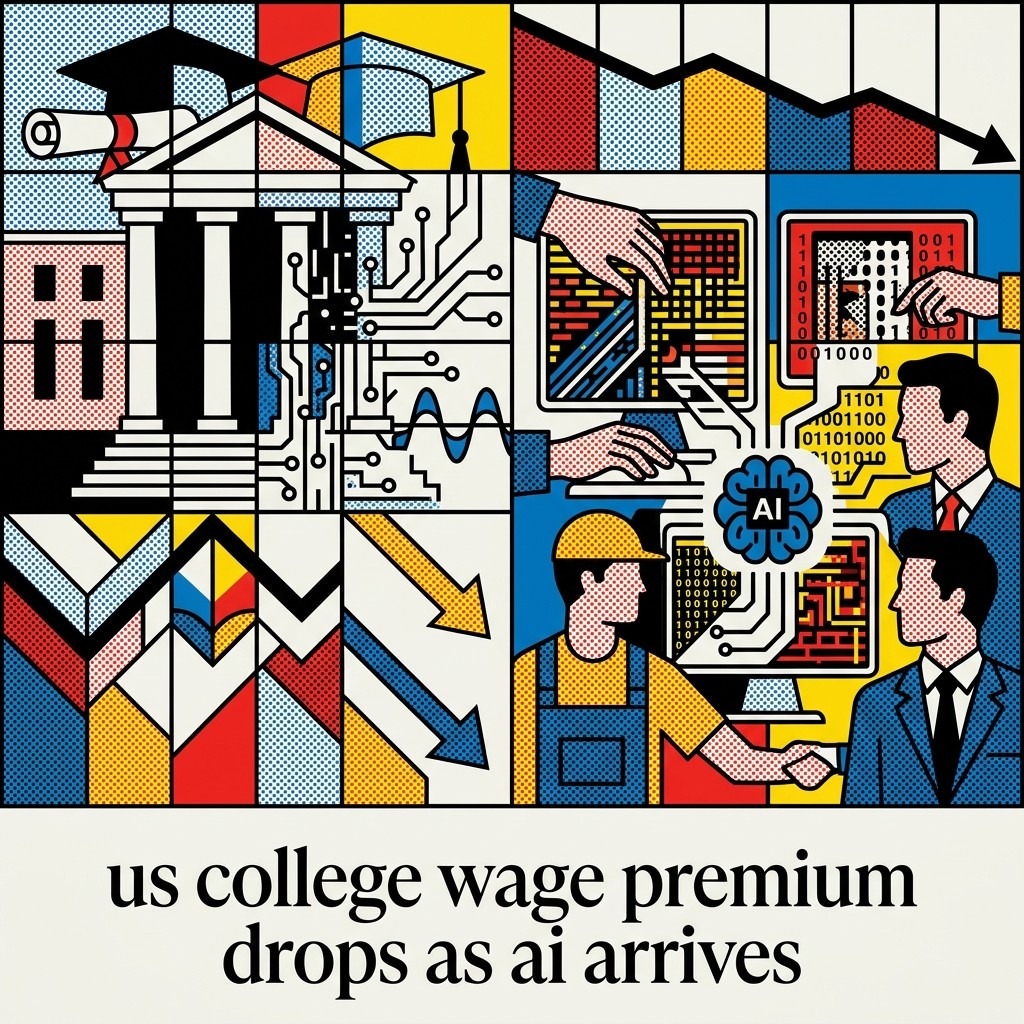
The U.S. college wage premium dropped from 0.626 in 2022 to 0.575 in 2026 as generative AI commoditizes white-collar labor. Policymakers spent decades trying to restrain tuition costs through subsidy reform and failed. Frontier models now dismantle the university credential monopoly through brute market substitution, performing the analytical tasks expensive degrees once signaled.

Employers adopt these tools because they gain immediate margin expansion by automating routine work. Universities, which hiked tuition because they captured guaranteed revenue from federal loans, cannot block a cheaper digital substitute. This wage compression carries steep trade-offs. It disproportionately hurts the middle class, risking the tax base required to fund the welfare state before AI’s productivity gains materialize.

According to the Federal Reserve Bank of St. Louis, a U.S. central bank branch, the American manufacturing sector shed one-third of its workforce between 2000 and 2010 due to physical automation; the cognitive equivalent is unfolding twice as fast.

The Gist AI Editor

The Global Overview

Generative AI College Wage Premium Contraction

Generative AI is compressing the college wage premium by aggressively commoditizing routine white-collar cognitive labor. The U.S. college wage premium dropped sharply from 0.626 in 2022 to 0.575 in 2026 (Marginal Revolution). Moving from zero to full occupational AI exposure correlates with a -0.086 wage effect. This exposure gap accounts for 28 percent of the total decline over the last four years, according to researchers José Azar, Mireia Gine, and Javier Sanz-Espín via SSRN, an open-access repository for academic preprints.

African Healthtech Consolidation

Alan, a French health tech startup backed by Kylian Mbappé and Prosus—a global consumer internet group and technology investor—has acquired Senegalese insurer Tanel to expand into West Africa (FT). Alan recently reached a €5.5 billion valuation following a €580 million funding round, while Tanel was previously valued at $7.5 million in 2024.

Japanese Import Inflation

Tokyo is monitoring the yen’s weakness amid domestic inflation fears (WSJ). A depreciating currency mechanically accelerates inflation given Japan’s heavy structural reliance on energy and food imports. Meanwhile, the fresh exchange of fire between the US and Tehran around the Strait of Hormuz reverses the recent optimism we noted, confirming that geopolitical risk premiums remain highly volatile.

Join us for the next edition to track exactly where global capital moves next. The Gist remains independent and reader-supported. If you value news free from corporate or state interests, consider supporting our mission with a donation.

The European Perspective

Volkswagen Restructuring Conflict

Volkswagen’s internal conflict exposes the structural contradiction of the European champion model: a firm cannot simultaneously operate as a globally competitive electric vehicle manufacturer and a domestic jobs program. CEO Oliver Blume warns the company must become radically ‘smaller and less German’ to survive Chinese competition (Wall Street Journal). Volkswagen’s primary constraint is not Chinese engineering superiority, but a paralyzed corporate governance structure where state ownership and union vetoes deliberately handicap agility to protect incumbent labor. Mass capacity reductions would devastate the regional economy of Lower Saxony, which holds a strategic voting stake precisely to shield social stability from pure market volatility. However, this protectionism carries a cost: the supervisory board recently rejected crucial efficiency proposals. Reflecting its declining equity value amid the governance crisis, Volkswagen is set to be removed from the Euro STOXX 50, a stock index representing blue-chip equities from the Eurozone (Reuters).

Nestlé Holistic Health Divestment

Swiss multinational Nestlé has agreed to sell its ‘holistic health’ division, comprising its primary vitamins and supplements portfolio, to Yellow Wood Partners (Reuters). The divestment is valued at €1 billion, narrowing the conglomerate’s capital focus and consolidating financial resources back into core operations.

UK Fiscal Policy Projections

The Resolution Foundation, a UK think tank focused on living standards and economic policy, calculates that the British middle class is squeezed less than its international peers (FT). The think tank argues this demographic will likely need to face higher taxes to fund a bigger state apparatus, signaling an impending shift in national revenue generation.

German Closure of Russian Facilities

Foreign Minister Johann Wadephul ordered the closure of the Russian consulate in Bonn and the Russian House in Berlin (ZDF). The decision confirms the escalation trajectory we tracked following the August airport sabotage, accelerating the formal decoupling of German state infrastructure from Moscow.

Catch the next Gist for the continent’s moving pieces.

🎙️ Listen to this edition as a podcast Listen

The Gist is an independent daily digest: AI-curated, human-directed, unapologetically liberal (how it’s made). Hundreds of sources, only what matters. Subscribe free or listen to the podcast.


Comments

Leave a Reply

Your email address will not be published. Required fields are marked *

This site uses Akismet to reduce spam. Learn how your comment data is processed.