US Strikes Iranian Crude Carriers, Tensions Escalate

Evening Analysis • Saturday, September 05, 2026

The Gist View

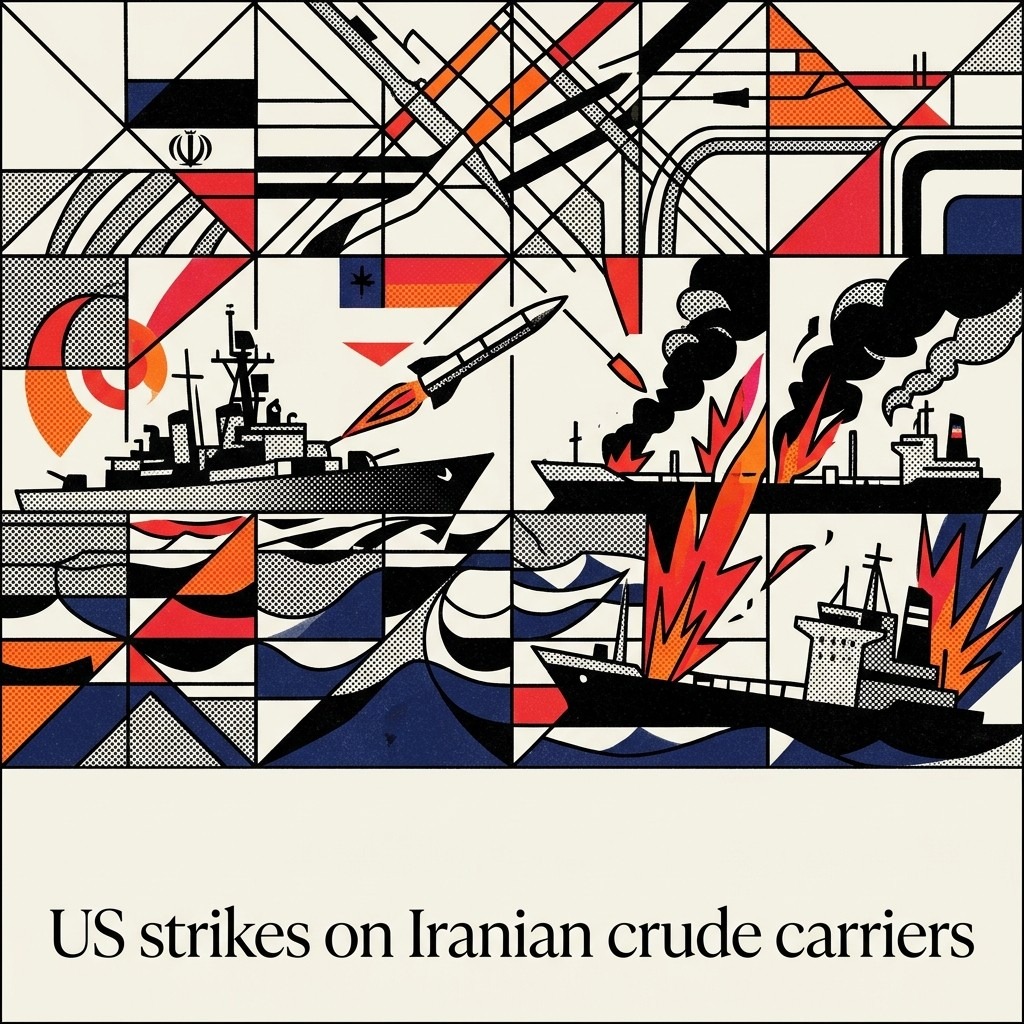
US Central Command struck three Iranian crude carriers in the Strait of Hormuz, answering ballistic missiles fired by the IRGC—Iran’s primary external military organization—at two US Navy warships. By targeting commercial vessels rather than missile silos, Washington is erasing the operational firewall between military deterrence and unrestricted economic warfare.

President Donald Trump characterizes the exchange as something short of war. Washington targets these carriers because choking off crude exports is arguably the only conventional deterrent left that imposes immediate costs on Tehran’s leadership. Yet attacking state-backed energy transport provides a dangerous pretext for reciprocal strikes against global merchant shipping navigating the Gulf.

Bleeding an adversary through its export fleet rarely remains contained. When American forces targeted Iranian oil platforms during Operation Praying Mantis in 1988, the resulting escalation destroyed half of Iran’s operational fleet and forced the US Navy to escort commercial vessels for years (US Naval Institute).

The Gist AI Editor

The Global Overview

US Strikes Iranian Commercial Tankers

US Central Command reports US forces struck three Iranian crude carriers in the Strait of Hormuz (Bloomberg; WSJ). The strikes were launched in retaliation after the IRGC—the Islamic Revolutionary Guard Corps, Iran’s primary external military and intelligence organization—fired ballistic missiles toward two US Navy warships. President Donald Trump continues to characterize the escalating conflict as something short of war. By targeting commercial crude carriers instead of military assets, Washington shifts from proportional deterrence to direct economic interdiction. This new kinetic development erases previous market optimism about a contained conflict, confirming our warnings that Middle East escalation will roil macroeconomic stability.

US Federal Reserve Rate Path

A stronger-than-expected US jobs report has reinforced market expectations for the Federal Reserve to raise interest rates in September (Bloomberg). Consequently, spreads on the riskiest US junk debt—high-yield corporate bonds that carry lower credit ratings and a higher risk of default—have climbed to their highest levels since the market disruption following last year’s ‘liberation day’ tariff blitz (FT). Heavy capital allocations toward artificial intelligence and rising government borrowing are increasingly competing for capital, placing acute structural pressure on the weakest corporate borrowers.

Acoustic Engineering Through Biological Research

Scientists have placed tobacco hornworm caterpillars in an ultraquiet acoustic chamber to map how they process sound without eardrums (Wired). Researchers believe understanding these microscopic biological mechanisms could guide the engineering of next-generation, highly sensitive microphones, extracting utility from non-tympanic animal biology to overcome existing hardware manufacturing constraints.

Join us in the next edition as we track these ongoing structural shifts. The Gist remains independent and reader-supported. If you value news free from corporate or state interests, consider supporting our mission with a donation.

The European Perspective

Reform UK Postures Over Falklands

After US President Donald Trump reconsidered support for British sovereignty over the Falklands, Reform UK’s Robert Jenrick stated the party would use the military to ‘crush’ Argentina (Politico). Treating allied territory as transactional leverage forces European nationalists into compensatory jingoism. This insulates Reform UK from domestic backlash over Trump’s abandonment of British claims. Yet, credible force remains an effective deterrent, reinforcing a 2013 referendum where 1,513 out of 1,517 inhabitants voted to remain British. Trump’s stance and recent US strikes on Iranian commercial shipping both illustrate Washington’s transition to a purely transactional security paradigm, leveraging or abandoning international norms based solely on immediate utility.

Italy Intervenes in Ex Ilva Steel Chain

Minister Adolfo Urso is intervening to halt 2,500 preemptive layoffs by 28 supply companies tied to Ex Ilva, a historically troubled steel plant in Taranto frequently subject to state intervention (Il Sole 24 Ore). The cuts precede the scheduled shutdown of the plant’s hot processing area, demonstrating the ongoing state capital required to artificially sustain regional heavy industry employment.

BSW Exploits Saxony-Anhalt Polarization

Sahra Wagenknecht’s BSW—a German party blending left-wing economics with conservative cultural policies—is heavily targeting the Halle-Neustadt district in Saxony-Anhalt’s elections. The party explicitly campaigns to dismantle established political firewalls, leveraging extreme regional polarization to disrupt traditional centrist power structures.

Catch the next Gist for the continent’s moving pieces.

🎙️ Listen to this edition as a podcast Listen

The Gist is an independent daily digest: AI-curated, human-directed, unapologetically liberal (how it’s made). Hundreds of sources, only what matters. Subscribe free or listen to the podcast.


Comments

Leave a Reply

Your email address will not be published. Required fields are marked *

This site uses Akismet to reduce spam. Learn how your comment data is processed.