Stellantis Delays Ram 1500 REV to 2027, Shifts to EREVs

Evening Analysis • Sunday, September 06, 2026

The Gist View

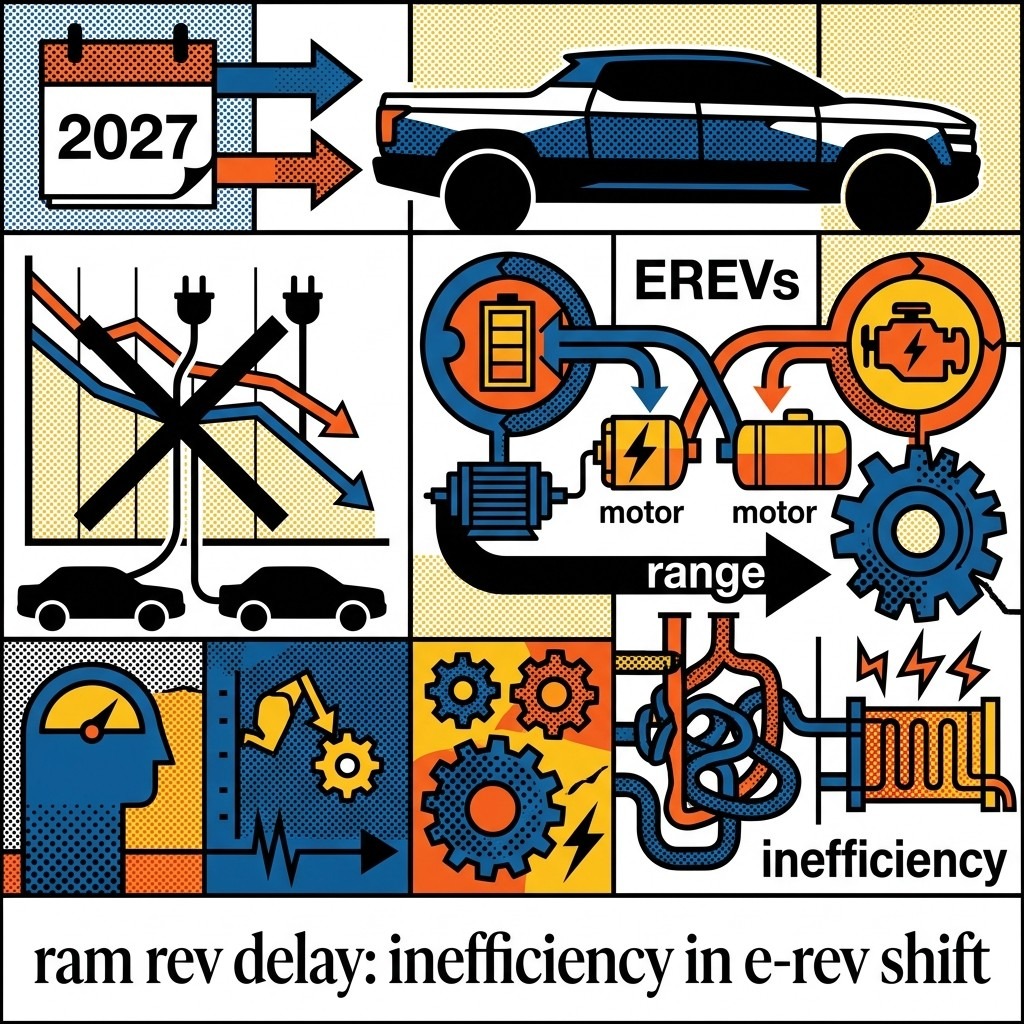
Stellantis delaying its Ram 1500 REV pickup to 2027 caps a broader pivot to Extended-Range Electric Vehicles (EREVs)—EVs hauling combustion engines purely as generators—after plug-ins stalled at 2% of the US market. This retreat reveals the expensive failure of top-down technology mandates. By forcing electrification faster than grid infrastructure permits, regulators did not eliminate the internal combustion engine; they forced manufacturers to repurpose it as a costly compliance mechanism.

Automakers build these dual powertrains because they capture state regulatory credits while solving consumer range anxiety. While pure electric models face genuine charging bottlenecks, making generators a pragmatic bridge, lugging around two distinct power systems adds massive dead weight. This penalty means these workarounds will likely run less efficiently than conventional hybrids.

When states dictate engineering rather than pricing emissions, capital funds rule-gaming over innovation. A standard electric truck battery already adds roughly 1,500 pounds of curb weight, a physics problem no legislative deadline can repeal (Wall Street Journal).

The Gist AI Editor

The Global Overview

Automakers Pivot to Extended-Range EVs

Hyundai, Ford, and Stellantis are developing Extended-Range Electric Vehicles (EREVs)—EVs equipped with a combustion engine acting solely as a generator to charge the battery. Traditional plug-in hybrids capture under 2% of the U.S. new-car market (WSJ), prompting Stellantis to delay its Ram 1500 REV pickup to 2027. Rigid state mandates forced a costly workaround: automakers are now installing heavy combustion engines as physical dead weight during battery-only operation just to guarantee range and achieve regulatory compliance (Electrek).

Huawei Faces Federal RICO Trial

Jury selection begins September 8 in Brooklyn for the U.S. criminal trial against Huawei (FT). A 16-count indictment charges the Shenzhen conglomerate with bank fraud and trade-secret theft spanning two decades. Prosecutors are deploying the Racketeer Influenced and Corrupt Organizations Act (RICO)—a federal law designed to combat organized crime enterprises. This legal strategy reclassifies long-term corporate intellectual property extraction as the operation of a coordinated criminal syndicate.

OPEC+ Abandons October Output Hikes

OPEC+ core members agreed on September 6 to leave October production unchanged, canceling planned increases (WSJ). The ongoing disruption of the Strait of Hormuz has functionally stripped OPEC+ of its pricing power. The cartel must pause hikes as physical maritime bottlenecks override its paper quotas, shifting structural leverage over global energy markets from institutional producers to the actors controlling physical transit routes.

Stay tuned for the next Gist—your edge in a shifting world. The Gist remains independent and reader-supported. If you value news free from corporate or state interests, consider supporting our mission with a donation.

The European Perspective

Italy Prepares Diesel Tax Cuts

Rome is drafting a targeted diesel excise duty cut, expected by late September (Il Sole 24 Ore). Finance Minister Giancarlo Giorgetti is balancing political demands for consumer relief against tight fiscal resources and a sluggish 1% national GDP growth forecast.

Catch the next Gist for the continent’s moving pieces.

Russia-Germany Diplomatic Relations Collapse

Russian Foreign Minister Sergey Lavrov declared Germany is steering toward war with Moscow following new Berlin sanctions (ZDF). This diplomatic escalation stems from German intelligence attributing an attempted early August drone bombing of Ukrainian cargo planes at Leipzig airport to Russian operatives.

Alternative for Germany Wins Saxony-Anhalt Elections

September 6 exit polls show the Alternative for Germany (AfD) securing a historic 44.5% of the vote in Saxony-Anhalt (Infratest dimap). The center-right Christian Democratic Union (CDU) trails at approximately 18.5%. We previously warned that Germany’s political firewall was structurally unstable; today confirms the mathematical impossibility of maintaining this quarantine without paralyzing regional governance. To exclude the AfD, the CDU must govern with left-wing factions, alienating its conservative base before the 2029 federal elections. Maintaining this quarantine is essential to protect institutions from a group the BfV intelligence agency classifies as a confirmed right-wing extremist movement. However, forcing legacy parties into sprawling, contradictory coalitions directly validates the far-right’s anti-establishment narrative.

🎙️ Listen to this edition as a podcast Listen

The Gist is an independent daily digest: AI-curated, human-directed, unapologetically liberal (how it’s made). Hundreds of sources, only what matters. Subscribe free or listen to the podcast.


Comments

Leave a Reply

Your email address will not be published. Required fields are marked *

This site uses Akismet to reduce spam. Learn how your comment data is processed.