BC Partners Targets LIV Golf’s Chapter 11 for Tax Gains

Morning Intelligence • Monday, September 07, 2026

The Gist View

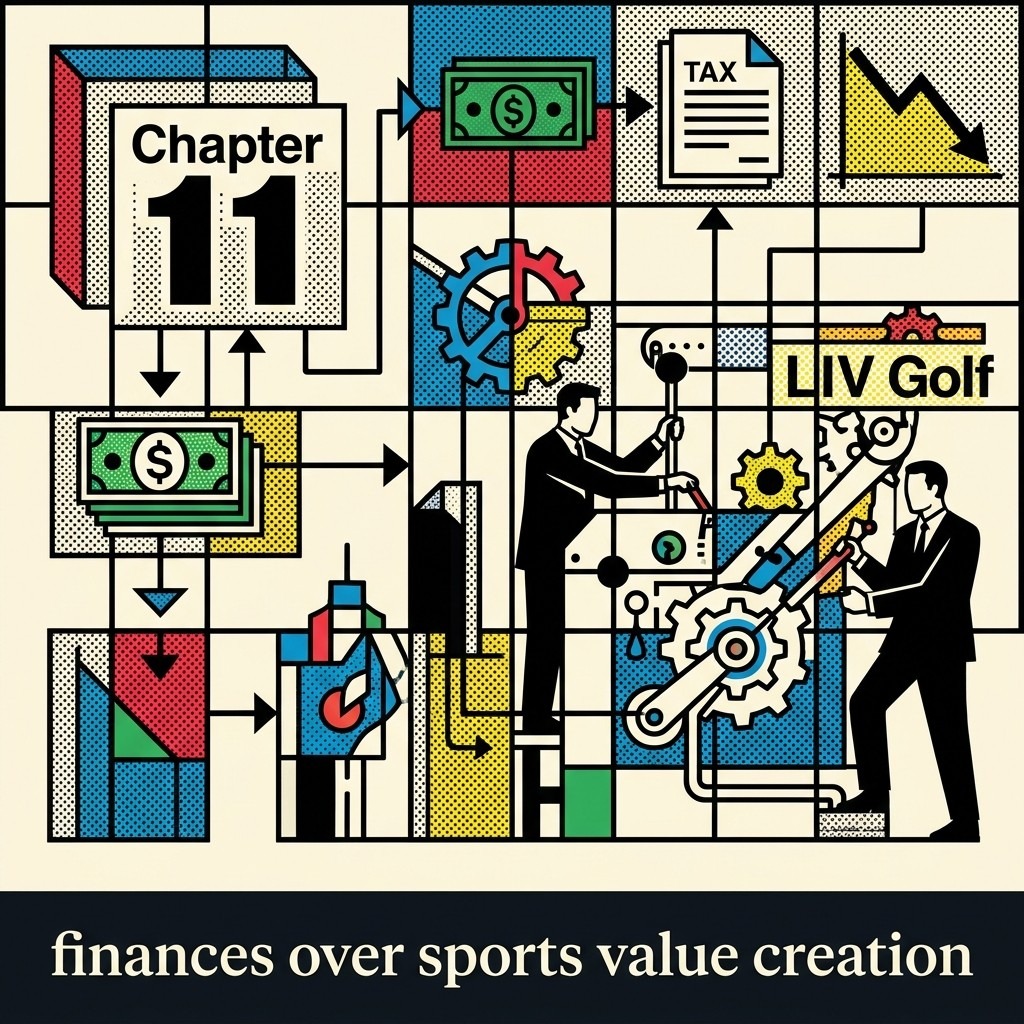
British private equity firm BC Partners is negotiating to acquire LIV Golf out of a Chapter 11 bankruptcy—a US debt reorganization process—to harvest its $5 billion accounting deficit. Backed by Saudi Arabia’s Public Investment Fund, the startup’s failure reveals how corporate tax codes warp market incentives: the state effectively transforms a sovereign-wealth blunder into a premium financial instrument.

Private equity targets these bankruptcies because buyout firms gain a legal mechanism to offset taxes on their winning investments against a defunct entity’s historical losses. To be fair, eliminating this Net Operating Loss provision would severely penalize legitimate entrepreneurship by taxing cyclical businesses on their peaks while ignoring their troughs. Yet for multinational conglomerates, this provision decouples financial engineering from actual value creation.

The acquired operation becomes entirely secondary to the math. Following the 2008 financial crisis, federal regulators had to issue emergency notices specifically to stop profitable banks from acquiring failed lenders solely to exploit this exact tax-loss loophole (US Treasury).

The Gist AI Editor

The Global Overview

BC Partners Negotiates LIV Golf Buyout
Backed by Saudi Arabia’s Public Investment Fund (PIF), LIV Golf is preparing a Chapter 11 bankruptcy—a US mechanism to reorganize debts while operating—after accumulating an estimated $5 billion in net operating losses (NOL) since 2022 (Forbes). British private equity firm BC Partners is negotiating to finance the restructuring, aiming to harvest this NOL—an accounting tool allowing current losses to offset future tax liabilities—across its broader portfolio (FT). Under this restructuring, regular event purses will drop by roughly 60%, falling from $30 million to approximately $10 million (GolfRaw).

WMO Flags Wildfire Toxicity Risks
The World Meteorological Organization’s September 7 bulletin reported that extreme fire-smoke events have tripled globally since the 1990s. The agency warned that conventional models underestimate wildfire-linked mortality by up to 93% because they fail to measure the uniquely high toxicity of fire-derived PM2.5 particulate matter.

US Oil Blockade Forces Indian Gold Crackdown
We warned that US strikes on Iranian commercial shipping were actively erasing the firewall between military deterrence and unrestricted economic warfare; today, a complete US naval blockade has reportedly driven Iranian crude exports to zero, pushing Brent crude past $96 (WSJ). This US naval blockade on Iranian oil is directly forcing New Delhi to suppress domestic gold demand, as the resulting spike in crude prices drains India’s foreign exchange reserves. Consequently, shares in retailers like Titan Company fell after Prime Minister Narendra Modi urged citizens to halt non-essential gold purchases, which cost India approximately $6 billion per month (FT).

Join us for the next Gist—your edge in a shifting global system. The Gist remains independent and reader-supported. If you value news free from corporate or state interests, consider supporting our mission with a donation.

The European Perspective

CDU Rejects AfD Coalition in Saxony-Anhalt

The Christian Democratic Union (CDU), Germany’s mainstream center-right party, refused coalition talks after the far-right Alternative for Germany (AfD) captured 43.8% of the September 6 state vote and 39 of 83 seats (ZDF). Because the Saxony-Anhalt AfD is classified as a confirmed right-wing extremist group by domestic intelligence, collaborating violates the CDU’s democratic obligations. However, this firewall policy guarantees that over 40% of voters lack representation in the governing coalition. Excluding a near-majority winner preserves constitutional hygiene but risks permanently delegitimizing democratic institutions among eastern voters, severely straining the region’s civic trust.

Anti-Ukrainian Violence Surges in Poland

Polish police recorded 180 ethnically motivated crimes against Ukrainians in the first half of 2026, a 30% year-over-year increase (Euractiv). Prime Minister Donald Tusk warned these attacks serve Russian information operations designed to inflame bilateral tensions ahead of Poland’s 2027 parliamentary elections.

European Creatives Confront AI Commoditization

Generative artificial intelligence is restructuring commercial design. UK industry leaders publicly frame AI as subordinate software to ease labor concerns (The Guardian), while French graphic designers organized online resistance against a summer proliferation of AI-generated public posters (Le Monde). This tension reflects growing professional anxiety over automated output commoditizing commercial art and compressing wages for skilled labor.

Catch the next Gist for the continent’s moving pieces.

🎙️ Listen to this edition as a podcast Listen

The Gist is an independent daily digest: AI-curated, human-directed, unapologetically liberal (how it’s made). Hundreds of sources, only what matters. Subscribe free or listen to the podcast.


Comments

Leave a Reply

Your email address will not be published. Required fields are marked *

This site uses Akismet to reduce spam. Learn how your comment data is processed.