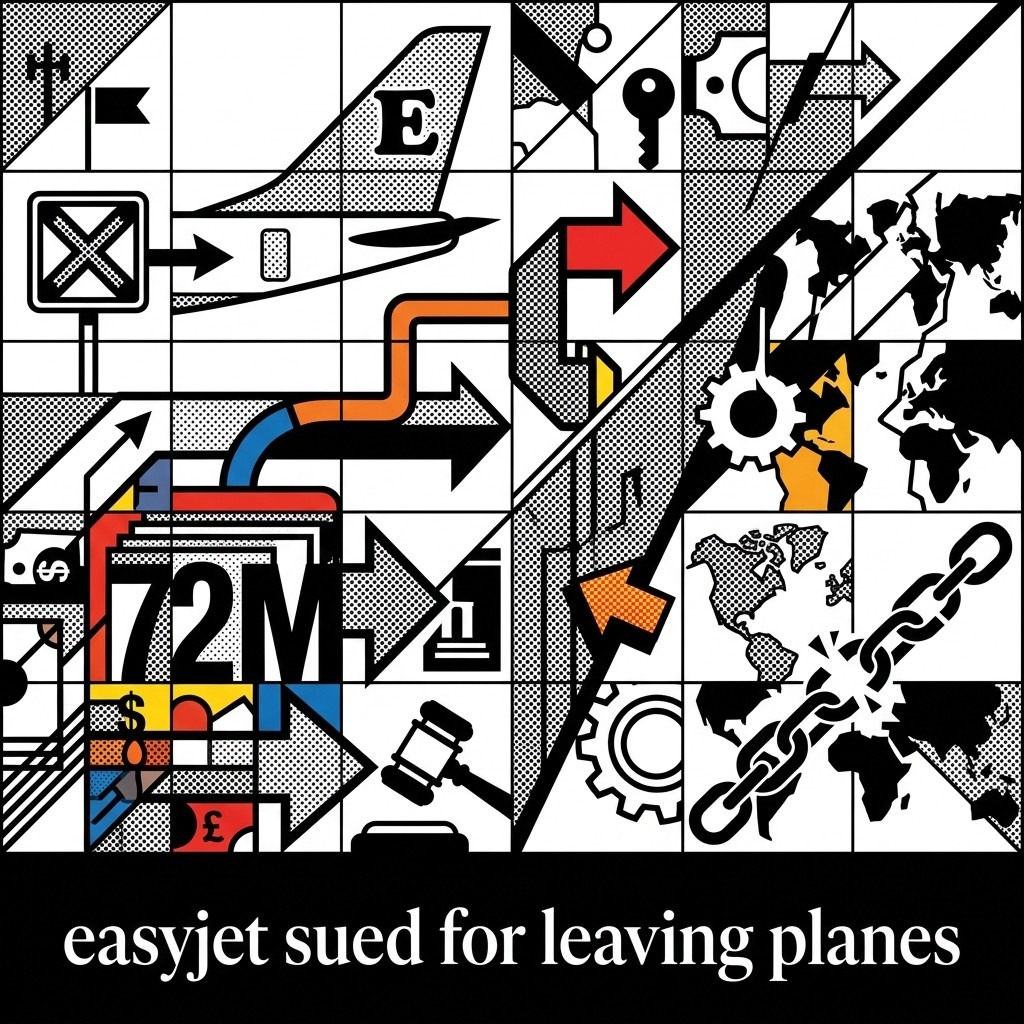
EasyJet Hit with $72M Lawsuit Over Russian Sanctions Compliance

Evening Analysis • Tuesday, September 08, 2026

The Gist View

EasyJet is fighting a $72 million lawsuit over aircraft it abandoned to comply with sanctions on Russia. The dispute reveals a hidden cost of economic warfare: when governments mandate the abrupt stranding of capital assets, they destroy the predictability that underpins global trade. These battles do not play out in Moscow, but in Western courts between Western entities fighting over the wreckage.

Without blockades, European aviation would directly subsidize a foreign war effort through continuous lease revenues. But states avoid absorbing this policy’s cost by forcing private companies to break their agreements. An Irish liquidator for GTLK, Russia’s state-owned State Transport Leasing Company, pursues the British airline because it gains by clawing back cash for its own trapped creditors.

When Britain passed the Trading with the Enemy Act in 1914, domestic courts spent over a decade untangling the defaulted commercial debt held by English banks, according to the UK National Archives.

The Gist AI Editor

The Global Overview

Sanctions Friction Hits Private Balance Sheets

EasyJet is facing a lawsuit in London’s High Court for at least $72 million from an Irish subsidiary of GTLK, Russia’s state-owned State Transport Leasing Company (FT). The budget airline abandoned six leased Airbus planes in Madrid and Cyprus in 2022, arguing EU sanctions legally prevented required maintenance. Liquidators claim the grounded aircraft suffered severe physical degradation without upkeep, resulting in a $32.5 million value shortfall when three were eventually sold. The litigation demonstrates how sanctions regimes inevitably corrode the predictability of commercial contract law, externalizing massive financial friction directly onto private balance sheets and civilian courts.

Cartels Capitalize on Agricultural Machinery

Mexican drug cartels are increasingly utilizing heavy agricultural machinery to launder illicit cash flows. The strategy exploits the high capital value and routine cross-border movement of farm equipment to obscure the origin of cartel profits. By embedding illicit funds into legitimate agricultural supply chains, criminal networks bypass traditional financial controls and leverage the administrative predictability of transnational industrial trade.

Private US Diplomacy Secures Assurances

Following weekend shuttle diplomacy to Kyiv and Moscow by private US negotiators Steve Witkoff and Jared Kushner, Vladimir Putin explicitly assured Donald Trump today that Russia harbors no aggressive plans toward Europe. The engagement demonstrates a structural shift where private actors bypass official state institutions to directly negotiate international security arrangements.

Stay tuned for the next Gist—your edge in a shifting world. The Gist remains independent and reader-supported. If you value news free from corporate or state interests, consider supporting our mission with a donation.

The European Perspective

France Proposes Direct EU Taxes

Fiscal Strategy Disguised as Defense

France’s lobbying for over €60 billion in direct European taxes, termed ‘own resources,’ aims to centralize revenue extraction away from national democratic accountability. French diplomats claim these funds for the EU’s next budget will support defense and competitiveness while lowering direct national contributions (Politico). Funding continental-scale defense through unpredictable member-state contributions is structurally inadequate and strictly requires reliable revenue. However, this push coincides with France’s severe domestic fiscal crisis as the government struggles to draft a finance bill ahead of the 2027 elections. The €60 billion target matches the exact scale of France’s domestic structural deficit, effectively attempting to mutualize its fiscal shortfall under the banner of European strategic autonomy.

Saxony-Anhalt Waives Administrative Role

Regional Politics Halts State Functions

Our warning that extreme regional politics disrupts basic state functions is materializing. Acting Minister-President Sven Schulze of the Christian Democratic Union (CDU) formally requested to skip Saxony-Anhalt’s upcoming chairmanship of the Ministerpräsidentenkonferenz (MPK), the regular conference of Germany’s 16 state premiers, scheduled to begin October 1, 2026 (ZDF). Schulze cited extreme uncertainty over state government formation following the Alternative for Germany (AfD) party’s decisive 44.5% victory in Sunday’s regional elections, proving how shifts in voter blocs directly paralyze administrative governance.

Catch the next Gist for the continent’s moving pieces.

🎙️ Listen to this edition as a podcast Listen

The Gist is an independent daily digest: AI-curated, human-directed, unapologetically liberal (how it’s made). Hundreds of sources, only what matters. Subscribe free or listen to the podcast.


Comments

Leave a Reply

Your email address will not be published. Required fields are marked *

This site uses Akismet to reduce spam. Learn how your comment data is processed.