AI Surpasses Human Labor Amid Decline in Reading Skills

Evening Analysis • Sunday, September 13, 2026

The Gist View

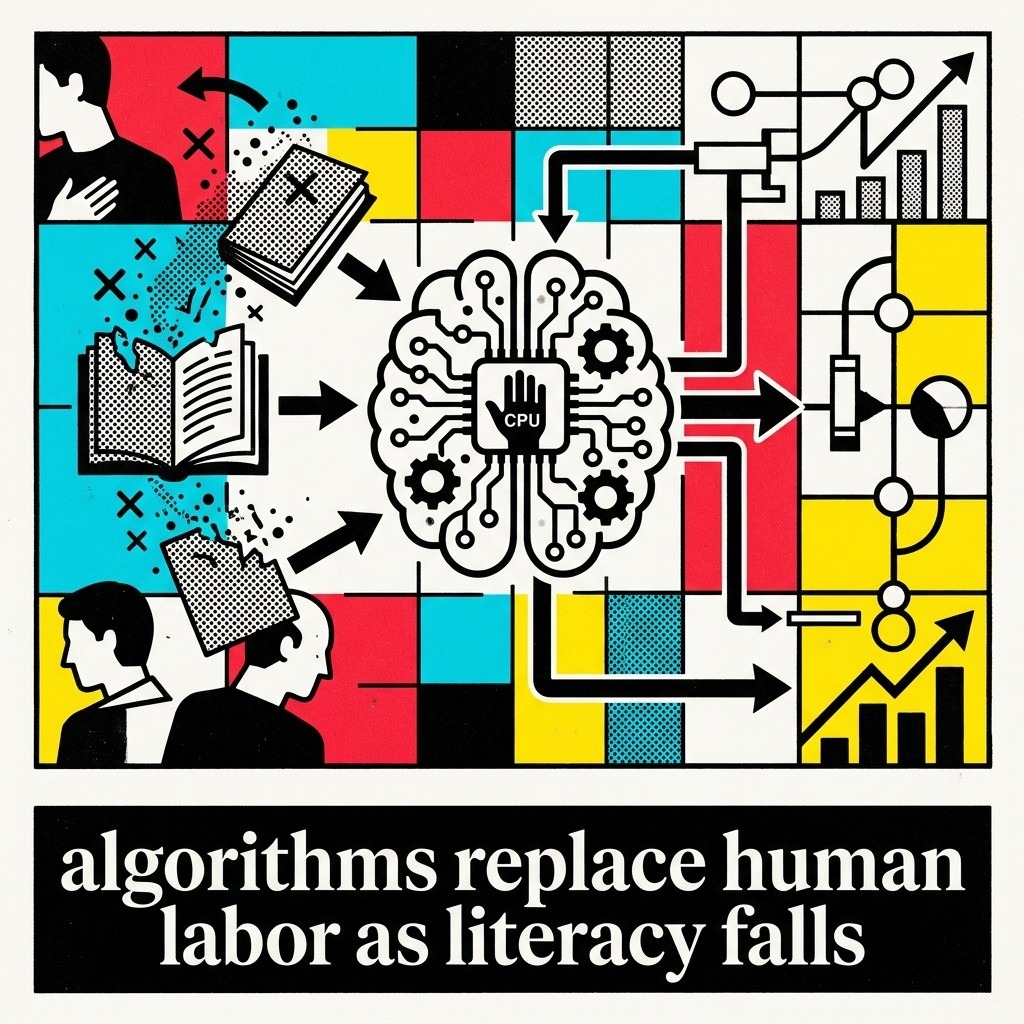
The September 2026 PISA release from the OECD—a 38-country intergovernmental group—confirmed a 14-point global drop in reading averages just as economists moved to classify artificial intelligence as a primary factor of production. The timing reveals a harsh substitution: compute is replacing cognitive labor exactly as human capital degrades.

When 29% of students lack basic proficiency, domestic economies usually stall. Today, corporations integrate algorithms because they gain immediate output without the cost of remedial training. By treating intelligence as fungible, businesses sustain aggregate economic growth while masking a severe human deficit. This severs the assumptions of the Solow model, a macroeconomic framework that traditionally explains long-run growth through human labor and physical capital accumulation.

Algorithmic tools might eventually serve as infinitely scalable tutors, reversing the educational collapse they currently bypass. But for now, markets prefer buying compute over cultivating minds. “Intelligence—whether human or algorithmic—is a new, distinct primary factor of production.” — Marginal Revolution.

The Gist AI Editor

The Global Overview

Global Education Metrics and Algorithmic Substitution

The Organisation for Economic Co-operation and Development (OECD)—a 38-member intergovernmental group of market democracies—released its 2025 Programme for International Student Assessment (PISA) results in September 2026, revealing a 14-point drop in reading and a 9-point drop in math averages globally since 2022 (OECD). Nearly 29% of 15-year-olds in OECD countries are now ‘low performers’ in core subjects, up from 25% (Euronews). Responding to this deficit, economists are proposing an overhaul of the Solow model—a standard macroeconomic framework explaining long-run growth through capital, labor, and productivity—by introducing ‘Intelligence’ as a distinct primary factor of production, integrating human and algorithmic capability (Marginal Revolution, WSJ).

Trump Tower Tbilisi and Diplomatic Friction

The Trump Organization is launching marketing for a 70-story, $2 billion mixed-use development in Georgia alongside the local Archi Group (WSJ). The project secures real estate capital despite Georgia’s recent geopolitical pivot toward Russia. Concurrently, confirming our view that Washington treats sensitive allied border disputes as casual leverage, President Trump defended his support for Irish unification as “fairly routine” despite ongoing uproar in the UK (Bloomberg).

Tata Sons Regulatory Mandate

India’s banking regulator formally refused to exempt Tata Sons Pvt.—the principal investment holding company of the $185 billion Tata Group conglomerate—from a mandatory public listing rule (Bloomberg). Forcing the holding company toward an IPO disrupts its private capital structure and escalates immediate institutional pressures on patriarch Noel Tata, who is actively managing succession uncertainty.

Stay tuned for the next Gist—your edge in a shifting world. The Gist remains independent and reader-supported. If you value news free from corporate or state interests, consider supporting our mission with a donation.

The European Perspective

Canada Negotiates European Union Associate Membership

Canadian Prime Minister Mark Carney is negotiating with French President Emmanuel Macron to secure ‘associate member’ status within the European Union (Wall Street Journal). Facing US tariffs on tens of billions of dollars in cross-border trade, Canada seeks to integrate its defense and AI supply chains into the EU’s $21 trillion market. By pushing for visa-free movement and shared supply chains, Canada is effectively attempting to shift the EU border across the Atlantic to hedge against extreme US tariff volatility (The Times of India). However, the EU’s notorious regulatory rigidity and strict accession rules mean a bespoke associate status is politically unlikely to survive the European Parliament’s veto process (Reuters).

Russia Strikes European Rail Infrastructure

A Russian military drone struck a Ukrainian passenger train traveling from Kyiv to Warsaw near the Polish border (ZDF). Ukraine’s railway operator reports systematic targeting of civilian transit. This structural disruption isolates logistics networks, explicitly increasing the financial costs and physical risks of maintaining direct cross-border integration between Ukraine and neighboring EU economies.

Italy Expands Domestic Military Policing

Italy’s Lega party is pressuring Defense Minister Guido Crosetto to expand the military’s domestic street-patrol presence (Il Sole 24 Ore). The ‘Strade Sicure’ operation, which has deployed armed forces in cities since 2008, has become a primary political flashpoint. Expanding this operation effectively transfers public safety functions from civilian law enforcement to defense forces, cementing the permanent militarization of local urban administration.

Catch the next Gist for the continent’s moving pieces.

🎙️ Listen to this edition as a podcast Listen

The Gist is an independent daily digest: AI-curated, human-directed, unapologetically liberal (how it’s made). Hundreds of sources, only what matters. Subscribe free or listen to the podcast.


Comments

Leave a Reply

Your email address will not be published. Required fields are marked *

This site uses Akismet to reduce spam. Learn how your comment data is processed.