AlphaGenome Atlas: DNA Breakthrough Shifts Aging Economics

Evening Analysis • Monday, September 14, 2026

The Gist View

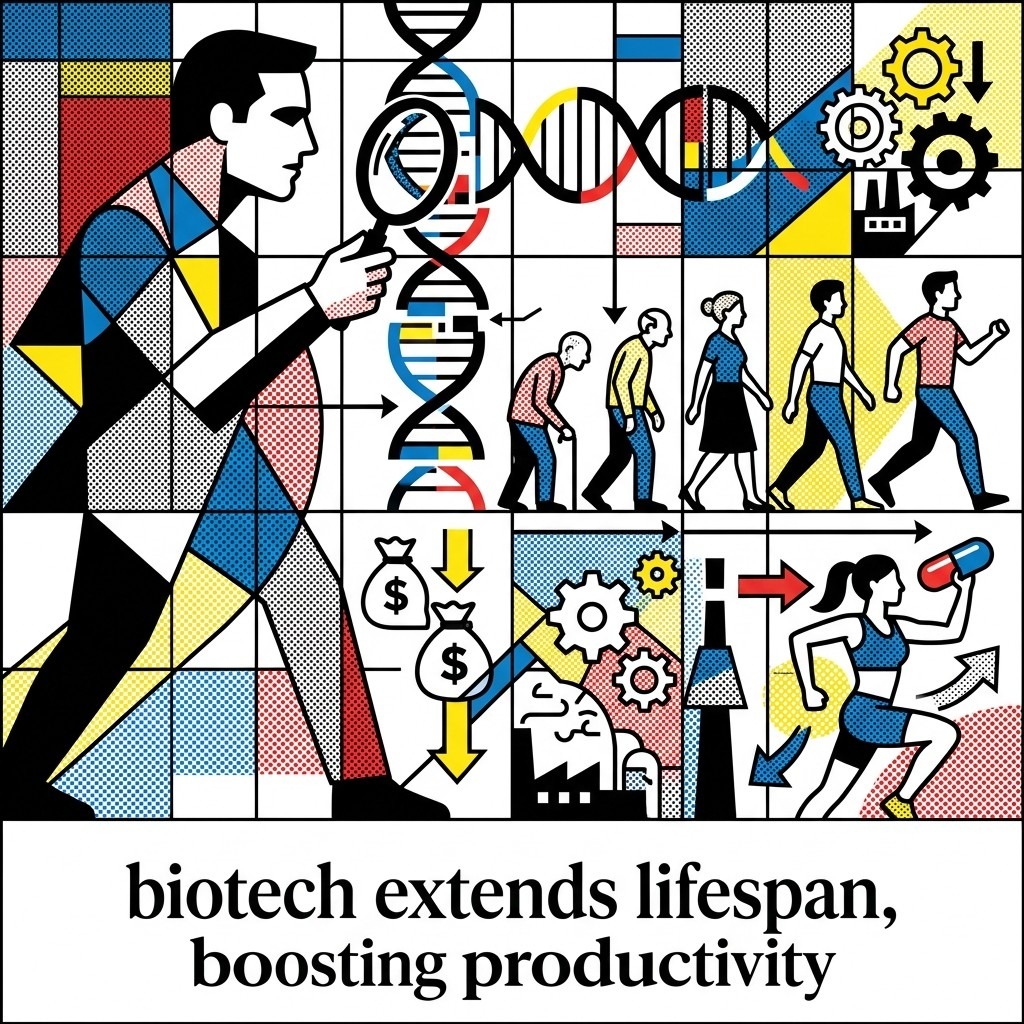
On September 8, 2026, Google DeepMind launched the AlphaGenome Atlas, mapping 9 billion DNA variants and shifting the economic calculus of global aging. While governments manage demographic decline through punishing taxation, private biotechnology engineers the supply-side alternative: extending the productive human lifespan.

Governments tax shrinking workforces because politicians gain immediate fiscal relief without funding complex scientific risks. Conversely, developers like Corbus Pharmaceuticals—a clinical-stage precision medicine firm—chase blockbuster valuations by solving the physical decay draining state treasuries. Their novel CB1-targeting therapies, which treat obesity by blocking cannabinoid receptors to bypass the severe gastrointestinal side effects of older GLP-1 diabetes medications, will initially strain public health budgets. Yet the profit motive ensures these treatments scale, eventually replacing lifetime state care with extended economic participation.

Perfusion machines that pump nutrients into donated organs for 6 to 12 hours demonstrably “improve transplant success rates,” proving human biological limits are now solvable engineering problems (MIT Technology Review).

The Gist AI Editor

The Global Overview

Medical Innovations Driving Health
Market-driven breakthroughs in predictive health are physically restructuring the economic capacity of aging populations. On September 8, 2026, Google DeepMind released the AlphaGenome Atlas, an AI tool predicting the physiological effects of genetic mutations across 9 billion DNA variants (Singularity Hub). Concurrently, Corbus Pharmaceuticals, a clinical-stage company developing precision medicines, reported a breakthrough for a CB1-targeting drug. This blocks cannabinoid receptor type 1 to treat obesity, avoiding the severe nausea of GLP-1s, which are diabetes medications mimicking appetite-regulating hormones (FT). Additionally, pumping donated organs on perfusion machines for 6 to 12 hours reverses cellular aging (MIT Technology Review).

French Pensioner Tax
Both domains address the economic weight of an aging society, but while markets engineer biological solutions extending productive capacity, the state relies on politically toxic fiscal contraction. French minister Sébastien Lecornu actively targets retirees for 2027 state budget savings, with final fiscal terms currently leveraged by Marine Le Pen’s political influence (Politico).

Scientific Realism and State Friction
On September 14, 2026, physicist Carlo Rovelli published a book critically examining the foundational scientific assumption that objective reality is perfectly knowable (NPR). Meanwhile, our view that frontier AI incumbents actively trade public market transparency for state partnership faces political turbulence, as Donald Trump explicitly vowed over the mid-September weekend to shut down the US AI regulation push entirely (Politico).

Stay tuned for the next Gist—your edge in a shifting world. The Gist remains independent and reader-supported. If you value news free from corporate or state interests, consider supporting our mission with a donation.

The European Perspective

EU-China Trade Decoupling and Business Unpreparedness

The stark gap between Brussels’ geopolitical de-risking strategy and EU firms’ failure to diversify supply chains exposes the limits of state-directed decoupling against entrenched market incentives. As the EU’s trade deficit with China hits €1 billion a day, Trade Commissioner Maroš Šefčovič is scheduled to speak with Chinese Commerce Minister Wang Wentao on September 17, 2026 (Politico). Despite explicit political warnings about Taiwan, European businesses are rationally choosing short-term supply chain efficiency over the state’s long-term security goals. A mid-September 2026 survey of 228 companies reveals that while 81% were negatively affected by the Ukraine war, 59% have no plans to prepare for a geopolitical shock in Taiwan, and only 10% have implemented concrete strategies to diversify their supply chains (Bertelsmann Stiftung). Shifting entrenched supply chains away from China requires massive upfront capital and years of restructuring, which many mid-sized European firms simply cannot afford.

Hungary’s Political Realignment

German Foreign Minister Johann Wadephul visited Budapest on September 14, 2026, marking the first such diplomatic visit to Hungary in seven years (ZDF). The visit solidifies European ties with Hungary’s new pro-EU government under Prime Minister Peter Magyar, who replaced Viktor Orbán’s 16-year rule in May 2026.

UK Secessionist Push

Nationalist leaders from Scotland, Wales, and Northern Ireland have launched an unprecedented joint campaign demanding independence from London explicitly to return their respective nations to the European Union (Il Sole 24 Ore). Meanwhile, the protracted strategic bombardment of Ukrainian infrastructure might see a tactical pause, with Donald Trump claiming on September 14 that both Moscow and Kyiv have agreed to halt strikes on each other’s energy facilities (ZDF).

Catch the next Gist for the continent’s moving pieces.

🎙️ Listen to this edition as a podcast Listen

The Gist is an independent daily digest: AI-curated, human-directed, unapologetically liberal (how it’s made). Hundreds of sources, only what matters. Subscribe free or listen to the podcast.


Comments

Leave a Reply

Your email address will not be published. Required fields are marked *

This site uses Akismet to reduce spam. Learn how your comment data is processed.