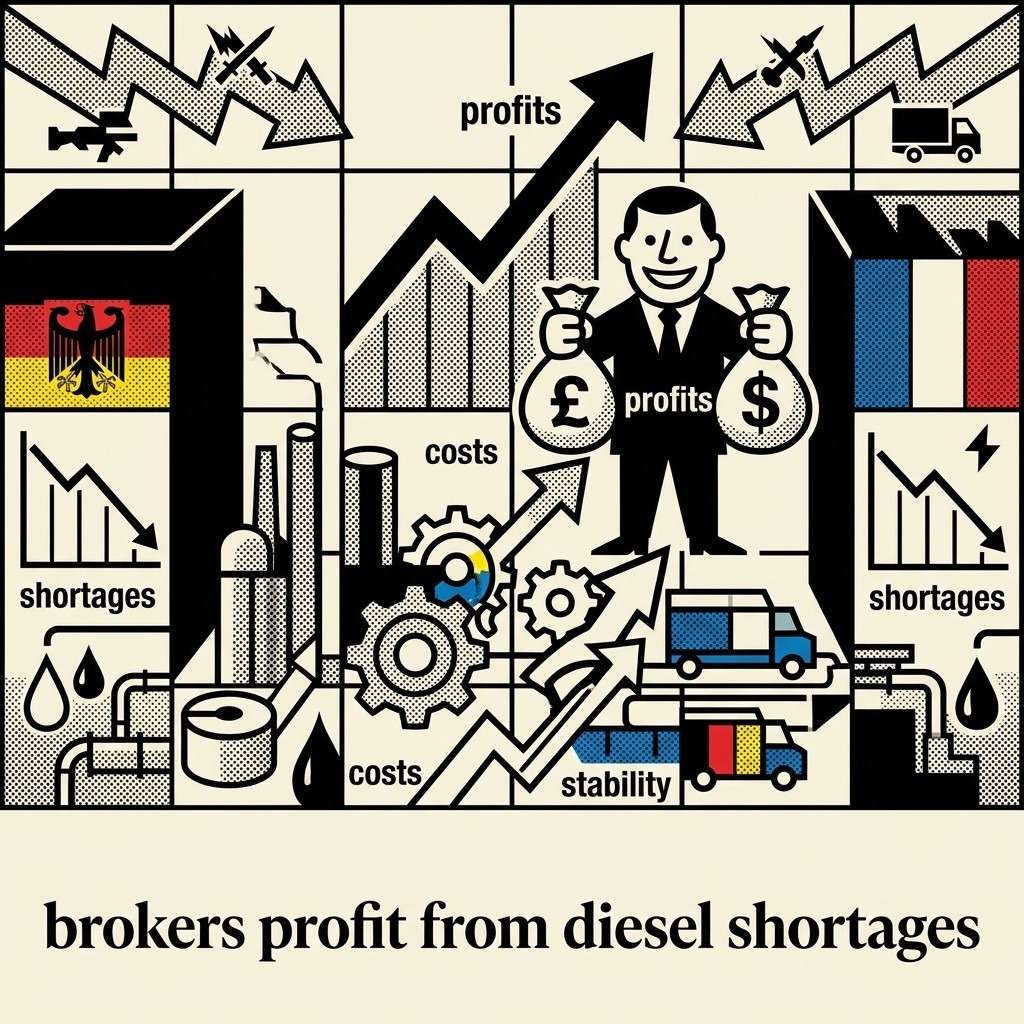
Diesel Shortages in Germany and France Boost Broker Profits

Evening Analysis • Thursday, September 17, 2026

The Gist View

Refiners in Germany and France facing diesel shortages after a Saudi pipeline attack are effectively funding the record windfalls of international energy brokers. As physical borders harden globally, moving restricted goods is no longer a low-margin logistical task, but a highly prized geopolitical service.

Trading houses capitalize on this friction because every blocked route raises the barrier to entry, locking out competitors. Consumers absorb these shocks as a regressive tax, paying a steep premium to keep domestic industry online. Yet these middlemen prevent total market failure during crises; their outsized profits accurately price the operational risk of underwriting wartime logistics. Western governments face a stark trade-off: securing strategic autonomy means abandoning the era of cheap, frictionless imports.

When Egypt closed the Suez Canal for six months in 1956, transit times around Africa doubled, instantly transferring global pricing power from state producers to the independent merchants who controlled the active tanker fleets (Oxford Institute for Energy Studies).

The Gist AI Editor

The Global Overview

Commodity Traders Profit in Geopolitical Friction

Global commodities brokers and energy traders are securing record profits as geopolitical conflicts disrupt traditional global supply routes (WSJ). Following a Saudi pipeline attack, European refiners face potential diesel shortages that threaten to increase costs for haulers, businesses, and consumers (Euronews). The structural fragmentation of global trade has created a lucrative arbitrage market, rewarding intermediary commodity traders who navigate this resulting supply chain chaos.

Physical Constraints on Artificial Intelligence

Scotland halted approvals for new hyperscale data centers—massive computing facilities designed to flexibly scale up to meet immense cloud and artificial intelligence workloads—over environmental concerns, impacting more than 20 proposed facilities including a major project in Fife. This regulatory block on physical infrastructure directly collides with hardware projections. Huawei Technologies predicts global computing demand will surge 100,000-fold by 2035, driven primarily by AI agents. Concurrently, Nvidia CEO Jensen Huang’s plea to King Charles III to regulate AI products rather than the underlying technology (Politico) echoes developers’ efforts to steer Western states away from foundational model bans that would cripple innovation.

NASA’s Space Shuttle at 50

On September 17, 1976, NASA unveiled OV-101, the first space shuttle orbiter. The vehicle was named ‘Enterprise’ following a successful 100,000-letter write-in campaign by Star Trek fans, altering the agency’s original plan to name it ‘Constitution’.

Stay tuned for the next Gist—your edge in a shifting world. The Gist remains independent and reader-supported. If you value news free from corporate or state interests, consider supporting our mission with a donation.

The European Perspective

The EU’s Sovereign Supply Chain Push

Europe recognizes its strategic autonomy must be physically built via secure supply chains. The European Space Agency (ESA), an intergovernmental organization for space exploration, selected a consortium led by Iceye Oy—a Finnish microsatellite manufacturer specializing in synthetic-aperture radar for Earth observation—to design a sovereign service. Tying space sovereignty to raw material extraction reveals Europe’s autonomy relies on allied resources, exposing the physical limits of autarky. To secure inputs, European Investment Bank (EIB) chief Nadia Calviño visited Ottawa to fund critical minerals projects, while EU Trade Commissioner Maroš Šefčovič heads to Beijing on October 8–9 to negotiate rare earth curbs (Bloomberg). State-directed efforts to build sovereign capabilities often yield non-competitive monopolies that lag free-market enterprise.

Canadian Trade Autonomy in Europe

In Strasbourg on September 17, Canadian PM Mark Carney declared Canada refuses to let anyone “dictate our culture, or with whom we can strike agreements” (Politico). Both moves reflect a structural realignment where middle-tier democratic powers bypass traditional superpowers to directly integrate industrial and resource bases against future trade shocks.

EU Kids Act Rollout

On September 17, Ursula von der Leyen and Henna Virkkunen presented the ‘Kids Act’ regulation for internet child protection (Euronews).

Catch the next Gist for the continent’s moving pieces.

🎙️ Listen to this edition as a podcast Listen

The Gist is an independent daily digest: AI-curated, human-directed, unapologetically liberal (how it’s made). Hundreds of sources, only what matters. Subscribe free or listen to the podcast.


Comments

Leave a Reply

Your email address will not be published. Required fields are marked *

This site uses Akismet to reduce spam. Learn how your comment data is processed.