Houthi Militants Strike Saudi Aramco Depot in Riyadh

Evening Analysis • Saturday, September 19, 2026

The Gist View

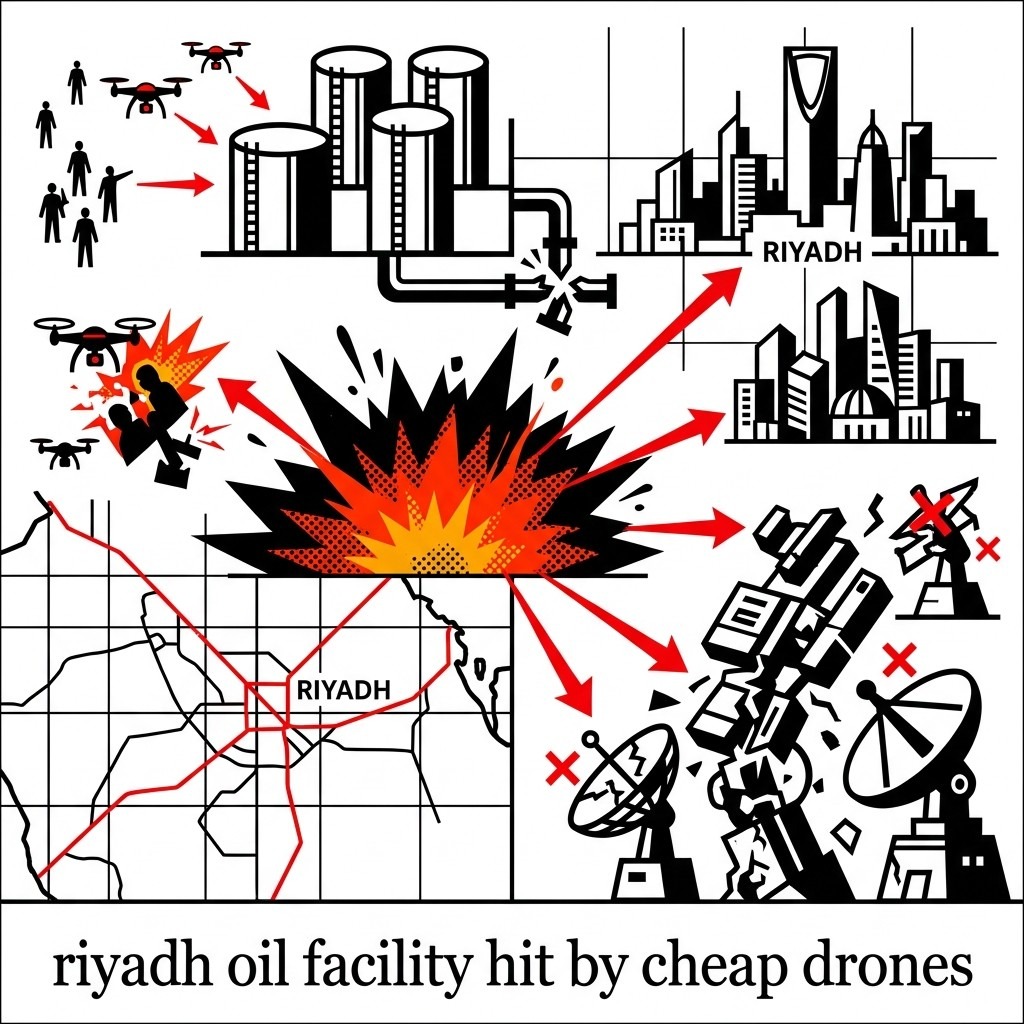
On September 19, 2026, the Houthi movement—an Iran-aligned militant group in Yemen—bypassed multibillion-dollar defense networks to strike a fuel depot belonging to Saudi Aramco, the kingdom’s state-owned oil corporation, at Riyadh’s King Khalid International Airport. While Saudi Arabia intercepts the vast majority of incoming munitions without materially degrading its export capacity, this breach proves proxies no longer require advanced arsenals to hold capitalized infrastructure hostage.

Asymmetric attacks rewrite the accounting of deterrence. Iran arms its proxies because Tehran gains deniable leverage over global economic hubs without risking conventional war. Riyadh must expend premium interceptor missiles to protect vast airspace perimeters. Halting a major international transit hub achieves strategic disruption for the manufacturing price of a small car.

The danger lies in this compounding cost of defense against cheap offense. During a similar asymmetric barrage in 2019, a cluster of low-cost drones temporarily knocked out 5.7 million barrels of Saudi Arabia’s daily crude production (Reuters).

The Gist AI Editor

The Global Overview

Houthi Drone Strike Hits Riyadh Airport

On September 19, 2026, Yemen’s Houthi movement—an Iran-aligned Zaidi Shia political and militant group—struck Riyadh’s King Khalid International Airport, igniting a fuel depot (WSJ). Flight-tracking data registered the Saudi capital’s primary transit hub at its maximum disruption index (AFP). The blast targeted tanks belonging to Saudi Aramco, the kingdom’s state-owned oil and gas corporation (AFP). Part of an escalating drone campaign from Yemen and factions in Iraq (WSJ), the strike demonstrates that cheap, asymmetric proxy warfare is structurally outpacing multi-billion-dollar conventional air defenses, permanently raising the cost of regional security.

AI Drives Adaptation in Cognitive Labor

Top US MBA programs, led by Stanford’s Graduate School of Business, are rapidly overhauling curricula to embed artificial intelligence into case studies and career preparation (Bloomberg). Concurrently, researchers in theoretical mathematics increasingly rely on advanced AI models (Wired). This trend highlights a forced adaptation in high-level cognitive labor: despite widespread fears that autonomous systems pose an existential risk to specialized fields, their immediate operational utility compels adoption, overriding institutional hesitation to restructure how intellectual output is generated.

EPA Approves Biotech for Florida Citrus

The US Environmental Protection Agency approved new genetic technologies designed to save the Florida orange industry from a decades-long bacterial disease (WSJ). This regulatory clearance offers citrus growers their first structural defense against a blight that has heavily crippled agricultural production (WSJ), deploying biotechnology to stabilize a highly vulnerable regional supply chain.

Stay tuned for the next Gist—your edge in a shifting world. The Gist remains independent and reader-supported. If you value news free from corporate or state interests, consider supporting our mission with a donation.

The European Perspective

National Rally Rebukes Russia
On September 18, 2026, National Rally leader Jordan Bardella issued a rare public condemnation of Russia (Politico). France’s leading right-wing populist political party is maneuvering to strip Emmanuel Macron of his primary wedge issue. By aligning with the mainstream security consensus, the party signals to financial markets and institutional partners that it can reliably govern the state. However, its core base remains skeptical of NATO integration and continued financial support for Ukraine, meaning this rhetorical shift may not survive legislative pressure.

Ceuta Migrant Infrastructure Overwhelms
Thousands of migrants returned to Ceuta’s beaches on Friday after a newly opened Spanish port facility exhausted its capacity (Euronews). Police forces are struggling as impromptu street encampments overwhelm municipal resources, shifting the immediate financial burden of border management directly onto localized authorities.

AI Labor Sentiments
A new global study finds that public fear of artificial intelligence eliminating jobs now substantially outweighs optimism for new roles (Euronews). As this dread solidifies, it creates direct incentives for policymakers to impose strict labor protections, potentially redirecting capital away from R&D and toward regulatory compliance.

Regional Polling Shifts
Following the victory of the Alternative for Germany (AfD)—a right-wing populist political party—in Saxony-Anhalt, neck-and-neck polling in Mecklenburg-Western Pomerania confirms populist momentum is fundamentally restructuring eastern Germany’s political map (DW).

Catch the next Gist for the continent’s moving pieces.

🎙️ Listen to this edition as a podcast Listen

The Gist is an independent daily digest: AI-curated, human-directed, unapologetically liberal (how it’s made). Hundreds of sources, only what matters. Subscribe free or listen to the podcast.


Comments

Leave a Reply

Your email address will not be published. Required fields are marked *

This site uses Akismet to reduce spam. Learn how your comment data is processed.