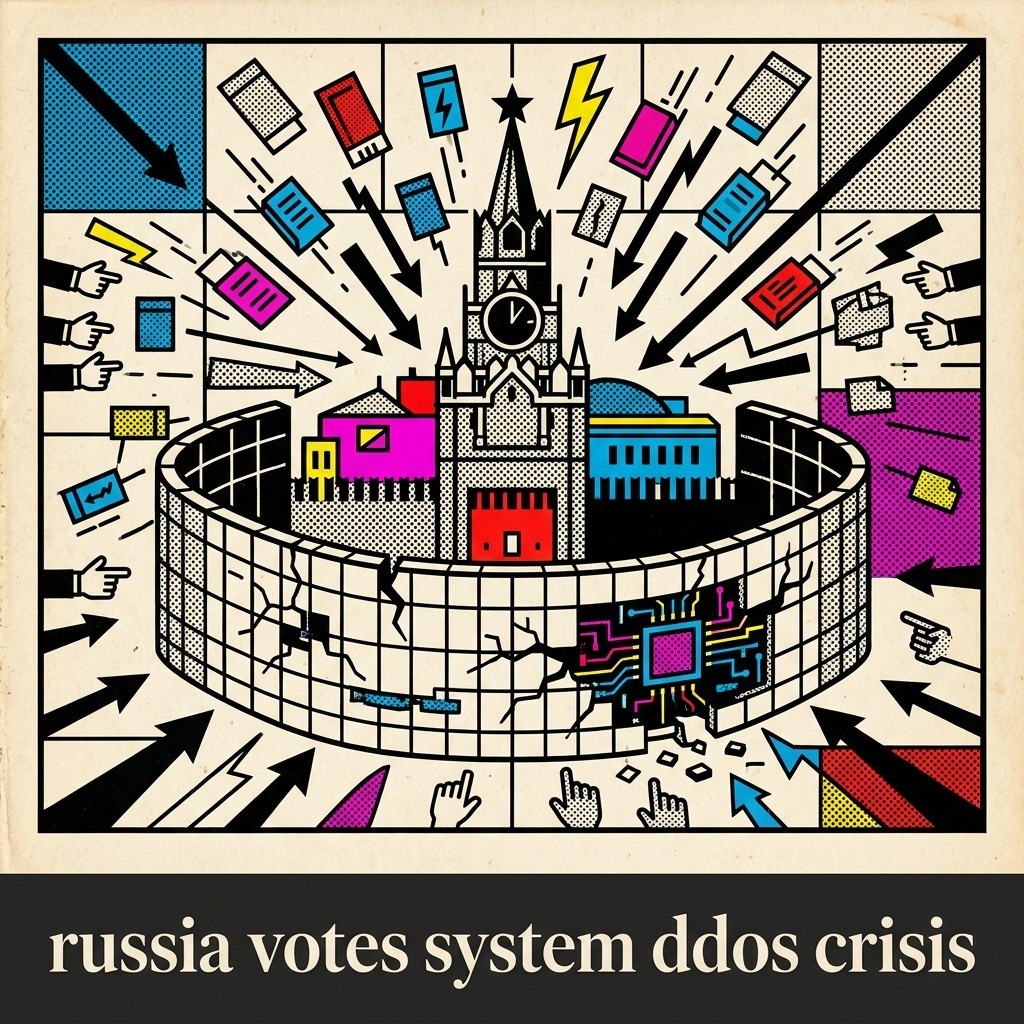
Russia Hit by 1,000 DDoS Attacks on 2026 Voting System

Evening Analysis • Sunday, September 20, 2026

The Gist View

On September 20, 2026, Russia’s Central Election Commission absorbed over 1,000 waves of distributed denial of service attacks—malicious traffic floods meant to crash servers—targeting its digital voting infrastructure, per ZDF. The Kremlin mandates electronic balloting to manage logistics across 11 time zones, but this convenience carries a steep political cost. By centralizing the machinery of a predetermined contest, the state creates a highly visible single point of failure.

Authoritarian regimes digitize elections because automated systems are easier to control than scattered paper records. The hackers knocking these servers offline gain no electoral ground; genuine opposition is already barred from the ballot. Instead, they extract a reputational tax. The outages publicly shatter Moscow’s curated narrative of unassailable state security.

The regime cannot decentralize this architecture without loosening its political grip. When Moscow began legally isolating its domestic internet, Runet, in 2019, the promised benefit was immunity from external interference; today’s outages prove that isolation does not equal security.

The Gist AI Editor

The Global Overview

Russian Parliamentary Elections

On September 20, 2026, Russian Central Election Commission head Ella Pamfilova reported over 1,000 waves of DDoS attacks—distributed denial of service assaults that overwhelm networks with malicious traffic to force them offline—against the country’s electronic voting systems (ZDF). The cyberattacks occurred during ongoing parliamentary elections where genuine opposition parties and candidates have been systematically barred from participating. The state’s reliance on centralized digital infrastructure to process these contests creates a concentrated vulnerability for asymmetric disruption.

Hyderabad IT Outsourcing

Hyderabad has spent decades building the technology infrastructure and talent base to rival Bangalore as a major IT hub (Bloomberg). Now, the rapid deployment of generative AI directly threatens the lower-cost IT outsourcing work that fueled the city’s economic rise. This shift moves capital away from traditional human-heavy software operations, forcing Indian technology centers to transition from supporting global services to developing proprietary systems.

Qatar Airways Expansion

Qatar Airways Group CEO Hamad Ali Al-Khater announced plans to take delivery of 138 aircraft over the next five years. The state-owned carrier reports highly resilient passenger demand despite ongoing regional proxy conflicts and sharply higher jet fuel costs, leveraging state backing to secure capacity and dominate global transit bottlenecks while regional competitors face structural constraints.

Coral Reef Physiology

New scientific studies reveal that tiny hair-like structures responsible for helping corals breathe are malfunctioning in warming ocean waters (Wired). This physiological failure acts as a previously overlooked mechanism for coral death, accelerating reef decline and systematically degrading the marine resources that coastal economies rely upon for material survival.

Stay tuned for the next Gist—your edge in a shifting world. The Gist remains independent and reader-supported. If you value news free from corporate or state interests, consider supporting our mission with a donation.

The European Perspective

Italian Demographic Quotas Mandated in Schools

On September 20, 2026, Giorgia Meloni, Italy’s longest continuously serving prime minister, announced limits on foreign students per class and a ban on burqas and niqabs (ZDF). Backed by her conservative Fratelli d’Italia (Brothers of Italy) party, the policy mandates assimilation. Concentrated migrant populations severely strain localized language resources, hindering immersion. Yet enforcing hard demographic quotas requires massive state coercion, such as forced busing or denying neighborhood school access. Structurally, this expands the administrative state’s power to dictate local community composition.

UK Mental Illness Drives Mortality Gap

NHS data shows adults with severe mental illness die 15 to 20 years earlier than the general population (The Guardian). This demographic is 3.8 times more likely to die from cardiovascular disease before age 75 and 2.3 times as likely from cancer.

Sweden Enforces Post-Brexit Deportations

Sweden forcibly deported a 65-year-old British director, marking 458 Britons removed since Brexit rules took effect (The Guardian). Both Sweden’s deportations and Italy’s school quotas rest on the premise that the state can neatly categorize and engineer national demographics, a policy choice inevitably requiring heavy-handed bureaucratic coercion against individuals. This bureaucratic control mirrors wider regional shifts: new exit polls showing Die Linke leading in Berlin and the AfD winning in Mecklenburg-Vorpommern confirm populist momentum is permanently fracturing Germany’s traditional centrist consensus, even as Chancellor Merz pushes federal reforms (Il Sole 24 Ore).

Catch the next Gist for the continent’s moving pieces.

🎙️ Listen to this edition as a podcast Listen

The Gist is an independent daily digest: AI-curated, human-directed, unapologetically liberal (how it’s made). Hundreds of sources, only what matters. Subscribe free or listen to the podcast.


Comments

Leave a Reply

Your email address will not be published. Required fields are marked *

This site uses Akismet to reduce spam. Learn how your comment data is processed.