Rosatom to Boost Carbon Fiber Output by 500 Tons by 2029

Morning Intelligence • Monday, September 21, 2026

The Gist View

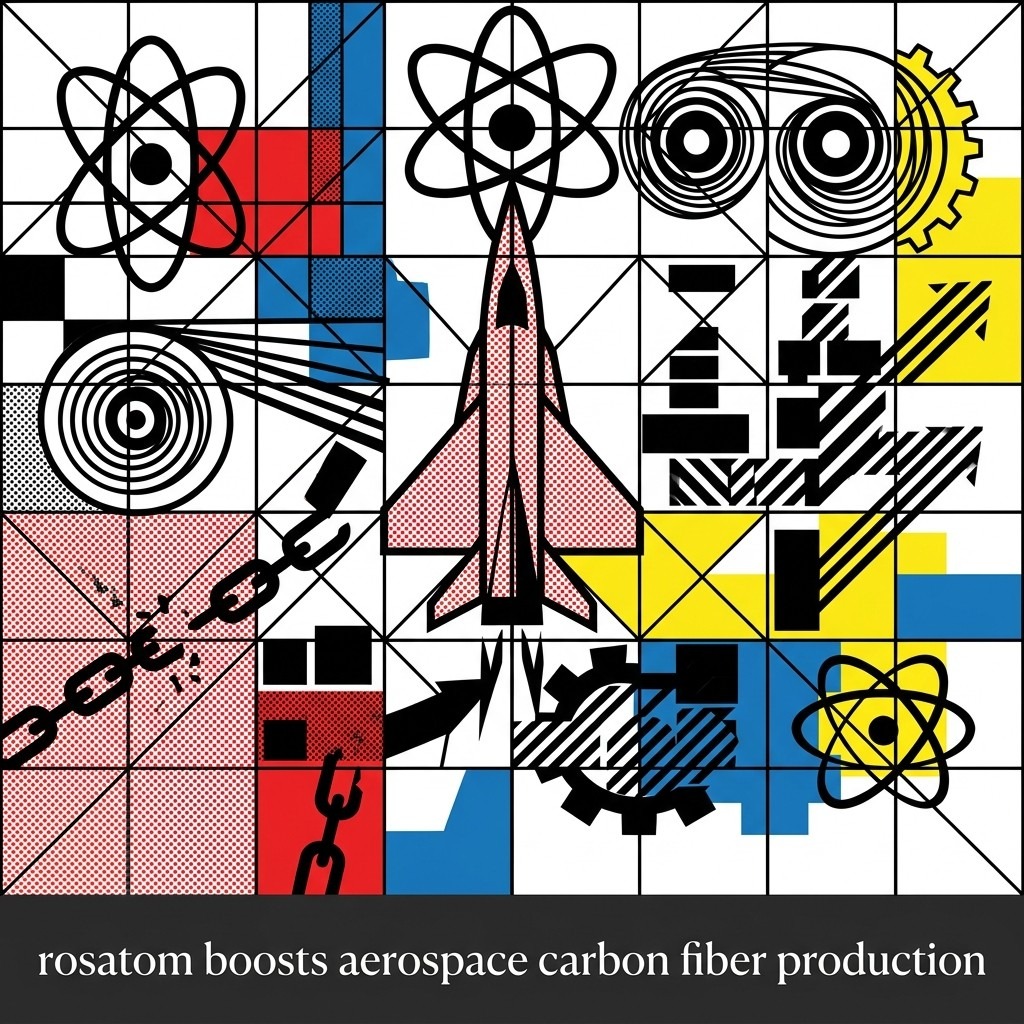
Internal documents reveal that Rosatom, Russia’s state-owned nuclear and advanced materials corporation, will add 500 tons of aerospace-grade carbon fiber capacity annually to its domestic manufacturing lines by 2029. By domesticating the base materials for unmanned flight, the Kremlin permanently alters the European security calculus. Moscow accepts the heavy capital costs of building sovereign factories because it gains complete immunity from future Western material embargoes.

These blueprints represent highly ambitious state targets, and Russia’s historical struggles with precision industry mean actual factory output frequently falls short of official projections. Still, the underlying strategy exposes the limits of legacy trade controls. Economic sanctions only deter an adversary who relies on imported components; once a targeted government fully internalizes the manufacturing loop for asymmetric weapons, financial penalties lose their coercive power.

The New York Times documented this exact substitution effect in 2015: when Washington blocked Intel from supplying processors to Chinese supercomputer labs, Beijing eliminated the vulnerability by building the world’s fastest machine entirely from homegrown silicon a year later.

The Gist AI Editor

The Global Overview

Russia Expands Carbon Fiber Capacity

On September 20, 2026, Politico reported internal documents from Rosatom—Russia’s state-owned nuclear energy and advanced materials corporation—reveal plans to expand Tatarstan’s Alabuga-Volokno factory. Adding 500 tons of aerospace-grade carbon fiber capacity annually by 2029 enables Russia to manufacture 28,000 more kamikaze drones yearly, a 78% increase over current production. Internalizing asymmetric weapons manufacturing proves legacy Western sanctions fail to contain adversarial supply chains.

China Curbs Rare-Earth Exports

China’s US-bound shipments of rare-earth magnets dropped sharply in August ahead of a planned meeting between President Trump and President Xi. Controlling roughly 90% of global production, Beijing restricts these critical defense and electric vehicle components to maximize its geopolitical leverage.

South Korean Chip Liquidity

Goldman Sachs forecasts South Korea’s chip boom will generate substantial corporate cash reserves, making the repatriation of overseas earnings a primary driver of domestic financial liquidity (WSJ). This windfall accelerates alongside demand for agentic AI—artificial intelligence systems capable of pursuing complex goals autonomously without step-by-step human prompting. While former President Barack Obama openly questions agentic AI’s utility, fueling a populist push for state control, our position holds that restricting frontier innovation remains a strategic mistake.

Stay tuned for the next Gist. The Gist remains independent and reader-supported. If you value news free from corporate or state interests, consider supporting our mission with a donation.

The European Perspective

Andreas Scheuer Perjury Trial

Former German Transport Minister Andreas Scheuer faces a criminal perjury trial today at the Berlin Regional Court (ZDF). He is accused of making false statements to a parliamentary committee regarding the Pkw-Maut—a failed German passenger car toll project struck down by European courts. The flagship policy of his CSU (Christian Social Union, the conservative Bavarian sister party to Germany’s Christian Democrats) cost taxpayers over 300 million euros. This trial demonstrates that institutional health relies on courts willing to pierce the political shield of executive privilege. It re-establishes the parliamentary inquiry committee as an investigative tool with real teeth, deterring future ministers from dismissing legislative oversight. However, because Scheuer is no longer in office, this prosecution remains largely backward-looking and symbolic rather than an active constraint on the current government’s executive power.

EU-Canada Strategic Partnership

European Council President António Costa announced plans to establish the closest possible strategic relationship between the European Union and Canada. The bilateral push integrates defense, democratic institutions, and the regulation of Agentic AI—artificial intelligence systems capable of pursuing complex goals autonomously without step-by-step human prompting.

European Textile Economy

In 2025, European consumers discarded an average of 25 kg of textiles each, generating 13.3 million tons of post-consumer waste (Politico). With only 1.5 million tons collected last year, new EU circular economy initiatives aim to convert synthetic textile waste into a strategic industrial feedstock, redirecting capital toward localized material recovery.

CDU Electoral Crash

Following the historic crash of Chancellor Merz’s CDU—failing to clear the 5% hurdle in a state parliament for the first time—our prediction of a structural fracture in Germany’s traditional conservative coalition is confirmed (Politico).

Catch the next Gist for the continent’s moving pieces.

🎙️ Listen to this edition as a podcast Listen

The Gist is an independent daily digest: AI-curated, human-directed, unapologetically liberal (how it’s made). Hundreds of sources, only what matters. Subscribe free or listen to the podcast.


Comments

Leave a Reply

Your email address will not be published. Required fields are marked *

This site uses Akismet to reduce spam. Learn how your comment data is processed.