CDC Workforce Cut by One-Third Under Kennedy Jr. Leadership

Evening Analysis • Saturday, September 26, 2026

The Gist View

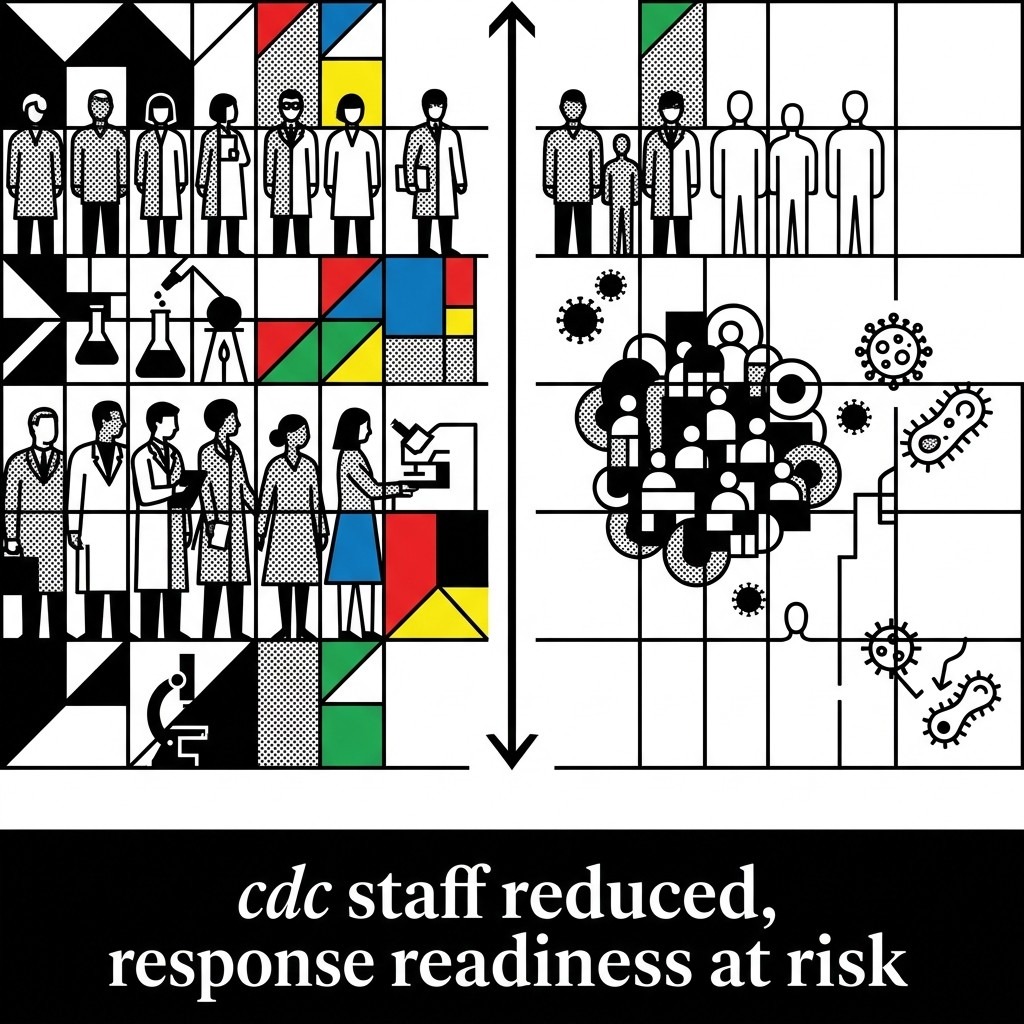
The Centers for Disease Control and Prevention, the national public health agency of the United States, has lost nearly one-third of its total staff—including 50% at its chronic disease centers—under Health Secretary Robert F. Kennedy Jr., reports the New York Times. Bureaucratic health departments often suffer from mission creep, making political disruption a rational check on administrative overreach.

But political appointees purge specialized science desks because they gain immediate partisan compliance, treating the decay of long-term crisis readiness as an acceptable casualty. This trade-off strips the government of its capacity to identify and suppress novel pathogens. Institutional memory vanishes quickly, and loyalists cannot instantly replace career epidemiologists when an outbreak hits.

State defense against biological threats relies on accumulated scientific capital, not just funding. The Institute of Medicine concluded that sidelining federal researchers during the early 1980s HIV epidemic cost vital months of initial containment; deliberately hollowing out the CDC guarantees a similar penalty today.

The Gist AI Editor

The Global Overview

CDC Staff Exodus Under Political Consolidation

The Centers for Disease Control and Prevention (CDC), the national public health agency of the United States, has lost nearly one-third of its total staff, including 50% of personnel at its chronic disease centers (NYT). Health Secretary Robert F. Kennedy Jr. and his associates have consolidated political control over the agency, resulting in a total loss of scientific independence. Subordinating a specialized public health agency to ideological control hollows out the state’s technical capacity. Replacing scientific independence with partisan obedience secures immediate alignment but deliberately degrades the institutional machinery required for future crisis readiness.

US AI Build-Out Absorbs $10.3 Trillion

The US artificial intelligence infrastructure build-out is projected to attract $10.3 trillion in capital investment between 2025 and 2032 (WSJ). Averaging 3.6% of US GDP annually, this data center expansion is being described by market analysts as the largest economic bet in American history. This unprecedented structural shift directs private capital away from traditional sectors to secure dominant industrial hardware pipelines.

US Rejects Iran’s Strait Reopening Offer

President Trump rejected Tehran’s latest offer to reopen the Strait of Hormuz, calling it an act of desperation (Politico). This confirms our expectation that the US would maintain maximum pressure despite the global energy squeeze. By refusing concessions, the administration accepts sustained supply chain disruptions as a strategic cost to deny geopolitical leverage to regional adversaries.

Join us tomorrow for the next Gist—your edge in a shifting world. The Gist remains independent and reader-supported. If you value news free from corporate or state interests, consider supporting our mission with a donation.

The European Perspective

French Cognac Industry Collapses Amid EU Trade Wars

French Cognac producers are suffering significant sales declines directly tied to escalating trade disputes between the EU, China, and the US (Euronews). The financial squeeze exposes the domestic cost of EU industrial protectionism: state-led trade wars invariably invite retaliatory tariffs that punish unrelated, export-dependent sectors. By pushing agricultural growers to demand EU financial support, the original intervention of trade protectionism is now successfully creating the political demand for further state subsidies. The long-term strategic value of defending foundational European tech and manufacturing industries may ultimately outweigh the localized economic pain inflicted on luxury agricultural exports.

UK Plug-in Hybrid Infrastructure Failure

An analysis of the UK market reveals that 74% of the top 20 best-selling plug-in hybrid electric vehicles (PHEVs)—a car equipped with both an internal combustion engine and a battery that can be charged from an external power source—cannot use rapid chargers of 50kW or more (The Guardian). The widespread incompatibility leaves the majority of subsidized PHEVs functionally reliant on their internal combustion engines for long-distance travel.

Munich Migration Meeting and EU Asylum Policy

German Federal Interior Minister Alexander Dobrindt hosted a ‘Munich Migration Meeting’ with 17 European interior ministers to advocate for stricter EU asylum enforcement (ZDF). EU Migration Commissioner Magnus Brunner announced at the summit that illegal migration into the bloc has dropped by 55%.

Catch the next Gist for the continent’s moving pieces.

🎙️ Listen to this edition as a podcast Listen

The Gist is an independent daily digest: AI-curated, human-directed, unapologetically liberal (how it’s made). Hundreds of sources, only what matters. Subscribe free or listen to the podcast.


Comments

Leave a Reply

Your email address will not be published. Required fields are marked *

This site uses Akismet to reduce spam. Learn how your comment data is processed.