Secondhand VLCCs Hit $150M Amid Market Demand Surge

Morning Intelligence • Sunday, September 27, 2026

The Gist View

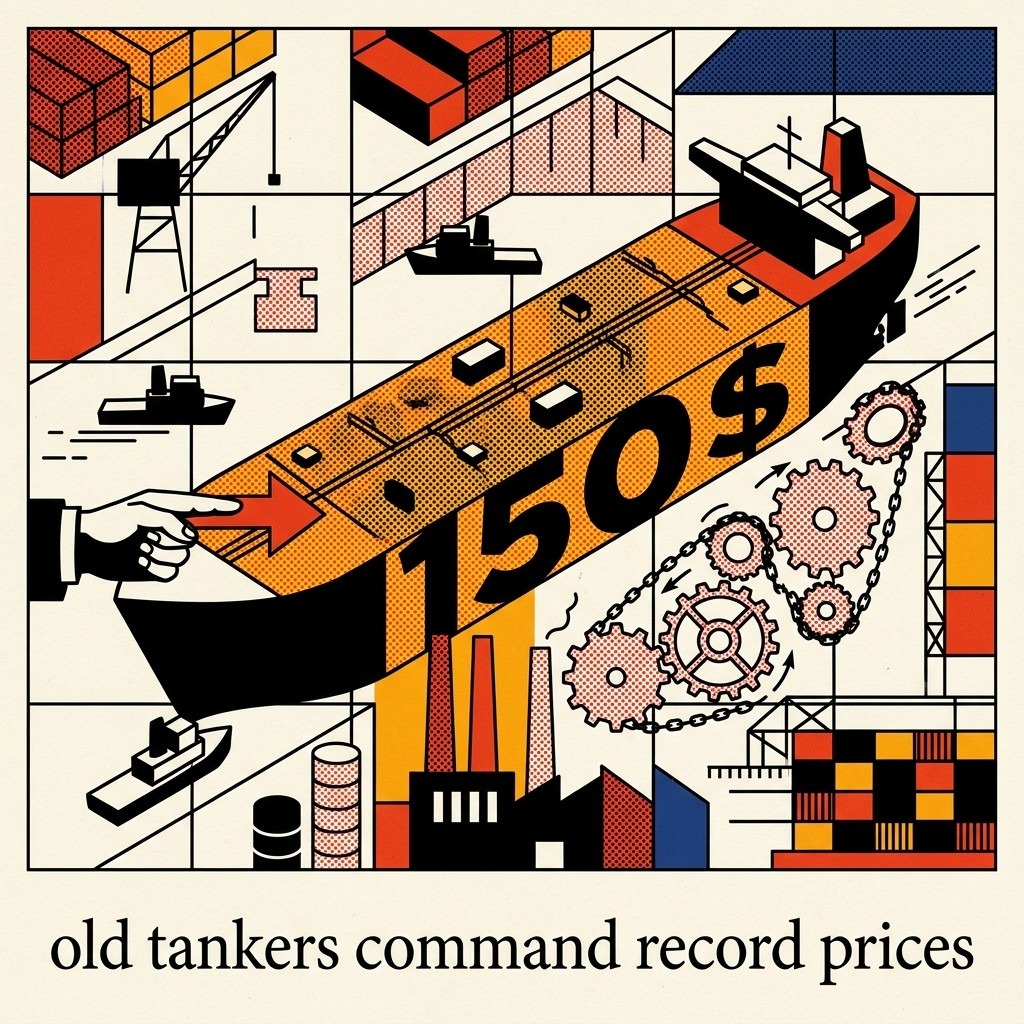
In late September 2026, secondhand Very Large Crude Carriers (VLCCs)—supertankers moving two million barrels of oil—began clearing $150 million at auction, eclipsing the $135 million average to commission a new build. This shatters the basic laws of asset depreciation. Shipping operators overpay for aging steel because they gain immediate access to a starved market, capturing Middle East-to-Asia freight payouts that have spiked to $1.2 million a day.

While this price inversion could simply be a temporary cyclical squeeze driven by short-term regional shortages, the sheer size of the premium suggests a darker shift. Maritime capital is no longer underwriting future trade capacity; it is desperately panic-buying existing assets just to survive the immediate geopolitical gridlock.

A standard VLCC operates for roughly 20 years. Committing $150 million to a half-depreciated hull, as reported by the Financial Times, means buyers expect today’s supply chain bottlenecks to outlast the vessels themselves.

The Gist AI Editor

The Global Overview

Very Large Crude Carriers

In late September 2026, five- and ten-year-old Very Large Crude Carriers (VLCCs)—2-million-barrel supertankers—sell for $150 million, exceeding the $135 million new-build average (FT). As Middle East-to-Asia freight hits $1.2 million daily, vessel age has remarkably little bearing on prices. When immediate delivery carries a $15 million premium over a decade of lifespan, markets price in structural supply chain chaos, laying bare the compounding economic damage of the protracted stalemate over the Strait of Hormuz.

Tata Sons

On September 11, 2026, the Reserve Bank of India (RBI), the nation’s central bank, rejected Tata Sons’ bid to surrender its core investment registration (WSJ). Forcing a public listing onto the Tata Group’s principal investment holding company sparked internal infighting. Chairman Noel Tata opposes the IPO to protect the historical ownership structure that controls 66% of the $350 billion conglomerate, as regulators force standardized market oversight onto legacy private empires.

North Korea

Kim Jong Un’s regime is testing swarm attacks combining drones and missiles (WSJ). The new doctrine incorporates tactics that have proven successful in overwhelming Western air defenses in European and Middle Eastern theaters, forcing regional adversaries to fund continuous upgrades to asymmetric defense architectures.

Join us for the next edition. The Gist remains independent and reader-supported. If you value news free from corporate or state interests, consider supporting our mission with a donation.

The European Perspective

Urbagestión Eviction Triggers Madrid Protests

On September 23, 2026, 87-year-old Maricarmen Abascal was evicted in Madrid after investment fund Urbagestión acquired her building and raised her rent by 275% to €2,650 per month (The Guardian). The displacement provoked up to 25,000 protesters demanding state intervention against private capital (France 24). Vilifying private funds obscures the root of Spain’s housing crisis. The 275% hike is the mathematical correction that occurs when decades of artificially suppressed legacy rents meet a severely supply-starved capital. While investment funds exploit regulatory gaps to deliberately flip legacy housing into short-term rentals—maximizing immediate yield at the direct expense of community stability—the Bank of Spain estimates a national deficit of 550,000 to 700,000 homes, with public housing comprising less than 2% of the total stock (Drooid). This structural supply deficit makes brutal market corrections inevitable.

Wadephul Meets Lavrov at UN General Assembly

On September 26, 2026, Johann Wadephul, Germany’s Federal Minister for Foreign Affairs, held a 20-minute bilateral meeting with Russian Foreign Minister Sergey Lavrov in New York (ZDF). Marking the first bilateral summit between the nations’ top diplomats since the 2022 invasion of Ukraine, Wadephul urged Moscow to abandon its “dangerous path of escalation.” This engagement tests pragmatic direct communication lines to manage entrenched geopolitical gridlock.

Catch the next Gist for the continent’s moving pieces.

🎙️ Listen to this edition as a podcast Listen

The Gist is an independent daily digest: AI-curated, human-directed, unapologetically liberal (how it’s made). Hundreds of sources, only what matters. Subscribe free or listen to the podcast.


Comments

Leave a Reply

Your email address will not be published. Required fields are marked *

This site uses Akismet to reduce spam. Learn how your comment data is processed.