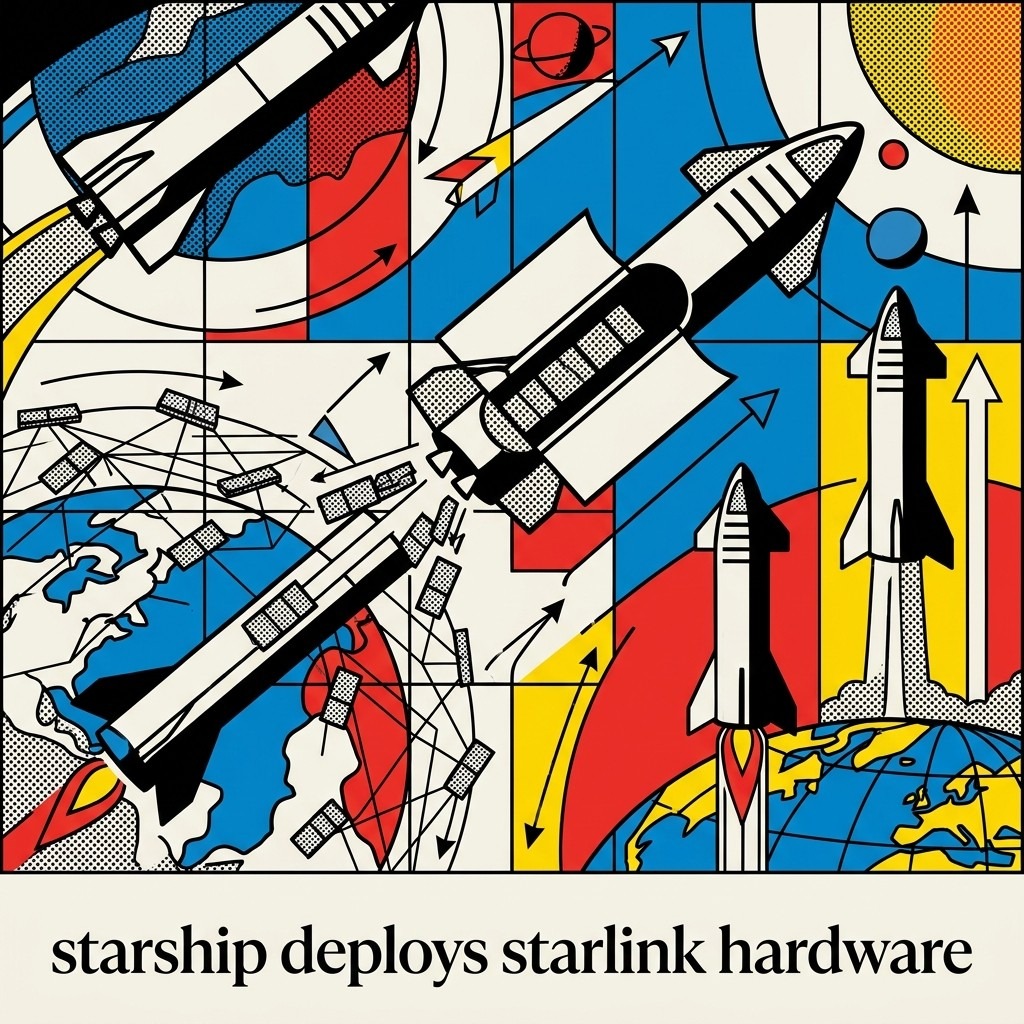
SpaceX’s 14th Starship Test Targets Starlink Deployment

Morning Intelligence • Monday, September 28, 2026

The Gist View

On September 28, 2026, Elon Musk’s SpaceX will launch its 14th Starship test flight, aiming for a 275 km orbital deployment of next-generation hardware for Starlink, its global broadband satellite internet constellation.

Commercial telecom operators face a brutal incentive trap: to deploy their own networks, they must purchase heavy-lift space access from their biggest competitor. SpaceX sustains immense private capital burn to cement this vertical integration, knowing that whoever owns the transport dictates the broader industry. Yet this infrastructure dominance rests on a massive operational risk, as the full rapid reusability of the Super Heavy booster remains an unproven economic premise at commercial turnaround speeds.

Heavy-lift launch costs to low Earth orbit have dropped by roughly 95% since the Space Shuttle era, permanently transferring orbital leverage from sovereign governments to a private firm in Texas (NASA).

The Gist AI Editor

The Global Overview

SpaceX Starship
SpaceX scheduled its 14th Starship test flight for September 28, 2026, targeting a fully orbital mission at a 275 km altitude (CNBC). The 10-hour flight deploys 26 satellites for Starlink, SpaceX’s satellite internet constellation that provides global broadband coverage. Operating roughly 11,000 active satellites, Starlink remains the aerospace manufacturer’s largest and only profitable business segment (AFP). By executing deployment at this scale, Starship transitions from an experimental testbed into a working commercial freight vehicle, effectively cementing a private monopoly over orbital infrastructure and heavy-lift space access.

Global Monetary Policy and Gold
Gold prices fell in late September 2026 as strong US industrial data and higher oil prices reinforced expectations of prolonged tight Federal Reserve monetary policy (WSJ). ANZ analysts note that persistent inflation metrics directly curb the appeal of non-yielding assets. Because gold generates no interest income, investors are shifting capital away from the metal and toward yield-bearing instruments that benefit from sustained high interest rates.

Climate Adaptation in Agriculture
Structurally rising global coffee prices are driving a surge in Japanese demand for substitutes like brown rice decaf (The Straits Times). This substitution highlights a permanent supply chain vulnerability: climate change is projected to eliminate half of the global land area suitable for major coffee varieties by 2050. In response, agricultural capital is migrating toward climate-resilient crop alternatives to secure future supply lines.

Stay tuned for the next Gist—your edge in a shifting world. The Gist remains independent and reader-supported. If you value news free from corporate or state interests, consider supporting our mission with a donation.

The European Perspective

EU Accession Target Dates

The European Commission is drafting a September 2026 initiative setting formal target dates for Ukraine, Moldova, Albania, and Montenegro to complete accession stages (Politico). Replacing a conditions-based process with timeline-driven expansion forces the EU to absorb massive agricultural and security liabilities prematurely. Deadlines strip Brussels of its primary leverage—strategic ambiguity—incentivizing candidates to demand political integration before fully aligning with single-market economic standards. Still, without credible accession timelines, the EU risks losing critical buffer states like Ukraine and Moldova to Russian influence, a far greater existential threat than internal institutional friction.

EPP 2029 Platform

Manfred Weber, leader of the European People’s Party (EPP)—the dominant center-right political group in the European Parliament—launched a task force in September 2026 to draft the bloc’s 2029 platform (Politico). Internal debates center on whether the group should maintain a centrist coalition or shift further right to co-opt rising populist factions.

Catholic Church Accountability

Pope Leo XIV visited Lourdes on September 27, 2026, to meet with victims of sexual violence, explicitly acknowledging the systemic character of abuse within the Church (Le Monde). Victim advocacy groups now demand concrete institutional reforms over mere awareness.

UK Electric Vehicle Tariffs

UK Business Secretary Jonathan Reynolds stated on September 27, 2026, that Chinese EV tariffs are being kept ‘under review’ (Politico). The EU is pressuring Britain to align with its anti-subsidy duties of up to 35.3% to avoid becoming a backdoor into the single market. The UK seeks inclusion in the Buy European program—an EU industrial initiative designed to favor domestic manufacturing in subsidies and public procurement. The UK’s admission confirms our expectation that Brussels would successfully use single-market access to pull neighboring states into its protectionist industrial orbit.

Catch the next Gist for the continent’s moving pieces.

🎙️ Listen to this edition as a podcast Listen

The Gist is an independent daily digest: AI-curated, human-directed, unapologetically liberal (how it’s made). Hundreds of sources, only what matters. Subscribe free or listen to the podcast.


Comments

Leave a Reply

Your email address will not be published. Required fields are marked *

This site uses Akismet to reduce spam. Learn how your comment data is processed.