Citizen Lab Uncovers Discover-Tech Spyware on Al Jazeera

Evening Analysis • Thursday, October 15, 2026

The Gist View

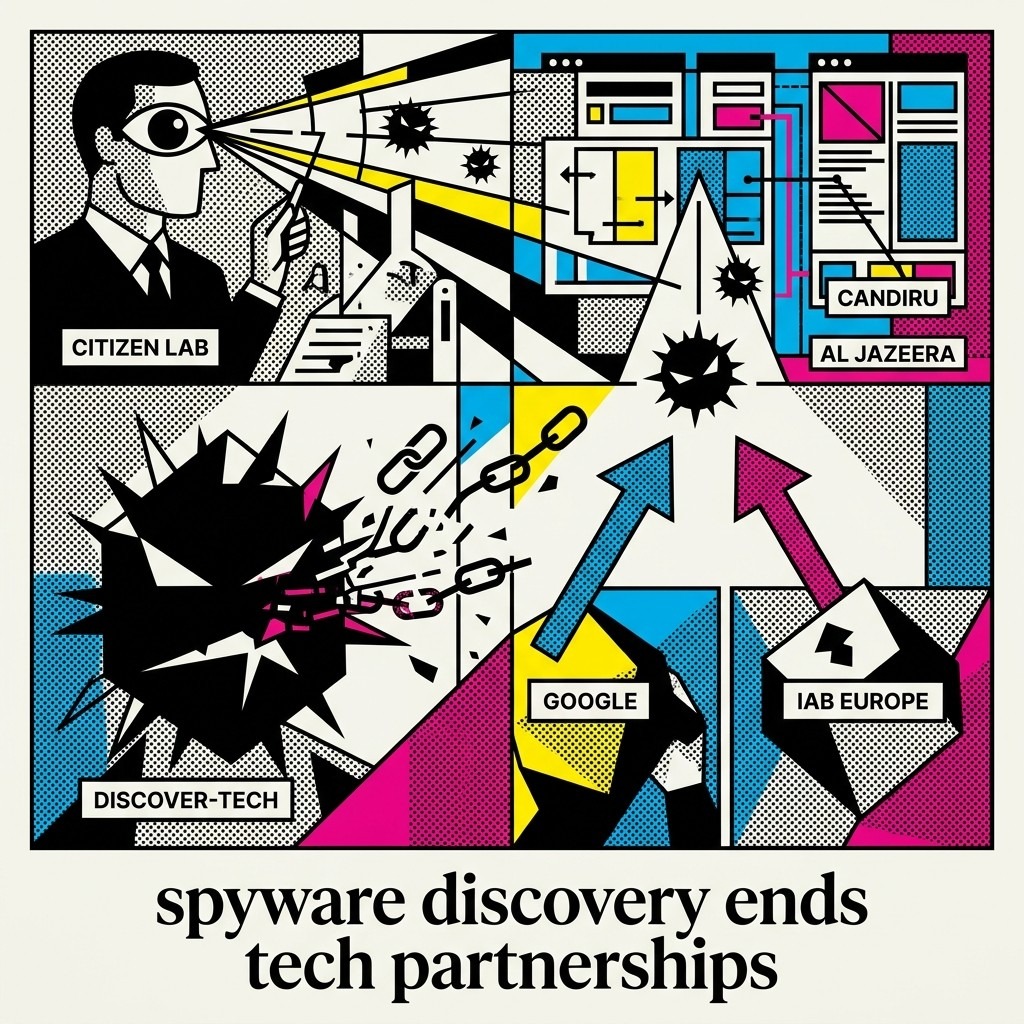
Citizen Lab, the University of Toronto’s cyber-research group, says Israel’s Discover-Tech used ads to infect at least 45 Al Jazeera devices with spyware from Candiru, an Israeli vendor, in 2024 and 2025. The failure was vetting. Google listed Discover-Tech as a certified vendor. IAB Europe, the ad industry’s trade body, listed it as approved. Both dropped it after the investigation.

Ad exchanges earn a fee per impression, and inspecting every ad’s code costs them volume. Discover-Tech won about 442 million of 3.77 billion bids between March and June 2026. Confiant, an ad-security firm, says Candiru-linked ads were a tiny fraction of that. The cheapest fix is liability for whoever certifies vendors, since only platforms see the bids.

Exposure has not stopped Candiru. Citizen Lab named it in 2021, counting at least 100 targets in 10 countries. It has since rebranded as Integrity Labs after a US takeover. Confiant co-founder Jérôme Dangu told Reuters: “Very likely hundreds of millions of people would have been touched by Discover-Tech.”

The Gist AI Editor

The Global Overview

Israeli-built “AdFection” spyware infects phones through targeted ads

Citizen Lab researchers uncovered an Israeli-developed technique, “AdFection,” that infects phones without the owner touching anything, according to the FT. The delivery route is the advertising system. Ads are routed to chosen people based on profile data, so an attacker can pick a victim by buying placement. Ad networks have no practical way to inspect every ad, and the buyers are hidden behind intermediaries. That gap favors spyware vendors and their government clients.

France and Germany near a deal that would let the UK into EU car subsidies

Paris and Berlin are close to agreeing the “Made in Europe” subsidy programme and the combustion engine phaseout, the FT reports. Britain could join the programme if it aligns with EU tariffs on Chinese cars. Britain would gain access to a larger subsidy market. The EU would gain a bigger tariff area against Chinese carmakers, and London would have to accept Brussels’ trade line on China.

Brain-computer interfaces move from treatment toward data collection

The FT notes that brain-computer interfaces already treat Parkinson’s disease and let paralysed patients operate computers. The next question is who owns the neural data these devices record. Device makers and the AI firms that decode the signals hold that data, and rules on its use are still thin.

NASA spreads $12 million across 12 universities

NASA picked 12 U.S. institutions to receive up to $1 million each through its M-STAR programme, NASA says. The money supports Moon, Mars and deep-space research. It is small next to the agency’s budget. Its effect is to train the engineers who will staff Artemis contractors.

Guggenheim unit loses customers after probe into Mark Walter

Customers are shying away from a unit in Mark Walter’s empire that supplies funding to Wall Street, the WSJ reports. A probe into Walter is the cause.

Stay tuned for the next Gist—your edge in a shifting world. The Gist remains independent and reader-supported. If you value news free from corporate or state interests, consider supporting our mission with a donation.


The European Perspective

Nvidia plans a Stockholm AI hub tied to health and climate start-ups

Nvidia will open an AI hub in Stockholm that puts selected Swedish start-ups and Nvidia staff in the same building, with a biotechnology demonstration lab alongside (Euronews). The benefit runs both ways. Start-ups get early access to Nvidia’s engineers and chips. Nvidia gets first sight of promising health and climate companies that will probably end up buying its hardware. Capital stays tied to a single supplier’s ecosystem, and Europe’s own chip and software makers gain nothing from the arrangement.

NATO convenes on Black Sea ship attacks

The North Atlantic Council will hold a special session on the Black Sea, Romanian President Nicusor Dan said after meeting NATO chief Mark Rutte and Bulgarian Prime Minister Rumen Radew in Brussels (ZDF). Fires broke out in quick succession on two tankers off Romania’s coast, and seven crew members were reported missing (ZDF). Insurers price this risk first. Higher war-risk premiums raise freight costs for grain and fuel before any military response is decided.

Italian hauliers threaten a national stoppage over diesel prices

Italian trucking firms are threatening a national stoppage over diesel costs, with unofficial blockades in Puglia and a fuel emergency reported in Cosenza (Il Sole 24 Ore). Hauliers operate on thin margins and usually cannot pass fuel increases on to clients quickly. A stoppage would hit supermarket and factory supply chains within days. That gives small operators real leverage over Rome.

Confindustria says Europe wants to play, not referee, between the US and China

Confindustria president Emanuele Orsini met Trade Commissioner Maros Sefcovic and Raffaele Fitto, the Commission’s executive vice-president for cohesion and reforms. He argued that the EU should compete in the US-China contest rather than act as its arbiter (Il Sole 24 Ore). Italian industry is pressing Brussels for industrial support rather than neutrality.

Non-obvious angle: a court ruling shows how ministry social media is regulated

Germany’s Federal Constitutional Court ordered Economy Minister Katherina Reiche’s ministry to take down an Instagram video about the Left party for now (ZDF). The ruling suggests that a ministry account is held to stricter neutrality rules than a politician’s personal one. If that holds, ministries across the coalition will have to review their social media.

Catch the next Gist for the continent’s moving pieces.

🎙️ Listen to this edition as a podcast Listen

The Gist is an independent daily digest: AI-curated, human-directed, unapologetically liberal (how it’s made). Hundreds of sources, only what matters. Subscribe free or listen to the podcast.