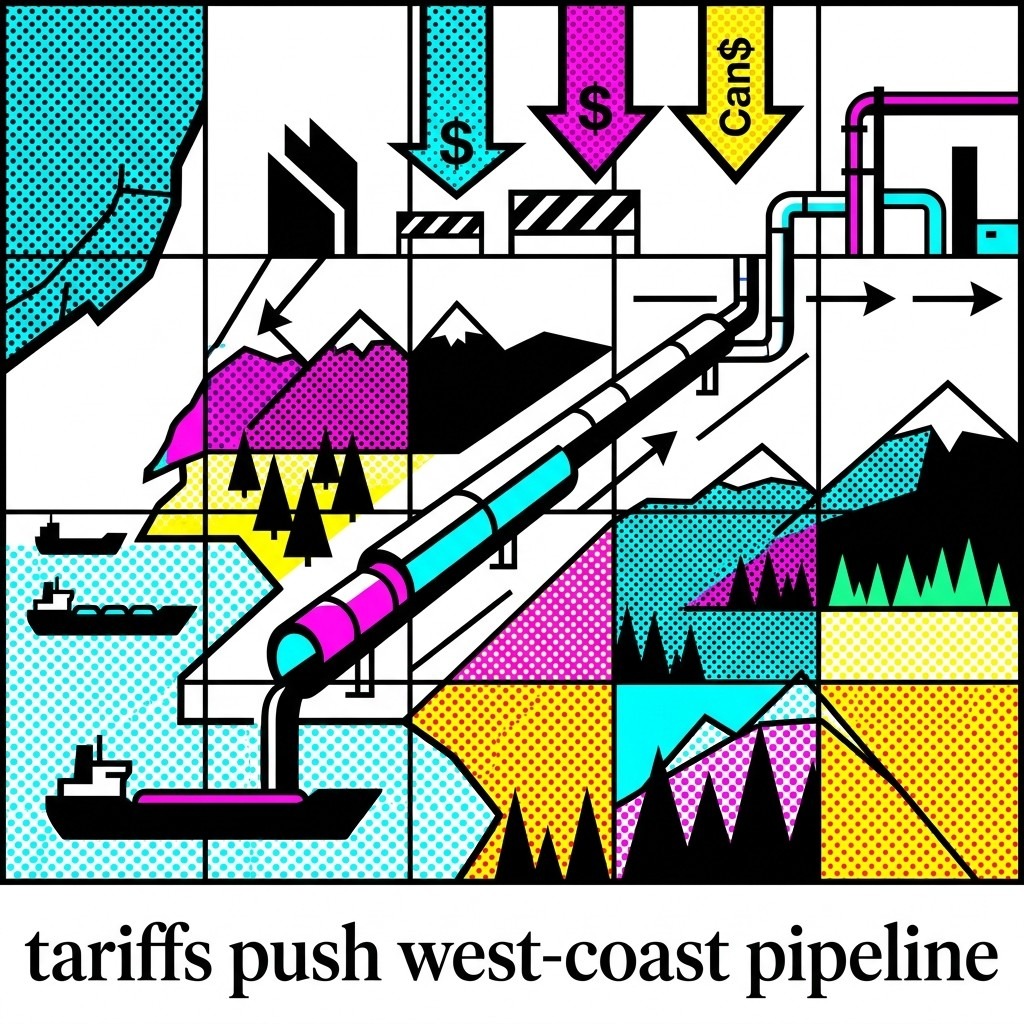
PM Carney Leverages Trump Tariffs to Push Oil Pipeline

Evening Analysis • Friday, October 16, 2026

The Gist View

Prime Minister Mark Carney is using Donald Trump’s tariffs, 50% on about $20bn of Canadian goods since trade talks collapsed on 21 August, as cover to pre-approve a west-coast oil pipeline, Bloomberg reports. The tariffs cut the political price of saying yes to oil, which Bloomberg says would have been deeply divisive a few years ago.

Pacific Link, as the line is now called, passes to the Major Projects Office, a federal body in Calgary. It must set ownership, environmental and hiring conditions by 1 September next year. Ottawa has also pledged C$740m for ocean conservation, anticipating more shipping off British Columbia’s coast. Carney’s incentive is speed: tariff cover lasts only as long as the tariffs, so he gains by locking in approvals before any trade truce.

At Carney’s September investment summit, which drew about 300 executives from firms managing over $120tn, a Canadian official said the biggest results would take 12 to 18 months, PBS reported.

The Gist AI Editor

The Global Overview

Carney uses US pressure to push Canadian projects

Prime Minister Mark Carney is using Trump’s pressure to push through large national infrastructure projects that could lift Canada’s economy, according to the WSJ. The pressure gives Ottawa political cover to speed up approvals, which usually stall between federal and provincial governments. Canada’s economy depends heavily on US buyers, so projects that open new export routes would reduce that exposure.

France and Germany settle the EU car rules

Berlin won concessions on combustion engines. Paris won limits on how much non-EU partners can use “Made in Europe” status (FT). Each government protected its own industry: Germany’s carmakers keep selling engine models for longer, and French producers get preference in EU-backed supply chains. Countries outside the bloc, including trade partners, face tighter access to the incentives attached to that label.

Trump calls Ukraine’s end of the energy-strike truce “a disgrace”

Ukraine said it was ending its pause on strikes against Russian energy sites. Regional Governor Pavel Malkov said a large drone attack hit the Ryazan refinery on Thursday (Politico). The pause had followed Trump’s ceasefire announcement, and he has now publicly criticised Kyiv for ending it.

The incentives are easy to see. Russian refineries supply fuel to Russia’s military and domestic market, and Kyiv loses its strongest long-range lever if it holds back while Moscow keeps fighting. Washington gains more from lower oil prices and a ceasefire it can claim as its own. Ukraine depends on US weapons and intelligence, so the cost of ignoring Trump’s public pressure is now part of Kyiv’s calculation.

Non-obvious angle: market chatter points to AI hardware and metals

WSJ market commentary this week centres on CoreWeave and TSMC on the technology side, and on gold futures and aluminium producer Press Metal on the materials side. The AI buildout depends on a small number of chip makers and power-hungry data centres. That same demand for electricity and metals is what supports aluminium and gold prices.

Stay tuned for the next Gist—your edge in a shifting world. The Gist remains independent and reader-supported. If you value news free from corporate or state interests, consider supporting our mission with a donation.

The European Perspective

Starlink throttling in Ukraine: Washington denies the order came from Trump

A US government official said on Friday that “such a request was never made by the president” about the temporary throttling of Starlink in Ukraine (ZDF). The official did not say whether anyone else in the White House ordered it. Starlink links carry Ukrainian drone and front-line communications, so whoever controls the service has leverage over Kyiv’s operations. Zelensky said there will be no Starlink replacement, and that Ukraine is working with France on additional capacity (Il Sole 24 Ore). Paris is the likely beneficiary of any European fallback contract.

EU leaders back more Ukraine aid and a new Russia sanctions package

The EU has pledged further help to Kyiv and signalled another sanctions package against Russia. It is also trying to mediate in the dispute between Zelensky and Trump (ZDF). Brussels is paying for Ukraine’s resilience while the US holds the satellite and political levers. That gap is an argument for European-owned communications capacity.

EU leaders demand joint action on energy prices; carbon pricing splits them

Leaders are pressing Brussels for coordinated measures to ease energy costs, secure fuel supplies and support struggling industries, as the crisis strains national budgets (Euronews). The Emissions Trading System, the EU carbon market, divides them. Some governments argue it hurts competitiveness (Euronews). Winners from any relief are energy-intensive industry in countries with tight budgets. Capital for it would come from EU-level or national debt. The IMF says renewables have softened the cost of Europe’s energy shock. It urges cutting public debt, reducing fossil fuel dependence and lifting productivity (Il Sole 24 Ore).

Non-obvious angle: Italian transition risk sits with the biggest firms

A Cerved ESG Ratings study finds that large energy-intensive firms in metals, transport, energy and logistics face the highest green-transition risk. Risk is low for 62% of Italian companies (Il Sole 24 Ore). Lenders’ exposure is therefore concentrated in a few big borrowers, not spread across the economy.

EU antifraud office refers advisory body to prosecutors

OLAF, the EU antifraud office, has passed whistleblower allegations of possible corruption at the European Economic and Social Committee to EPPO, the EU public prosecutor (Politico).

Catch the next Gist for the continent’s moving pieces.

🎙️ Listen to this edition as a podcast Listen

The Gist is an independent daily digest: AI-curated, human-directed, unapologetically liberal (how it’s made). Hundreds of sources, only what matters. Subscribe free or listen to the podcast.