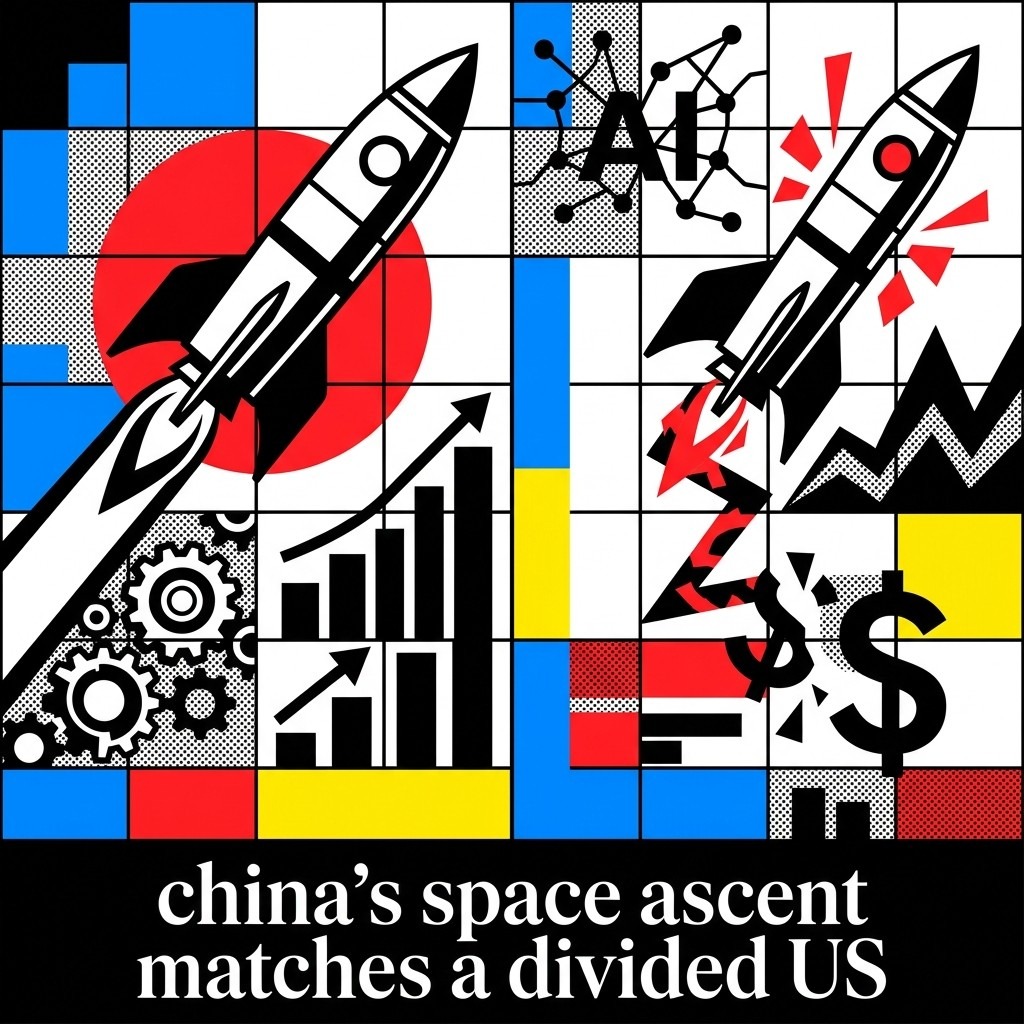
China Equals US in Space Race Amid Funding Uncertainties

Evening Analysis • Monday, October 19, 2026

The Gist View

Robert Manning and Nick Hawkins of the Stimson Center, a Washington think tank, argued in Foreign Affairs on Oct. 19 that China now matches the US in space. The sharper question is who has more reason to keep paying. China’s crewed-spaceflight agency has long promised astronauts on the moon before 2030, and a one-party state does not reopen that deadline every budget cycle.

Washington’s incentives pull the other way. Congress funds NASA, the US space agency, year by year, while private investors pay for the AI race that dominates attention. Space gets money when a rival is visible, so the “peer” label serves every contractor wanting a bigger budget. The International Telecommunication Union, the UN body that registers satellite frequencies and orbital slots, gives priority largely by filing date, which rewards early commitment.

Washington has moved fast before. Sputnik reached orbit on 4 October 1957, and NASA opened on 1 October 1958, according to NASA’s own history office.

The Gist AI Editor

The Global Overview

China’s space program now matches US capabilities, Foreign Affairs analysts argue

Robert Manning and Nick Hawkins of the Stimson Center write in Foreign Affairs (Oct. 19) that Washington is focused on the AI contest while China closes in on the US in space. Their argument is that China is now a peer competitor in satellites and lunar missions. Space is also becoming a contest over who sets the rules. Whoever builds the most launch capacity and the largest satellite networks will decide which standards, frequencies and orbits others have to work around. The piece is an opinion analysis, so treat it as an argument and not as a data release.

French weekend riots put security ahead of the budget

Looting and clashes spread across France on Oct. 17 and 18, according to Politico Europe. Emmanuel Macron then left for the Middle East, after a televised address that, per Politico, did not convince his own camp. Presidential candidate Gabriel Attal says the government should be able to block social media platforms in affected areas. He says any block should be temporary and limited to the area where riots are happening. This moves the election argument from affordability to policing, and toward a legal power over platforms that no French government currently holds. Businesses in affected areas carry the immediate cost of closures and damage.

Colossal buys a moa egg and sends it to New Zealand

Bloomberg reports that Colossal Biosciences, which says it is working to bring extinct species back, has acquired a rare egg of the extinct flightless moa. The company will return it to New Zealand. The move gives Colossal a link to local institutions and Māori stakeholders, whose cooperation any future project there would likely require.

Mars imagery shows the long-term value of public science

NASA released a Curiosity panorama on Oct. 6 showing wind-carved ridges called yardangs. It was taken on sol 4,982 of the mission. The data comes from a rover that has run for years, which shows how long public science programs take to deliver results.

Stay tuned for the next Gist—your edge in a shifting world. The Gist remains independent and reader-supported. If you value news free from corporate or state interests, consider supporting our mission with a donation.

The European Perspective

French unrest costs Interior Ministry control, not its minister

997 injured officers and 2,331 people taken into police custody over the weekend, according to ZDF. Interior Minister Laurent Nuñez conceded a “loss of control.” Macron turned down his resignation offer. Paris recorded another 350 arrests between Sunday and Monday, and the government has announced local curfews. Prime Minister Lecornu said nearly 200 investigators will review footage to identify looters in the Paris region alone (Euronews).

Keeping Nuñez in place protects the government from a second ministerial crisis while the budget is still being negotiated. Macron has also called a round table on the underlying grievances. Shopkeepers and insurers in the damaged districts will be the first to see what that costs.

Italian truckers’ fuel protest empties southern shelves

Cold stores on southern farms are full. Lorries carrying perishable goods are stuck on the roads, and the first gaps have appeared in supermarkets, according to Il Sole 24 Ore. The hauliers are protesting high fuel prices. Farmers and fresh-food distributors bear the loss first, because produce spoils while the lorries wait. Retailers then lose sales. Hauliers have leverage because Italian supply chains depend on road freight, and southern producers have few other ways to reach northern markets.

Putin gains ground in Ukraine talks

ZDF reports that Russia’s position in the background talks has improved as the war nears its fifth year, with no settlement in sight. ZDF’s analysis credits Trump’s approach for the shift. The more the talks favour Moscow, the weaker Europe’s hand becomes in deciding the terms of any deal. Europe also stays the main source of financing for Kyiv.

ECB says nature loss is now a competitiveness issue

Frank Elderson, an ECB board member, told a Manila conference that summer 2026 was not just another warm season for Europe (ECB). He argued that climate and nature damage will keep shaping the economy whatever happens elsewhere. For banks, this points to supervisors pressing lenders to price in physical losses from extreme weather. Separately, Le Monde reports that scientists are testing species’ capacity to adapt by moving plots of vegetation and running extreme-weather simulations.

Catch the next Gist for the continent’s moving pieces.

🎙️ Listen to this edition as a podcast Listen

The Gist is an independent daily digest: AI-curated, human-directed, unapologetically liberal (how it’s made). Hundreds of sources, only what matters. Subscribe free or listen to the podcast.