Quebec Separatist Leader Uses EU Summit Snub as Leverage

Morning Intelligence • Wednesday, October 28, 2026

The Gist View

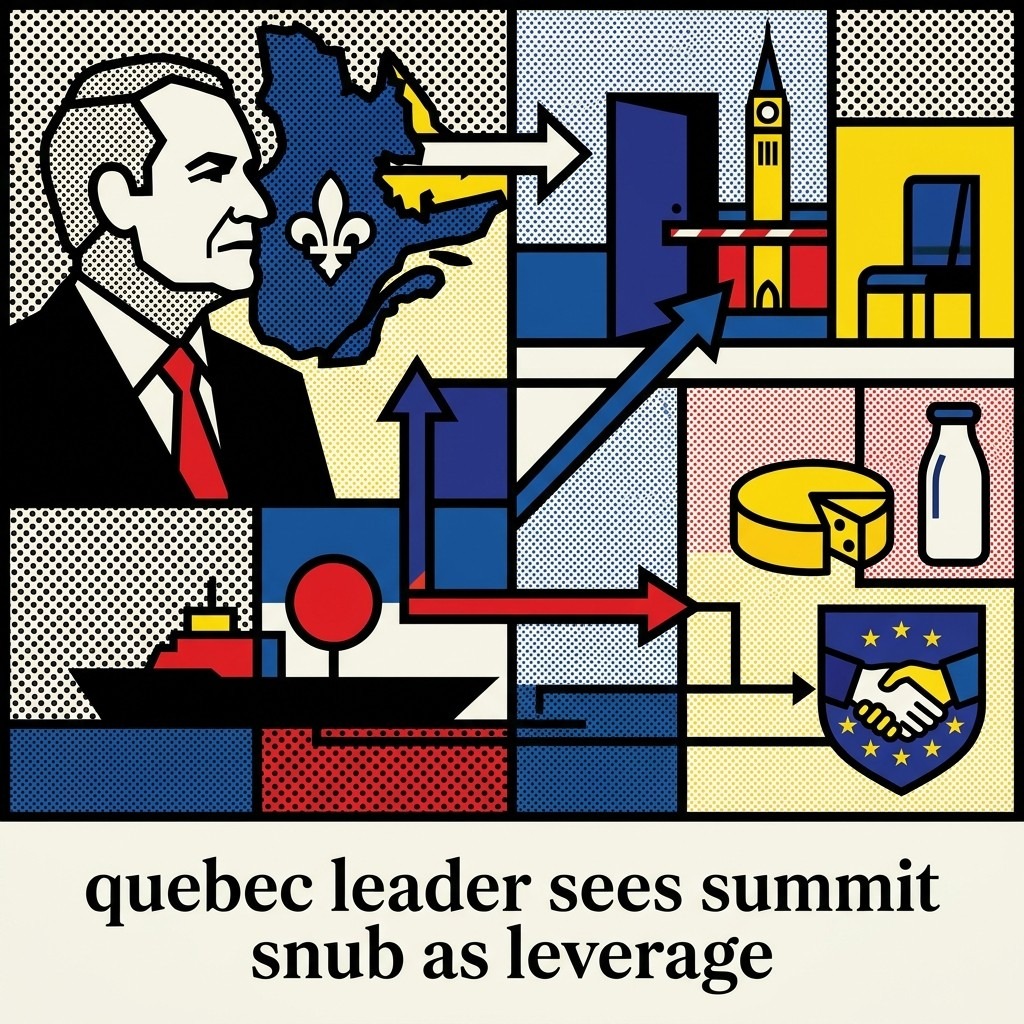
Paul St-Pierre Plamondon, the separatist Parti Québécois leader who won Quebec’s election on October 5, says Ottawa shut his province out of this week’s EU-Canada summit. For a sovereigntist premier, the snub is an asset: each time Ottawa speaks for Quebec unasked, his case gains evidence.

His leverage is real because provinces, not Ottawa, run much of what the Comprehensive Economic and Trade Agreement (CETA) changes: public procurement, professional licensing and dairy. Quebec, Canada’s dairy heartland, has the most to lose from the larger European cheese quota CETA granted. Neither side gains by yielding first. Ottawa wants one voice at the table; Quebec City wants the snub on record.

Brussels has seen this before. In 2016, Wallonia, a Belgian region of 3.6 million people, withheld consent, and the EU-Canada signing slipped from October 27 to October 30, according to the Council of the EU’s records. A region less than half Quebec’s size cost three days and won written assurances.

The Gist AI Editor

The Global Overview

Quebec’s new separatist government threatens to complicate Canada’s EU summit

Premier Paul St-Pierre Plamondon, who won office on October 5, says Ottawa barred Quebec from this week’s EU-Canada summit in Montreal. He also warns that his province will have the last word on any deal that touches its jurisdiction (Politico Europe). The EU wants one signature from Canada. A province that can block implementation gives Brussels a reason to ask for guarantees before it commits, and that weakens Prime Minister Mark Carney’s position in the talks.

Israel’s election produces no clear winner

Early results show no decisive result, and Prime Minister Benjamin Netanyahu is still competing for another term (WSJ). A coalition may take weeks to assemble. Until it does, decisions on Gaza, Iran policy and the budget are likely to stay on hold.

Oil and gold show traders pricing physical risk

Oil rose even though diplomatic talks eased tension in the Middle East. ANZ said traders are now watching events on the ground, not the diplomacy, and that is the cue to keep a premium on supply risk (WSJ). Higher crude feeds straight into European energy bills, so it keeps pushing up inflation expectations there. Gold held above $4,000 an ounce ahead of the Federal Reserve and other central bank decisions (WSJ). Investors are paying to hold an asset that does not depend on any government’s interest-rate choices.

A hack at GMO shows how little retail currency traders react to cyber risk

Trading volumes in Japan’s retail currency market held up after the cyberattack on GMO Internet Group, though some investors are closing accounts, according to Central Tanshi FX (Bloomberg). Volumes held because few platforms offer the same leverage and tight pricing, so most clients stay. Only a few traders move their money elsewhere.

Stay tuned for the next Gist—your edge in a shifting world. The Gist remains independent and reader-supported. If you value news free from corporate or state interests, consider supporting our mission with a donation.

The European Perspective

Israel’s election ends in a deadlock, leaving coalition math to decide power

Early projections after polls closed showed no clear winner between Prime Minister Benjamin Netanjahu and challenger Gadi Eisenkot, according to ZDF. Netanjahu says he still expects to govern and is pressing for a strong right-wing government. A deadlock moves power to the smaller parties, whose votes decide who forms a coalition. Their price is usually ministries and budget lines, so bargaining over those could last weeks.

Energy costs are now reaching shop prices, and ifo expects inflation above 3%

The ifo institute, a Munich-based economic research body, reports that its price-expectations index (the share of firms planning price rises, balanced against cuts) rose to 22.7 in September from 21.4 in August. Its economist Timo Wollmershäuser expects inflation to climb above 3% in the coming months. Fuel and heating oil have already risen. Utilities are expected to raise power and gas prices in winter. Crude prices rose again after the blockade of the Bab al-Mandab strait. Gas and electricity prices hit their highest level since late 2022 in mid-September (ifo). Firms with pricing power pass costs on, while households and energy-intensive manufacturers absorb them. A rise like this also complicates any ECB (European Central Bank) case for lower rates.

Merz travels to Asia to cut reliance on Chinese raw materials

Chancellor Friedrich Merz is touring Asia to find new supply partners. Politico describes the trip as a possible template for reducing dependence on Chinese raw materials. Politico also says the trip may speed up deliveries of Japanese Patriot missiles to Ukraine. German industry stands to gain from supply deals that diversify sourcing.

US–Canada trade talks speed up, with no concessions yet

Washington and Ottawa have stepped up talks over the past week, but neither has offered concessions, Politico reports. Frequent meetings alone don’t signal a deal.

Researchers call for climate change to be declared a global health emergency

Nearly 150 researchers from more than 30 countries want the declaration, DW reports. They cite more than half a million heat deaths in 2023 alone. A formal emergency label could shift health-budget priorities toward heat and drought preparedness.

Non-obvious angle: EU prosecutors still have questions on Pfizer vaccine talks

Politico reports little visible progress in the European Public Prosecutor’s Office (EPPO) probe into von der Leyen’s Covid vaccine negotiations with Pfizer’s chief executive, Albert Bourla. The open file keeps pressure on how Brussels runs future joint health purchases.

Catch the next Gist for the continent’s moving pieces.

🎙️ Listen to this edition as a podcast Listen

The Gist is an independent daily digest: AI-curated, human-directed, unapologetically liberal (how it’s made). Hundreds of sources, only what matters. Subscribe free or listen to the podcast.