Binance Hit by Record $6bn Crypto Theft; Plans Repayment

Evening Analysis • Friday, October 30, 2026

The Gist View

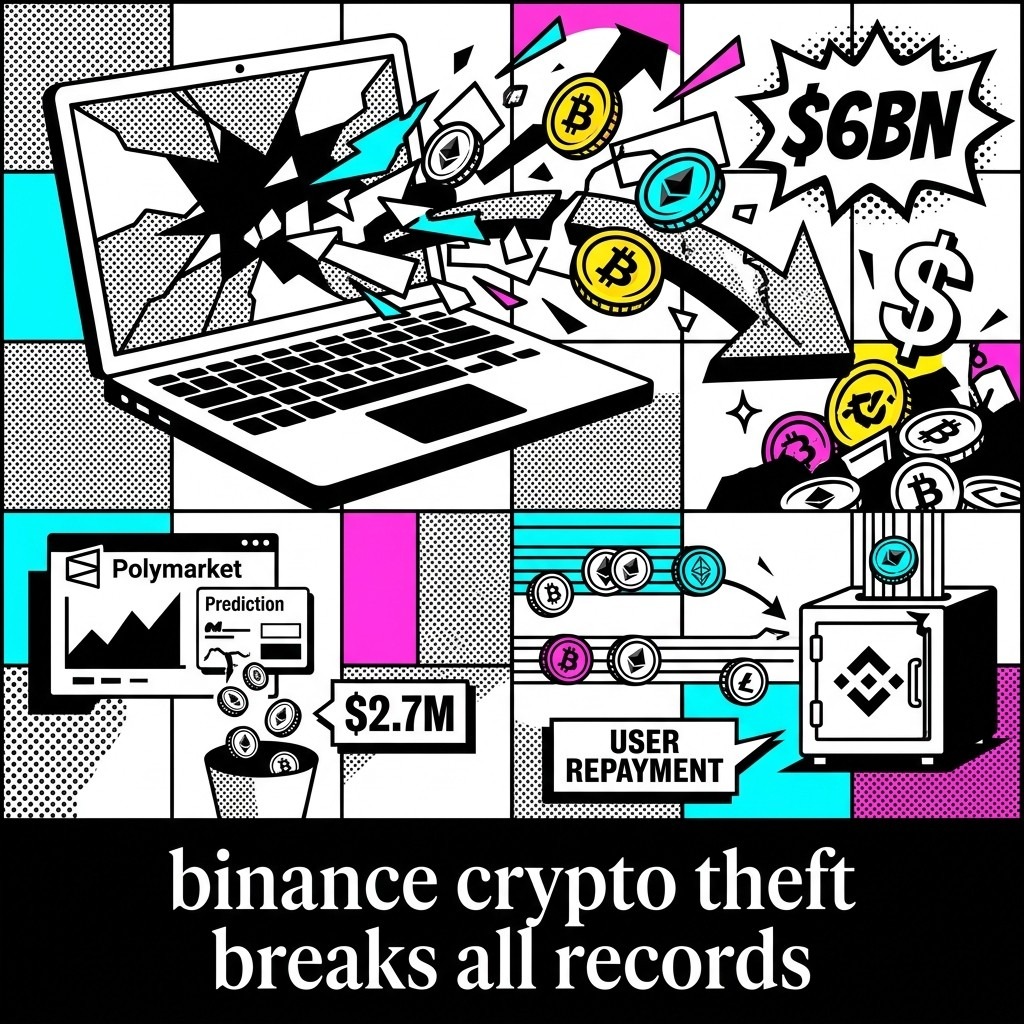
Binance, the world’s largest crypto exchange, lost more than $6bn on Thursday, Axios reports, the biggest crypto theft on record. Polymarket, a platform for betting on events, lost about $2.7m. Neither attacker broke the cryptography. Axios says Binance’s breach began with one engineer’s compromised laptop. At Polymarket, code slipped in through DebugBear, a website-speed monitoring vendor, and drained 737 accounts, CCN reports.

Binance’s pledge to repay every user, with $6.34bn reserved by its own account, is rational: its product is trust that deposits are safe, and a rush to withdraw would cost more than the theft. Only a firm that size can make that promise. Smaller exchanges use the same cheap outside tools on thinner balance sheets, so expect regulators to ask about vendor lists, not just cryptography.

In May 2019, Binance lost about $40m in bitcoin to stolen API keys and covered it from its own funds, TechCrunch reported. Thursday’s loss is roughly 150 times larger.

The Gist AI Editor

The Global Overview

Binance and Polymarket halt trading after hacks

Trading suspended on two major platforms

According to the WSJ, Binance and Polymarket suspended trading after hacks. Both platforms hold customer funds and settle bets and trades themselves. Until they restart, users can’t move positions, and rival venues are the most likely place for that volume to go.

Gold and silver slide as oil lifts rate expectations

Gold and silver futures extended their losses as rising oil prices raised inflation fears, the WSJ reported. Higher oil costs push up prices across the economy. That makes central banks more likely to keep interest rates high. Gold pays no interest, so higher rates make holding it less attractive.

Tariff relief becomes a bargaining chip for factories

The WSJ reports the Trump administration promised tariff relief in talks to secure a U.S. Audi factory. Separately, Cleveland-Cliffs is retaining Stelco amid a jobs dispute with the Canadian government. Tariff exemptions are now traded against investment commitments, and each company negotiates its own terms. Firms that can promise U.S. jobs gain a cost advantage over rivals that can’t.

Anthropic’s founder control wins over long-term investors

Baillie Gifford’s Peter Singlehurst told Bloomberg that Anthropic’s governance gives its seven founders voting control, which he considers good for long-term investors. The non-obvious point is that founder control means outside shareholders can’t force a change of strategy. Investors accept that in return for access to a company they say uses computing power efficiently.

Stay tuned for the next Gist—your edge in a shifting world. The Gist remains independent and reader-supported. If you value news free from corporate or state interests, consider supporting our mission with a donation.

The European Perspective

France’s economy shrinks 0.1% as its finance minister warns of a wall

France’s economy contracted 0.1% in the third quarter of 2026, according to Insee, the national statistics agency (Politico). Finance and Economy Minister Roland Lescure said the economy is at a standstill. A second negative quarter would meet the common definition of recession. It would also cut the tax revenue the government needs to hold down its debt-driven fiscal strain.

Germany grows 0.2% while energy costs spread through prices

German GDP rose 0.2% in the third quarter, against an average of 0.3% over the previous three quarters, despite higher energy prices and low river water that hampered freight (ifo). Germany is therefore growing while France is not. The ifo institute’s price-expectations index, which tracks the share of firms planning price rises, edged up to 22.7 from 21.4 in September (ifo). Ifo expects inflation to climb above 3% in coming months. It said natural gas and electricity prices hit their highest level since late 2022 in mid-September, after the blockade of the Bab al-Mandab strait lifted crude oil prices. Utilities are expected to raise household power and gas prices this winter. Energy suppliers and importers gain first. Households and energy-intensive manufacturers carry the cost.

Oleshky evacuation runs through Russia and Belarus

Civilians left the Russian-held Ukrainian city of Oleshky on Friday in a joint relief operation. It was the first of its kind in four years and eight months of war (The Guardian). Ukrainian negotiator David Arakhamia said the group travelled to Anapa in Russia, then flew to Belarus before continuing home by bus (ZDF). Both warring sides had to cooperate through a ceasefire and a route across territory of their ally. That shows a working channel for narrow humanitarian deals exists.

Ukraine’s drone market runs on front-line points

Ukrainian soldiers order drones online through Brave1, a military-technology marketplace. They pay with points earned for performance at the front (ZDF). Demand therefore comes straight from units, and suppliers compete on what works in combat.

Catch the next Gist for the continent’s moving pieces.

🎙️ Listen to this edition as a podcast Listen

The Gist is an independent daily digest: AI-curated, human-directed, unapologetically liberal (how it’s made). Hundreds of sources, only what matters. Subscribe free or listen to the podcast.