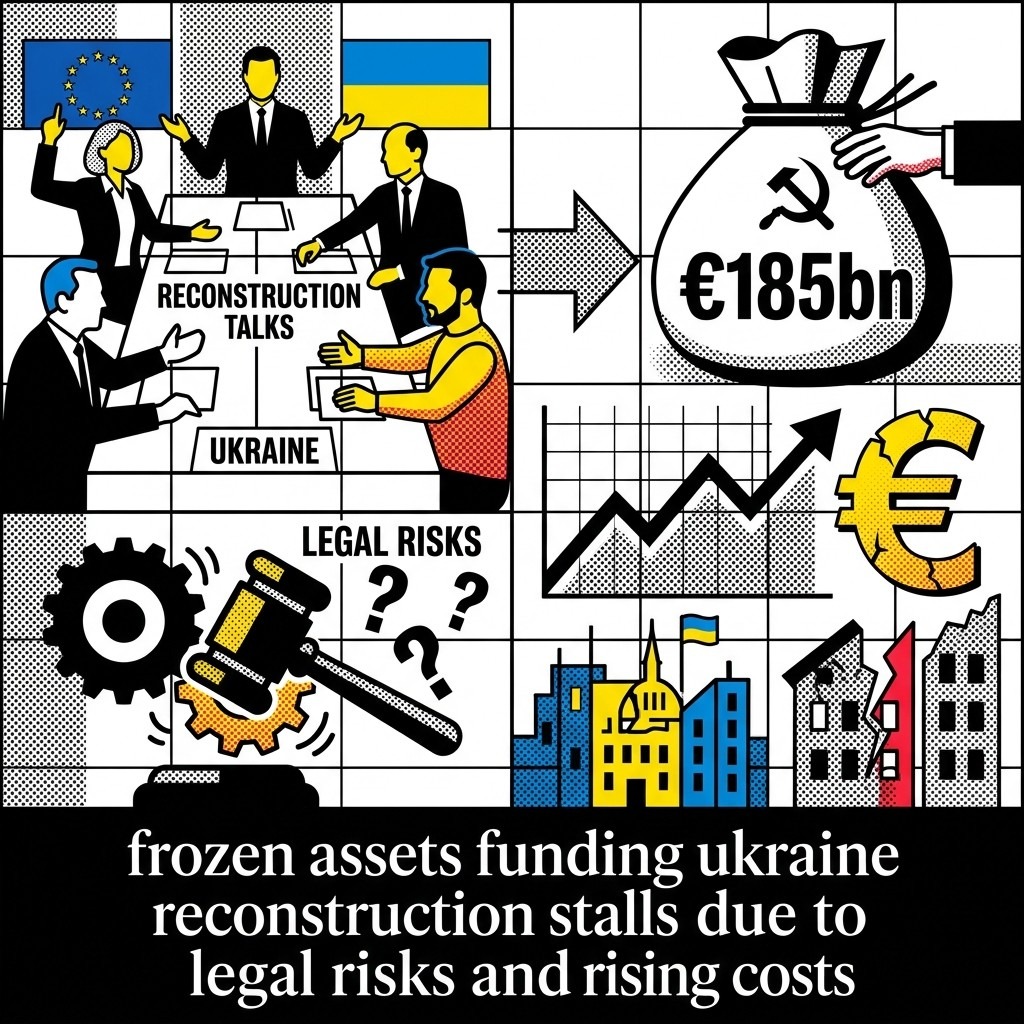
EU Eyes €185bn Russian Assets for Ukraine Rebuild

Evening Analysis • Tuesday, November 03, 2026

The Gist View

The European Commission, the EU’s executive arm, hosts Ukraine reconstruction talks in Brussels on Wednesday with Washington and London. The World Bank’s February 2025 assessment put the bill at $524bn. Europe’s money on the table is far smaller. The €90bn loan leaders agreed in December 2025 covers Ukraine’s budget and military needs through 2027, not rebuilding.

The real prize is roughly €185bn of frozen Russian central-bank assets held at Euroclear, a Brussels-based clearing house. Belgium blocked their use in December. It feared Moscow’s lawsuits and retaliation unless other states shared the legal risk. Every government that wants contracts needs those assets unlocked. Belgium carries the risk and gains nothing by agreeing without a guarantee. Expect no contract rules until it gets one.

Waiting has a price. The World Bank’s estimate rose from $486bn in February 2024 to $524bn a year later.

The Gist AI Editor

The Global Overview

EU convenes Ukraine reconstruction talks with Washington and London

The European Commission hosts talks in Brussels on Wednesday on Ukraine’s post-war economic future, spokesperson Paula Pinho confirmed (Politico Europe). France, Germany, the U.K., NATO, the World Bank, Kyiv and Washington will attend. The guest list shows who expects to shape reconstruction contracts and financing terms. Whoever sets the rules for funding decides which countries’ firms get the work.

Tech stocks look to snap a three-day slide

Tech shares are trying to end a three-session losing streak as investors shift focus from earnings to the U.S. midterm elections (WSJ). Shopify is falling after its first quarterly revenue miss in four years (Bloomberg). Lattice Semiconductor is rising after an outlook that points to growth into 2028 (Bloomberg). Investors are paying for chipmakers with visible demand and punishing software firms that miss once.

Apple’s iPhone Duo is supply-limited, not demand-limited

Wait times for the iPhone Duo extend into January, which suggests supply, not demand, is the constraint, says analyst Craig Moffett of MoffettNathanson (Bloomberg). He calls it off to a strong start but not a big growth driver. Reports of cracking screens hurt Apple’s reputation, though he warns against overemphasizing them.

Non-obvious angle: a dying NASA telescope tests who tracks space debris

NASA’s 3,200-pound Swift Observatory is expected to reenter the atmosphere this week after 22 years in orbit and a failed rescue attempt this summer (Wired). The possible reentry zone covers parts of Africa, Australia, Southeast Asia and South America. Countries in that zone depend on U.S. tracking data, so they have little independent information about where debris may land.

Stay tuned for the next Gist—your edge in a shifting world. The Gist remains independent and reader-supported. If you value news free from corporate or state interests, consider supporting our mission with a donation.

The European Perspective

Brussels clears China’s JD.com to buy Mediamarkt-Saturn’s parent Ceconomy

The European Commission approved the takeover on Tuesday, 3 November, but with conditions. Mediamarkt-Saturn may not benefit from Chinese state subsidies, and JD.com has committed to removing unfair competitive advantages (ZDF). The beneficiary is a Chinese retailer that gains a Europe-wide store network. The cost to Brussels is low: it can say it enforced its subsidy rules while Germany keeps a large retail employer open. Enforcement is the open question. Subsidies can reach a subsidiary through supplier terms and financing, which are hard to audit from outside.

Trump claims Greenland as a gift from Europe

In a Fox News call on Tuesday, Trump said Europe “just gave” the US Greenland, calling it the greatest gift the US had received (Politico). This follows a US-Greenland-Denmark security pact signed in New York on 22 September. Earlier this year Trump declined to rule out military force to gain control of the mineral-rich island (Politico). For Copenhagen and Nuuk, the gap between a security pact and a claim of ownership is now a negotiating problem.

Energy costs are reaching shelf prices

The ifo institute’s price-expectations index, which measures the share of firms planning price rises, rose to 22.7 in September from 21.4. Crude oil rose again after the Bab al-Mandab strait was blocked, and gas and power prices hit their highest since late 2022 in mid-September. Ifo expects inflation to climb above 3% in coming months (ifo). Utilities are expected to raise electricity and gas tariffs this winter. Households on fixed-price contracts will see the increase later than businesses do.

Chemical sector sentiment drops

Ifo’s chemical-industry business climate index fell to -5.9 in October from +3.0. Expectations fell to -13.8 from -1.5 (ifo). Plant closures and restructuring are the stated concern. Capacity that closes in Germany is unlikely to return.

Non-obvious angle: Europe’s research funds help build US startups

Ifo president Clemens Fuest and more than 50 scientists argue in Science that European-funded research often ends up in patents held by US startups, which then capture the market success (ifo). They want public money directed to where European research can become marketable products. The implication is that Europe’s public research spending is subsidizing American returns.

Catch the next Gist for the continent’s moving pieces.

🎙️ Listen to this edition as a podcast Listen

The Gist is an independent daily digest: AI-curated, human-directed, unapologetically liberal (how it’s made). Hundreds of sources, only what matters. Subscribe free or listen to the podcast.