The Gist View
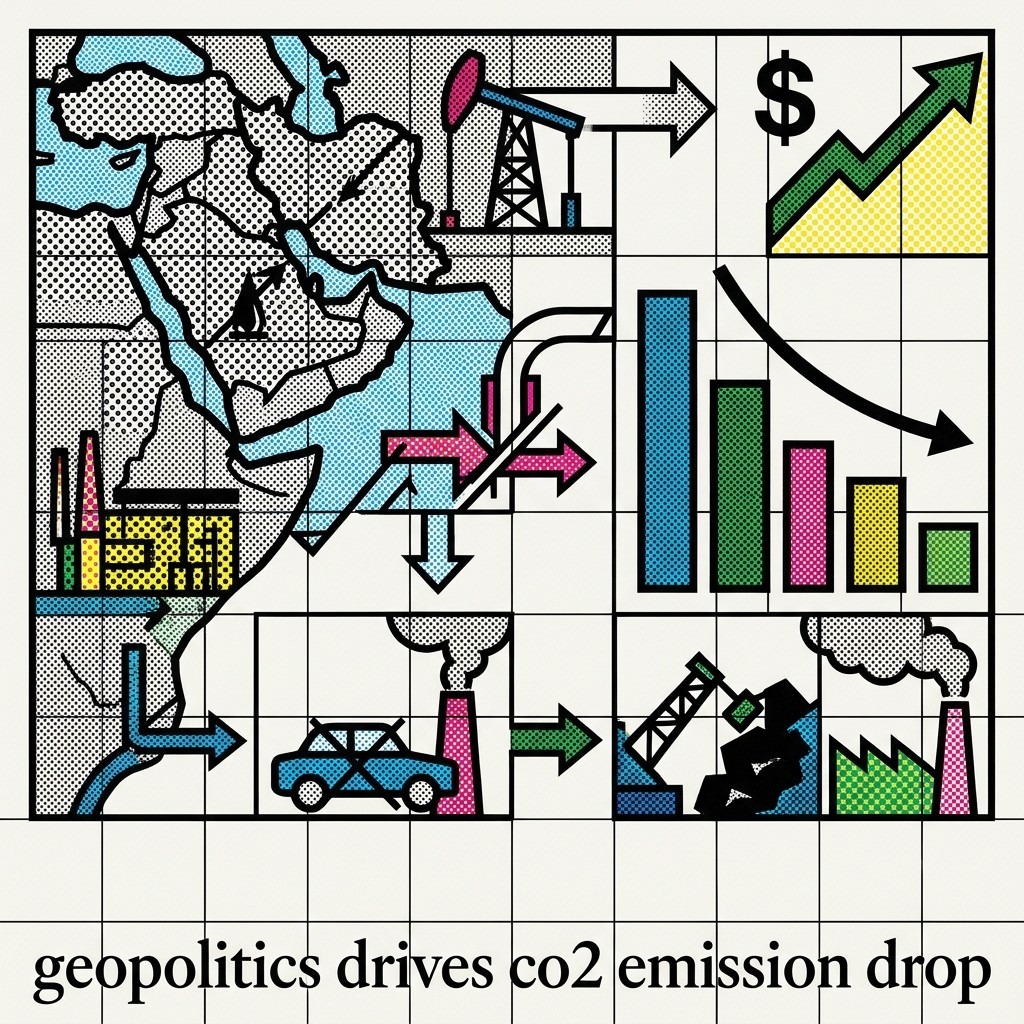
Iran’s war has produced the first fall in global carbon dioxide emissions since the 2020 pandemic, the New York Times reported on 10 November, and no climate policy had any part in it. A blockade-driven spike in oil and gas prices worked as a de facto carbon tax that nobody legislated, and its revenue went to producers rather than to clean investment.
Researchers warn the drop may be short-lived because higher prices make people burn less, but only new capital in power plants, vehicles and grids changes what they burn. Sceptics also have a fair point: demand destroyed by a supply shock is recession and rationing by price, and coal switching could erase the gain.
The emissions story and the cost-of-living story are one shock, and Europe, which imports its energy, is paying for it: ifo, Munich’s economic research institute, put German firms’ price expectations at 25.9 points on 30 October.
The Gist AI Editor
|
The Global Overview
Iran war cuts global carbon emissions for the first time since 2020
The Iran war unexpectedly drove down carbon emissions this year, the first fall in planet-warming pollution since the 2020 pandemic, according to the New York Times (10 Nov). Researchers quoted by the paper cautioned that the decline could be short-lived. The price spike behind it is documented by ifo, the Munich-based German economic research institute whose business surveys are a leading economic indicator. On 30 Sep, ifo reported that crude prices had risen sharply again after the blockade of the Bab al-Mandab, the narrow strait at the southern end of the Red Sea that carries oil and container shipping. On 30 Oct, it reported that crude oil and gas prices had reached their highest level since 2022 in the second half of October. The UN’s 31st annual climate summit, COP31, is opening in Antalya, Turkey.
Carney calls Stellantis factory sale “unacceptable”
Canadian Prime Minister Mark Carney said the sale of a factory by Stellantis, the carmaker formed from the merger of Fiat Chrysler and France’s PSA and owner of Jeep, Fiat and Peugeot, is “unacceptable” (WSJ, 10 Nov). He said he is prepared to use whatever legal and policy levers are available to protect the roughly 2,000 workers affected. His statement puts the Canadian government on record against the sale before any specific measures have been announced.
Anthropic launches office tools before its IPO
Anthropic is releasing a video-call assistant, a data-dashboard tool and a spreadsheet service called Claude Sheets, which closely resembles Microsoft Excel and Google Sheets (Bloomberg, 10 Nov). The launch puts the company in sharper competition with two of its backers, Microsoft and Google. It comes as investors question a $1.5 trillion valuation, and broader products give prospective public-market buyers more revenue sources to assess ahead of a listing.
Oura buys Counsel Health; NASA shows X-70 Fractal
Oura agreed to acquire the AI and on-demand doctor service Counsel Health for $625 million, expanding its business after it scrapped an attempt to go public (Bloomberg, 10 Nov). Separately, NASA announced an experimental aircraft, the X-70 Fractal, designed to explore new flight capabilities (Wired, 10 Nov). No actual photos have been released, and details of its design and operation remain under wraps.
Stay tuned for the next Gist, your edge in a shifting world. The Gist remains independent and reader-supported. If you value news free from corporate or state interests, consider supporting our mission with a donation.
|
The European Perspective
Aigner’s “above party” pitch meets a closed door for AfD and Linke
Ilse Aigner, a member of Bavaria’s CSU, says she wants to be Germany’s Bundespräsidentin (federal president, the ceremonial head of state) “with heart and mind” and to work for a “new unity” (ZDF). Politicians from the Union (the CDU/CSU bloc) and the SPD call her “überparteilich”, meaning above party politics, but she is not speaking to the AfD or the Linke for the time being (ZDF). On Tuesday she visited the SPD parliamentary group (ZDF/phoenix). The president is chosen indirectly, so the campaign runs through party caucuses, which makes an office meant to stand above parties a post sponsored by a coalition. Her refusal to talk to two parties shows who actually decides. The office has no executive power, and declining to engage an openly hostile hard-right party “for now” can be defended as protecting the post’s dignity, but unity talk that leaves out those two parties is still partisan.
German, US and Canadian space agencies plan a lunar greenhouse
The German Aerospace Center (DLR), together with NASA and the Canadian Space Agency, is developing a concept for greenhouses on the Moon to grow vegetables for astronauts (Euronews). The work is at the research-concept stage.
Italian finance police seize over 7,000 counterfeit goods in Sicily
Italy’s Guardia di Finanza raided four shops across Catania, Misterbianco, San Giovanni la Punta and Giarre, seizing more than 7,000 fake products (Il Sole 24 Ore). The goods included mini phones, earbuds, consoles, glasses and playing cards copying brands such as Nintendo, Pokemon, Apple and Louis Vuitton.
Catch the next Gist for the continent’s moving pieces.
|
The Data Point
378 days: that’s how long four volunteers in NASA’s CHAPEA Mars simulation stayed sealed inside a habitat at Johnson Space Center in Houston, emerging on Oct. 31. That’s more than a full year of fake Mars life, and the health and performance data from it will help shape future Artemis and Moon Base missions.
|
|
The Editor’s Listenings
Sun Araw – Proper (2026)
A loose, groove-led opener that drifts from song-shaped warmth toward hazy abstraction.
|
|
|
|
🎙️ Listen to this edition as a podcast
|
Listen
|
|
|
|