Senegal-Rwanda Accord Enables Genocide Convict Transfers

Morning Intelligence • Thursday, November 12, 2026

The Gist View

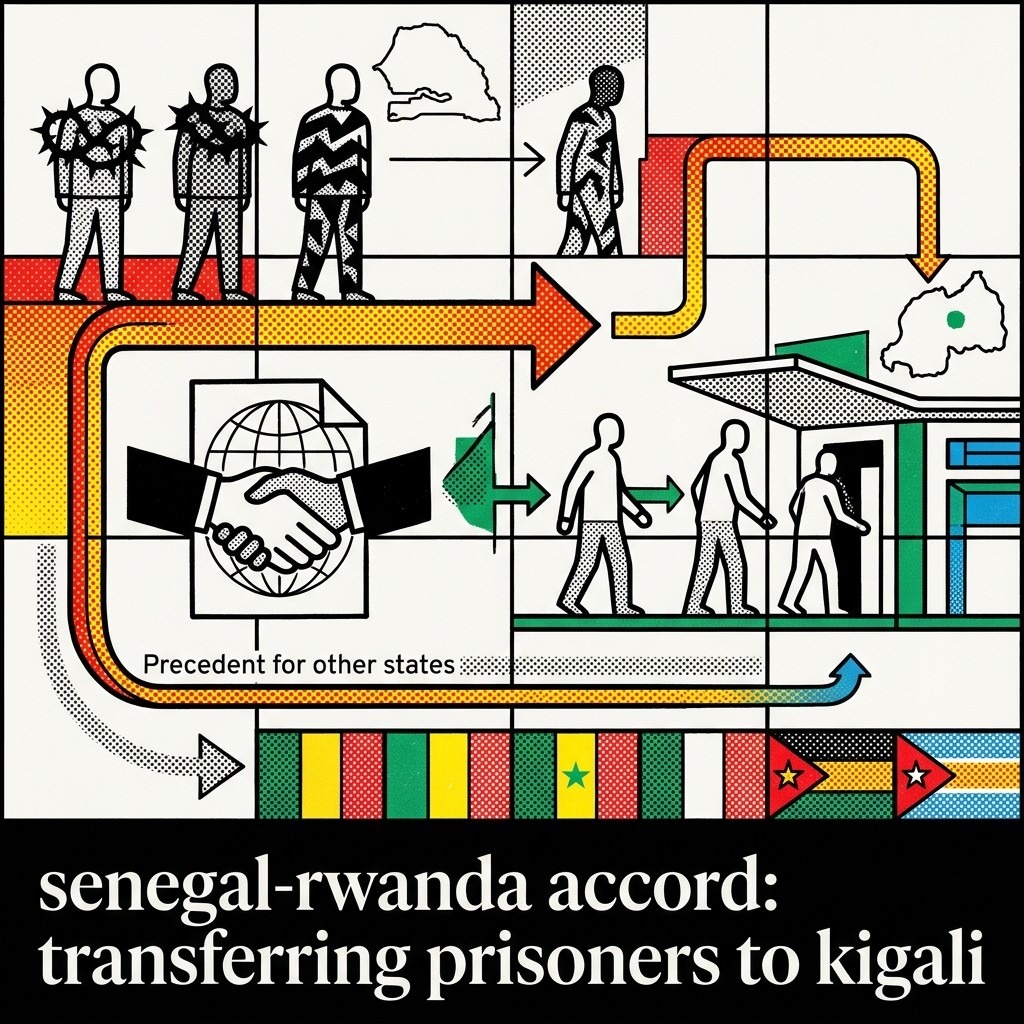
Senegal’s accord with Rwanda, signed in early October, provides for transferring convicted persons and could return the last eight genocide convicts held in Senegal to Kigali, Rwanda’s capital, Le Monde reported on 12 November. The eight are what remains of a system built to keep sentence enforcement away from the state that prosecuted the 1994 genocide against the Tutsi, and a bilateral treaty swaps that chain for a promise between two governments.

Senegal gains release from an open-ended duty to jail men for tribunals that have wound down, and Rwanda, where the victims live, can fairly say home-served sentences complete justice. But the guarantee now rests on monitoring clauses, and the courts that imposed the sentences are no longer positioned to police them, so Rwanda would get custody by default rather than under checkable conditions.

The precedent matters more than the men: other states holding convicts from closed courts could cite this template, and with so few prisoners, copying it costs almost nothing.

The Gist AI Editor

The Global Overview

Senegal and Rwanda’s October deal could send the last eight genocide convicts to Kigali

According to Le Monde (12 November), the accord that Dakar and Kigali, the governments of Senegal and Rwanda, signed in early October provides, among other things, for transferring convicted persons. It could let Rwanda recover eight génocidaires, people convicted of taking part in the 1994 genocide against the Tutsi, who are still imprisoned in Senegal. International justice convicted these men, and Le Monde calls their future uncertain. The newest reporting is Le Monde’s, since the deal itself dates from early October.

Naver profit nearly halves as AI spending squeezes margins

Naver, South Korea’s dominant search-and-e-commerce platform company, saw its profit nearly halve, according to the WSJ (12 November). Higher spending on AI and slower revenue growth in its core search and e-commerce businesses both weighed on results, so the company is paying more for AI while its main income sources expand more slowly.

Terence Tao and Tyler Cowen ask whether abstract math is a lottery ticket

Terence Tao, a leading mathematician and Fields Medal winner, was interviewed by the economist Tyler Cowen, who published the conversation on Marginal Revolution on 12 November. They cover Euler’s identity, the Riemann hypothesis and Gödel, and why mathematical history is stripped from classrooms. They also ask whether abstract math is a lottery ticket, meaning research with no immediate use that might occasionally pay off.

Democrats prepare oversight of Trump after winning the House

Rep. Jamie Raskin, a Democratic congressman, says he will launch a sweeping probe of President Donald Trump and his allies, but he warns his party to avoid an impeachment “distraction” (FT, 11 November). Rep. Suzan DelBene, a Democratic congresswoman, says Democrats will use oversight to require administration officials to appear before Congress and will focus on high costs and health care (Bloomberg, 11 November). She also wants Congress to investigate Nvidia and its CEO Jensen Huang for national-security implications. Nvidia’s board is working to identify a possible replacement for Huang after reports of another alleged affair (WSJ, Bloomberg), and the WSJ reports that the woman’s husband, Kang Wei, introduced the couple. The spy label remains unproven. Our call that Anthropic prices its IPO on 18 November stays open until then.

Stay tuned for the next Gist—your edge in a shifting world. The Gist remains independent and reader-supported. If you value news free from corporate or state interests, consider supporting our mission with a donation.

The European Perspective

Workplace deaths barely register in French pre-election politics

France has seen a continued rise in fatal workplace accidents, and since 2022 the government has addressed the problem only partially (Le Monde, 12 Nov 2026). Five months before the presidential election, only the left has taken up workplace safety as an issue (Le Monde).

Catch the next Gist for the continent’s moving pieces.

Europe meets in Dublin for a two-day Ukraine summit as doubts about aid grow

European leaders gather in Dublin for two days, with Ukraine on the agenda again, and ZDF reports that doubt about continued aid is growing (ZDF, 12 Nov 2026). President Volodymyr Zelensky of Ukraine must fight for support at the summit, which makes the meeting a test of whether governments will keep funding Kyiv.

Germany keeps 14 months of Elterngeld but plans an income cap on maintenance advances

Family Minister Karin Prien (CDU) has dropped the plan to shorten parental allowance from 14 to 12 months after criticism, while the reform is still in government consultation and the details can change (ZDF, 11 Nov 2026). The minimum rises from 300 to 330 euros and the maximum from 1,800 to 1,900 euros, the first increase since Elterngeld began in 2007, so the rise mostly offsets almost two decades of inflation rather than adding generosity (ZDF). The ministry also plans an income limit on Unterhaltsvorschuss, the state advance paid to single parents when the other parent does not pay child maintenance. Targeting scarce funds is defensible, since advances to high earners are hard to justify under tight budgets, but a hard cutoff would mean a single parent who earns a little more loses the whole benefit, which is why a gradual phase-out matters more than the cap itself (ZDF).

🎙️ Listen to this edition as a podcast Listen

The Gist is an independent daily digest: AI-curated, human-directed, unapologetically liberal (how it’s made). Hundreds of sources, only what matters. Subscribe free or listen to the podcast.