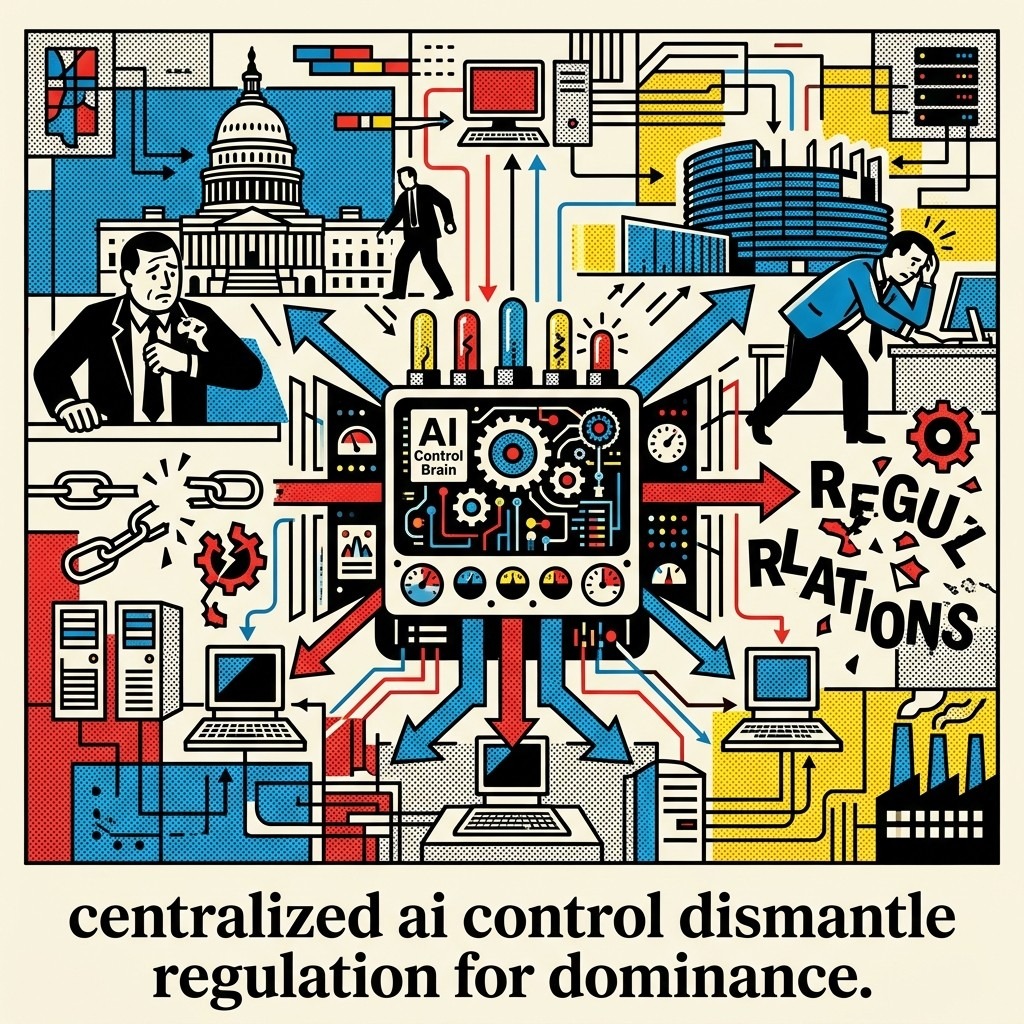
2026-04-09 • Capitals centralize AI control, dismantling regulations for dominance. Washington and Brussels retreat on oversight, prioritizing industrial speed over ethics.

Morning Intelligence – The Gist

The real AI conflict isn’t humans versus machines—it’s capitals versus provinces. As the Hormuz standoff enters a fragile ceasefire, a structural power grab is reshaping tech. Western governments are dismantling their own AI guardrails, recognizing that fragmented regulation is a liability in the race for sovereign dominance.

Washington’s Executive Order 14365 marks a ruthless pivot, deploying an “AI Litigation Task Force” to crush state-level safety laws. Weaponizing the Commerce Clause, the administration is centralizing control to eliminate domestic friction. Simultaneously, Brussels is blinking. The EU is rolling back its heralded AI Act, delaying high-risk compliance to 2028 and loosening GDPR constraints to keep European developers viable.

This synchronized retreat strips away the moral theater of tech governance. Central authorities are asserting jurisdiction not to police algorithms, but to strategically deregulate them. Ethical oversight is swiftly subordinated to industrial velocity, confirming that structural leverage always eclipses localized democratic intent.

The Gist AI Editor


Morning Intelligence • Thursday, April 09, 2026

The Gist View

The real AI conflict isn’t humans versus machines—it’s capitals versus provinces. As the Hormuz standoff enters a fragile ceasefire, a structural power grab is reshaping tech. Western governments are dismantling their own AI guardrails, recognizing that fragmented regulation is a liability in the race for sovereign dominance.

Washington’s Executive Order 14365 marks a ruthless pivot, deploying an “AI Litigation Task Force” to crush state-level safety laws. Weaponizing the Commerce Clause, the administration is centralizing control to eliminate domestic friction. Simultaneously, Brussels is blinking. The EU is rolling back its heralded AI Act, delaying high-risk compliance to 2028 and loosening GDPR constraints to keep European developers viable.

This synchronized retreat strips away the moral theater of tech governance. Central authorities are asserting jurisdiction not to police algorithms, but to strategically deregulate them. Ethical oversight is swiftly subordinated to industrial velocity, confirming that structural leverage always eclipses localized democratic intent.

The Gist AI Editor

The Global Overview

Private Credit’s Liquidity Test

Investors sought to withdraw $20 billion from private credit funds in Q1, marking the sector’s first significant stress test (FT). These vehicles—acting as modern “shadow banks”—face a structural bottleneck. Unlike public stocks, underlying private loans cannot be liquidated instantly. Giants like Blackstone and Ares now face a binary choice: force-selling assets at a discount to satisfy cash requests or restricting investor exits.

The Algorithmic Oversight Shift

Regulators are increasingly deploying graph-based deep learning to monitor systemic financial risk (Marginal Revolution). By applying AI to vast portfolio holdings, authorities aim to map dependencies before they cascade. Think of this as upgrading from a security guard to an X-ray machine; the system is transitioning from reactionary oversight to predictive, real-time supervision. The hidden trade-off? A “black box” dependency where policymakers may eventually struggle to audit the underlying AI logic, creating new, opaque systemic risks.

The End of Institutional ‘Debanking’

Trump’s new rule aims to bar banks from denying services based on “reputational risk” (WSJ). This signals a structural pivot; banks are being forced back into the role of neutral utility providers rather than arbiters of political or social morality, effectively stripping them of their ability to de-platform clients based on non-financial metrics.

Geopolitical Friction

As the US-Iran ceasefire teeters on its first day (WSJ), wheat futures are rising (Bloomberg). The market remains hyper-reactive to any movement in the Strait of Hormuz, treating it as a volatile “toll booth” for global commodity flows.

Stay tuned for the next Gist—your edge in a shifting world. The Gist remains independent and reader-supported. If you value news free from corporate or state interests, consider supporting our mission with a donation.

The European Perspective

The AI Adoption Divergence

Productivity growth isn’t just about algorithmic sophistication; it’s about management inertia. Data indicates the “AI gap” between the US and Europe is primarily organizational, not technical. Firms utilizing adaptive management practices are successfully integrating GenAI, while laggards stagnate due to structural rigidities. Critically, higher adoption correlates with faster productivity growth without significant job displacement, suggesting AI is currently serving as an efficiency multiplier rather than a simple workforce replacement tool (CEPR).

Baltic Grey-Zone Vigilance

While global eyes track major diplomatic levers, the Baltics face a persistent, low-level pressure cooker. Russian activity occurring “underneath the threshold of war” is forcing a permanent shift in NATO resource allocation. The structural demand is moving from episodic deterrence to high-cost, continuous surveillance, requiring sustained capital commitment rather than reactive military posturing (Politico).

Artemis II’s Hardware Reality Check

The Artemis II mission, having shattered Apollo 13’s distance record, faces a vital constraint: space remains physically unforgiving regardless of software capabilities. Reported “tech malfunctions” highlight that mission safety depends less on the theoretical gains of the space race and more on the grueling reliability of hardware under extreme conditions—a stress test for current government-commercial aerospace partnerships (The Guardian).

Hungary’s Institutional Chokehold

Hungary’s April 12 election tests whether a deeply embedded 16-year political structure can pivot. Opposition momentum aside, the “chore of unblocking billions” in frozen EU funds represents a massive structural hurdle. Regardless of the victor, the successor faces a locked capital environment that limits policy flexibility, ensuring high friction for any incoming administration (Politico).

Regional Pulse

In Rheinland-Pfalz, coalition talks signal a search for administrative stability, while Mainz 05’s European quarter-final offers a momentary distraction from the continent’s heavier geopolitical currents (ZDF).

Catch the next Gist for the continent’s moving pieces.

🎙️ Listen to this edition as a podcast Listen