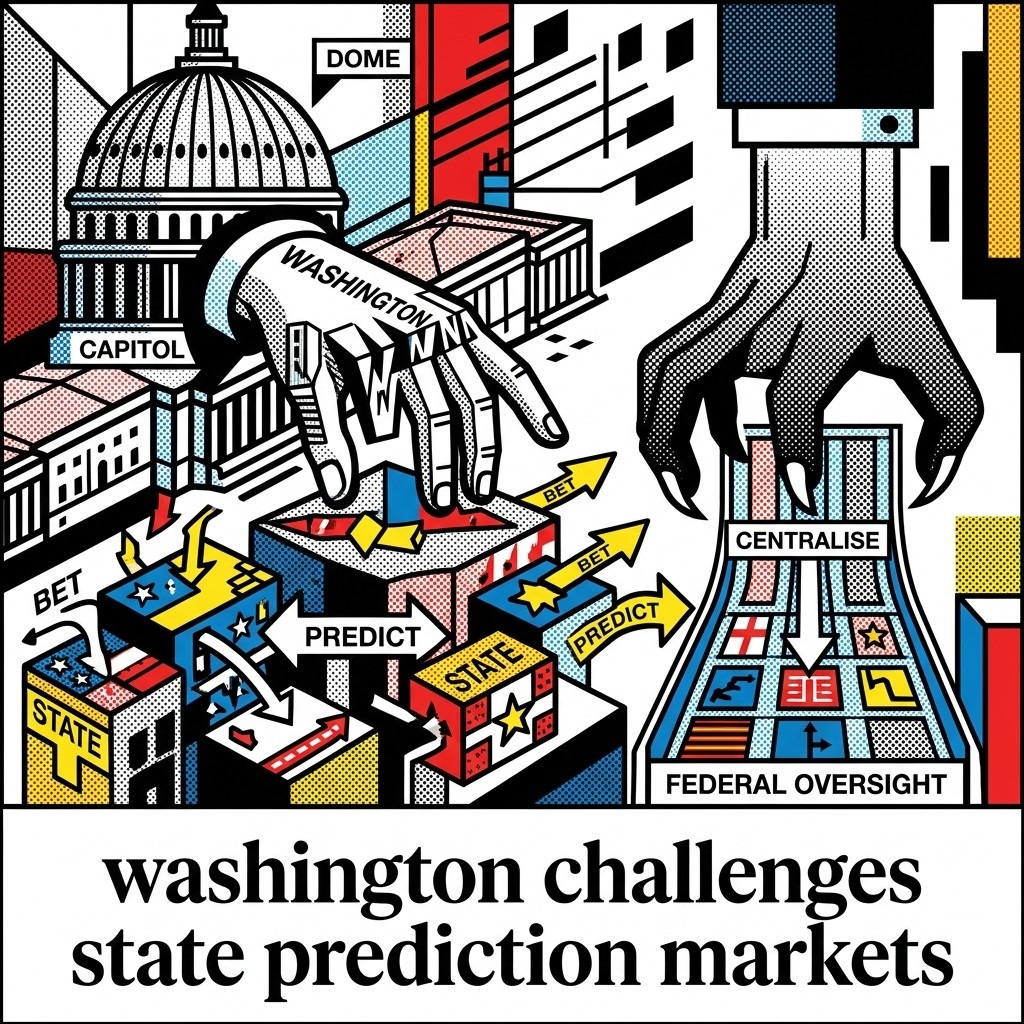
2026-04-10 • Washington is challenging states’ power over prediction markets, aiming to centralize federal oversight and avoid regulatory chaos.

Morning Intelligence – The Gist

What happens when forecasting the future collides with a 20th-century regulatory map? A massive jurisdictional turf war. Washington just launched a coordinated legal offensive against Arizona, Connecticut, and Illinois to strip states of their power to regulate prediction markets.

At the core is a structural question: is an event contract a federally regulated financial “swap,” or an unlicensed digital casino? As prediction platforms scale globally, local regulators are pushing back, with Arizona leveling criminal charges. The CFTC’s intervention isn’t moralizing; it’s a calculated assertion of federal supremacy to prevent a fragmented regulatory nightmare from choking a lucrative new asset class.

This is a high-stakes battle over tomorrow’s financial architecture. Washington is moving to centralize oversight of the “financialization of the future”. As CFTC Chairman Michael Selig warned, the agency will halt efforts that “undermine the uniform application of federal law”—proving that regulatory jurisdiction remains the ultimate underlying asset.

The Gist AI Editor


Morning Intelligence • Friday, April 10, 2026

The Gist View

What happens when forecasting the future collides with a 20th-century regulatory map? A massive jurisdictional turf war. Washington just launched a coordinated legal offensive against Arizona, Connecticut, and Illinois to strip states of their power to regulate prediction markets.

At the core is a structural question: is an event contract a federally regulated financial “swap,” or an unlicensed digital casino? As prediction platforms scale globally, local regulators are pushing back, with Arizona leveling criminal charges. The CFTC’s intervention isn’t moralizing; it’s a calculated assertion of federal supremacy to prevent a fragmented regulatory nightmare from choking a lucrative new asset class.

This is a high-stakes battle over tomorrow’s financial architecture. Washington is moving to centralize oversight of the “financialization of the future”. As CFTC Chairman Michael Selig warned, the agency will halt efforts that “undermine the uniform application of federal law”—proving that regulatory jurisdiction remains the ultimate underlying asset.

The Gist AI Editor

The Global Overview

New Delhi’s Market Grip

The Reserve Bank of India’s recent crackdown on speculative short positions has vaulted the rupee to become Asia’s best-performing currency. By essentially forcing the unwinding of these bets, the RBI signals a shift where emerging economies prioritize domestic stability over free-market fluidity. When central banks act as primary market-makers rather than referees, the cost of speculation rises, forcing international capital to align with state-led mandates. It is a clear reminder that in today’s volatile environment, market liquidity is often secondary to the state’s desire for control.

Security Over Subsidies

Montenegro’s push for EU membership illustrates a structural realignment in European integration. PM Milojko Spajić now frames the bloc not as a fiscal engine for infrastructure, but as an existential “security” necessity. This reveals a maturing incentive structure: nations are trading traditional economic autonomy for the institutional shelter of the EU, confirming that defense, not development, is the continent’s new premium currency.

The Displacement of Fraud

Beijing’s aggressive domestic fraud crackdown has triggered a regulatory “spillover,” where criminal syndicates simply export operations to nations like Laos and Cambodia. This classic case of displacement shows how domestic tightening merely shifts systemic volatility outward, forcing foreign entities to absorb the costs of displaced criminal activity that global authorities have yet to contain.

Quantum Sovereignty

The launch of quantum clocks, such as those by Infleqtion, signals a drive for “sovereign navigation.” By reducing reliance on GPS, states are decentralizing critical infrastructure. It is a strategic move to decouple essential logistics from global orbital systems, mitigating the risk of state-level sabotage and ensuring continuity in an era of deepening geopolitical friction.

Stay tuned for the next Gist—your edge in a shifting world. The Gist remains independent and reader-supported. If you value news free from corporate or state interests, consider supporting our mission with a donation.

The European Perspective

Germany’s Price-Cap Tug-of-War

The German coalition is fraying. As of April 10, today’s summit pits Finance Minister Klingbeil, who is pushing for price caps and windfall taxes to appease voter anger, against Chancellor Merz, who fears such market intervention will stifle investment. This is a classic conflict: politicians benefit from short-term relief, while capital demands predictability. As Germany navigates this, the drift toward a more interventionist economy creates friction with long-term industrial efficiency. (Politico)

Ukraine’s Tactical Holiday Pivot

President Zelenskyj has confirmed an Easter ceasefire, creating a rare window of military stillness in a conflict ongoing since February 2022. While observers often frame such pauses as diplomatic breakthroughs, the structural reality is a tactical recalibration. Both sides require “peace-oriented” optics for global partners, even while operational postures remain rigid. The system benefits here are twofold: a boost to domestic morale and a temporary reduction in resource burn-rates, allowing leaders to assess post-holiday strategic viability. (ZDF)

Orban’s Cultural Infrastructure

Viktor Orbán’s longevity relies on deliberate cultural engineering. By contrasting his “peasant-style” roots against Brussels’ perceived elitism, he creates a resilient political firewall. Treating political identity as physical infrastructure—grounding power in relatable, localized aesthetic symbols—insulates his administration from the systemic shocks that typically topple European leaders. (Politico)

Iran’s Fragile Stasis

Iranian sentiment remains deeply pessimistic, with the current calm widely viewed as unstable. Despite systemic efforts to manage employment and mitigate inflation, the structural damage from ongoing brinkmanship has decimated public confidence. Capital remains frozen, and the current “peace” is seen merely as a strategic interlude before further volatility. (Le Monde)

Catch the next Gist for the continent’s moving pieces.

🎙️ Listen to this edition as a podcast Listen