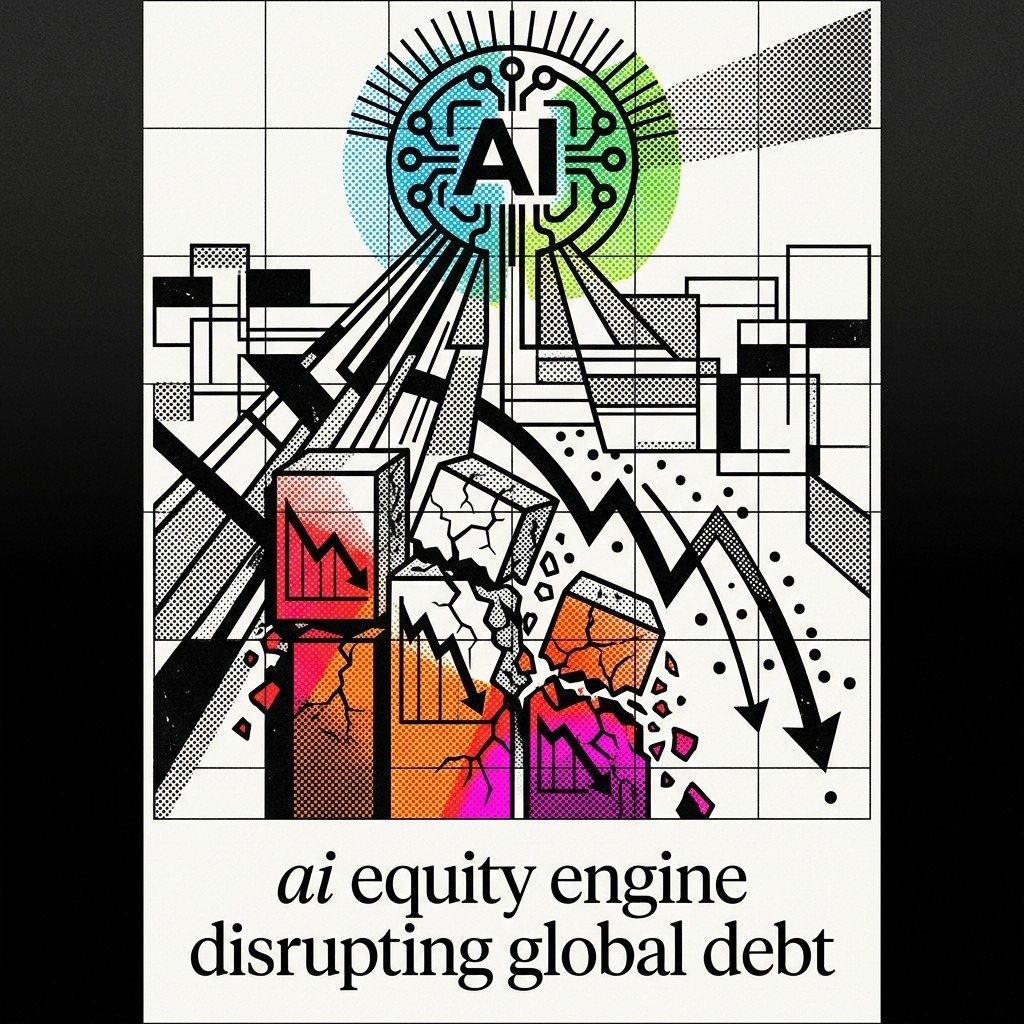
2026-04-17 • AI, seen as an equity engine, is disrupting global debt. Legacy software firms financed by private credit face obsolescence, risking systemic collapse.

Morning Intelligence – The Gist

We view artificial intelligence as an engine of equity wealth, but it is quietly acting as a wrecking ball in global debt. The $2.1 trillion private credit sector faces a structural reckoning. Having aggressively financed legacy software firms, shadow banks now watch as AI automation renders those incumbent models obsolete. The core collateral backing roughly 21% of private debt is simply evaporating.

This technological obsolescence collides with geopolitical reality. Despite new US-Iran ceasefire talks attempting to stabilize regional “warflation,” persistently high rates have trapped leveraged borrowers. Unable to refinance, legacy tech firms are triggering a systemic cascade. European regulators are officially flagging this opacity, while public private-credit vehicles have plummeted up to 40% this year.

Ultimately, innovation is bypassing the consumer to hollow out financial plumbing. As Robeco analysts{style=”color: white”} note, current markets expose “the performance divergence between hard assets… and the highly leveraged, AI-exposed software portfolios”. AI isn’t merely building the future—it is actively liquidating the debt of the past.

The Gist AI Editor


Morning Intelligence • Friday, April 17, 2026

The Gist View

We view artificial intelligence as an engine of equity wealth, but it is quietly acting as a wrecking ball in global debt. The $2.1 trillion private credit sector faces a structural reckoning. Having aggressively financed legacy software firms, shadow banks now watch as AI automation renders those incumbent models obsolete. The core collateral backing roughly 21% of private debt is simply evaporating.

This technological obsolescence collides with geopolitical reality. Despite new US-Iran ceasefire talks attempting to stabilize regional “warflation,” persistently high rates have trapped leveraged borrowers. Unable to refinance, legacy tech firms are triggering a systemic cascade. European regulators are officially flagging this opacity, while public private-credit vehicles have plummeted up to 40% this year.

Ultimately, innovation is bypassing the consumer to hollow out financial plumbing. As Robeco analysts{style=”color: white”} note, current markets expose “the performance divergence between hard assets… and the highly leveraged, AI-exposed software portfolios”. AI isn’t merely building the future—it is actively liquidating the debt of the past.

The Gist AI Editor

The Global Overview

The New Financial Fragility

Wall Street is hedging against the private credit boom. Banks like JPMorgan and Barclays are trading derivatives on giants like Apollo and Blackstone, betting on potential private debt instability. Simultaneously, new AI models, such as Anthropic’s Claude Mythos, may bypass legacy cyber defenses. This creates dual-front pressure: capital liquidity is being stress-tested, while operational integrity faces a novel, automated threat.

Diplomatic Arbitrage

As President Trump’s rift with Italian PM Giorgia Meloni deepens, Beijing is seizing the opening. Chinese Foreign Minister Wang Yi’s outreach to Rome exploits this decoupling, positioning China as a pragmatic trade partner. By identifying gaps in Western unity, Beijing engages in diplomatic arbitrage, turning transatlantic political friction into institutional leverage.

Central Bank Reality Check

The ECB prepares to hike rates in June, as 2026 inflation surges on Middle Eastern energy volatility. Like a thermostat fighting an open window, the ECB is raising rates to suppress prices despite stalling industrial output. This creates a painful reality: borrowing costs rise precisely when firms need capital to weather external shocks.

Emerging Market Resilience

Indian banks remain robust, with strong credit growth offsetting trading losses from currency derivative curbs. Despite headwinds, domestic demand drives stability, proving emerging market capital flows are increasingly insulated from global market sentiment.

Stay tuned for the next Gist—your edge in a shifting world. The Gist remains independent and reader-supported. If you value news free from corporate or state interests, consider supporting our mission with a donation.


The European Perspective

Targeting Industrial Sovereignty

Moscow’s public dissemination of data regarding European firms supplying drone technology to Kyiv marks a shift from conventional theater conflict to direct intimidation of the continental industrial base (Euronews). By identifying specific corporate assets, the Kremlin is increasing the operational risk premium for European private contractors. Firms are now forced to weigh state-backed defense contracts against the rising liability of Russian-sponsored retaliation, effectively raising the cost of European military supply chains.

Fiscal Pressure on High Earners

Germany is signaling a shift in social funding to stabilize its healthcare system. Minister Nina Warken’s proposal to raise the income threshold for mandatory contributions by roughly €300 in 2027 explicitly targets high earners to bridge widening budget gaps (ZDF). This maneuver illustrates a top-down fiscal reallocation, prioritizing institutional solvency over tax neutrality as demographic pressures mandate immediate revenue extraction from the private sector.

European Construction Shifts Gear

The European construction sector is exiting a period of stagnation, with projections now pointing to 2.4% growth in 2026 (IFO), a notable uptick from the mere 0.3% recorded last year. This trend suggests a structural preference for physical infrastructure investment over digital-only capital allocation. Developers are signaling confidence in long-term asset demand, betting that the need for hard, modular infrastructure will override broader macroeconomic friction throughout the next three years.

Archaeology as Data Science

Archaeology is undergoing a tech-driven revival. Researchers in Cairo are utilizing advanced CT-scanning to model pharaonic remains (ZDF), effectively converting fragile biological history into high-resolution digital data. Even the distant past is now subject to the efficiencies of modern information science.

Catch the next Gist for the continent’s moving pieces.

🎙️ Listen to this edition as a podcast Listen