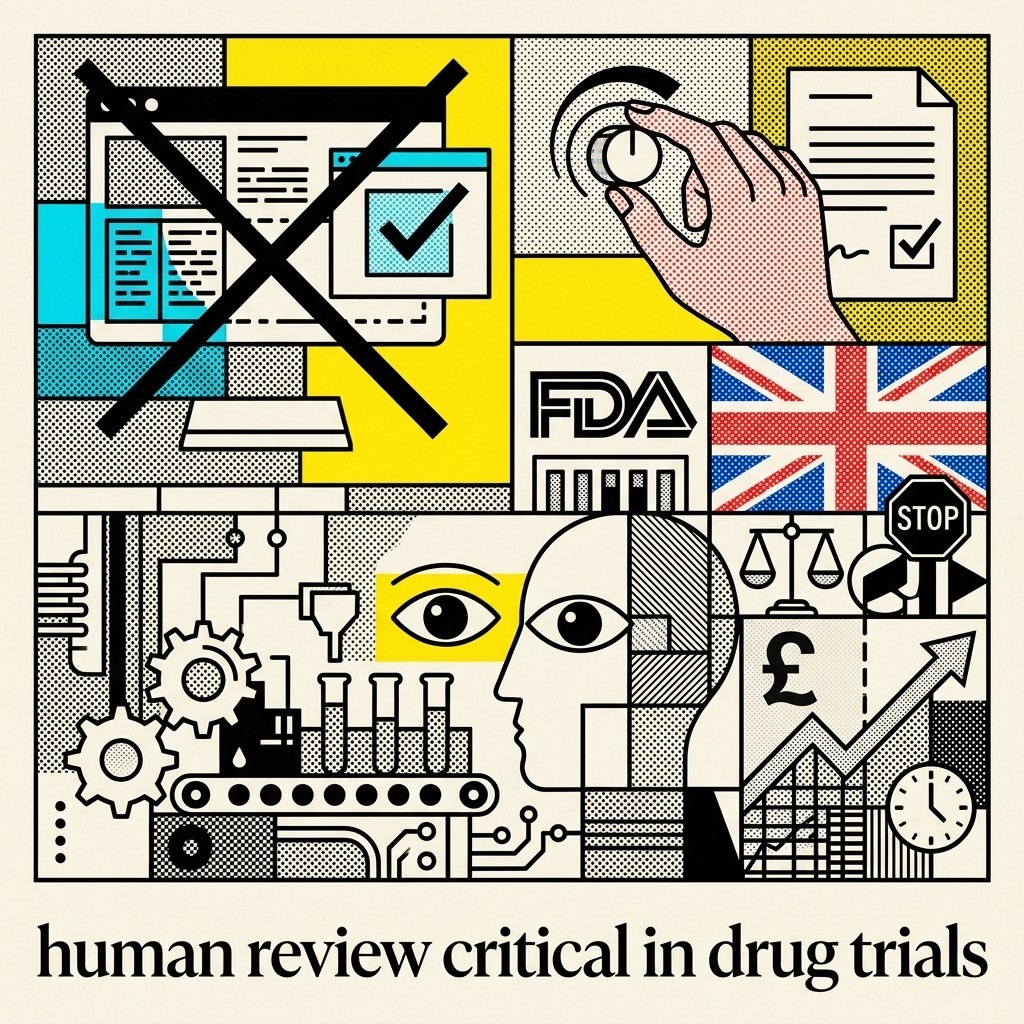
2026-04-28 • FDA warns against AI-only validation in drug manufacturing, emphasizing human oversight. UK updates trial regs amid economic pressures; human input is vital.

Morning Intelligence – The Gist

The defining battle over biological engineering isn’t happening in a lab—it’s playing out in compliance departments. Yesterday, the FDA issued its first warning letter penalizing a drug manufacturer for delegating process validation entirely to artificial intelligence.

This shatters the assumption that AI can unilaterally drive biotech scaling. Regulators are establishing a structural boundary: algorithms can optimize, but human liability retains the final veto. Simultaneously, the UK activated its revised clinical trial regulations today, safely codifying AI modeling to front-run the impending EU Biotech Act.

This reckoning collides with tightening capital. With the Bank of Japan holding rates at 0.75% today and the Hormuz standoff entering its ninth week, expensive money pushes firms toward automation. Yet states demand human friction remain embedded in production. As Dot Compliance notes, the FDA mandate proves “humans are the heroes of AI in quality”. Code may design the drug, but humans underwrite the risk.

The Gist AI Editor


Morning Intelligence • Tuesday, April 28, 2026

The Gist View

The defining battle over biological engineering isn’t happening in a lab—it’s playing out in compliance departments. Yesterday, the FDA issued its first warning letter penalizing a drug manufacturer for delegating process validation entirely to artificial intelligence.

This shatters the assumption that AI can unilaterally drive biotech scaling. Regulators are establishing a structural boundary: algorithms can optimize, but human liability retains the final veto. Simultaneously, the UK activated its revised clinical trial regulations today, safely codifying AI modeling to front-run the impending EU Biotech Act.

This reckoning collides with tightening capital. With the Bank of Japan holding rates at 0.75% today and the Hormuz standoff entering its ninth week, expensive money pushes firms toward automation. Yet states demand human friction remain embedded in production. As Dot Compliance notes, the FDA mandate proves “humans are the heroes of AI in quality”. Code may design the drug, but humans underwrite the risk.

The Gist AI Editor

The Global Overview

Central Bank Volatility

The Bank of Japan’s decision to raise inflation forecasts has sent the yen surging, tightening global liquidity. Think of this as a central bank closing the spigot on a high-pressure firehose; the “easy money” used to fund international bets is drying up, forcing investors across the globe to rapidly re-price risk. As these carry trades unwind, market volatility is the inevitable side effect.

The Exodus of Capital

California’s proposed wealth tax is accelerating a structural exit of assets, with $777 billion already fleeing the state (WSJ). When tax regimes ignore the hyper-fluidity of modern capital, money simply moves to lower-friction environments. This leakage illustrates a fundamental shift in institutional leverage: high-mobility capital now exerts more power over state policy than legislative mandates ever could. The state loses not just revenue, but the base required to sustain its infrastructure.

Biological Infrastructure

FDA approval for Motif Neurotech’s brain implants marks a transition from experimental research to commercialized biology. As these devices integrate into the human nervous system to treat depression, regulators face a new frontier: governing the “biological software” that could eventually redefine human productivity. This represents a nascent asset class where control over the interface determines the value of the outcome.

Regulatory Friction

Italy’s dispute with Swiss hospitals over emergency medical bills reveals the fragility of transnational services (FT). When state cooperation collapses, individuals—not institutions—become the collateral damage in bureaucratic disputes. It is a stark reminder that “European cohesion” often fails at the service-delivery level, leaving citizens to navigate the resulting vacuum of liability.

Stay tuned for the next Gist—your edge in a shifting world. The Gist remains independent and reader-supported. If you value news free from corporate or state interests, consider supporting our mission with a donation.

The European Perspective

Ukraine’s Trade Friction

Kyiv’s move on Tuesday to summon the Israeli ambassador over disputed grain shipments—allegedly sourced from occupied territories—highlights a critical secondary market risk. The conflict has birthed a grey-market arbitrage incentive, where intermediaries exploit wartime supply chain fragility (ZDF). This creates a structural headache for Western powers: enforcing sanctions against Russia now requires policing complex, multi-jurisdictional trade flows that are increasingly resistant to oversight.

The Romanian Coalition Shift

The decision by Romania’s Social Democrats (PSD) to form a coalition with far-right factions on Monday marks a structural pivot in European political risk. By abandoning the cordon sanitaire—the long-standing informal agreement excluding the far-right from power—the center-left has prioritized immediate governance over ideological purity (Politico). The systemic incentive here is clear: as traditional party blocs fracture, political survival necessitates opportunistic alliances. This realignment signals to investors that national policy in Eastern Europe is becoming increasingly tactical, less predictable, and structurally detached from pan-European party cohesion.

Institutional Friction in Venice

The La Fenice opera house’s dismissal of incoming music director Beatrice Venezi reveals the defensive mechanics of legacy institutions. Following her public remarks on nepotism, the organization terminated her contract—months before her start date—to protect established power structures (BBC). It is a classic clash between structural incumbents and external disruption; when institutional culture views merit-based reform as an existential threat, the institution will almost invariably eject the catalyst.

Catch the next Gist for the continent’s moving pieces.

🎙️ Listen to this edition as a podcast Listen