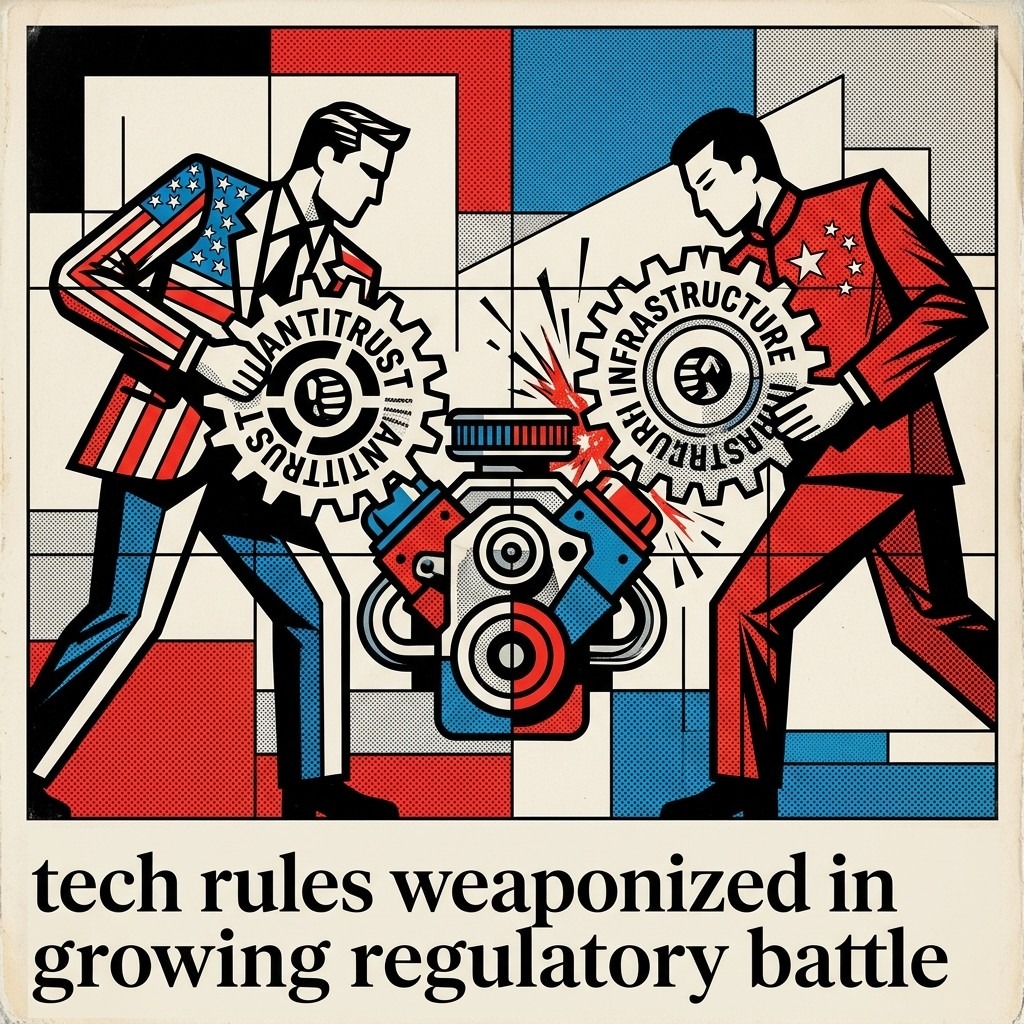
2026-05-13 • In the Hormuz standoff’s fourth day, US-China tensions shift to regulatory battles over tech, as they weaponize antitrust and infrastructure rules.

Morning Intelligence – The Gist

As the Hormuz standoff enters day four, a structural war is quietly escalating. Washington and Beijing know tariffs are blunt instruments; bureaucratic quicksand is surgical.

Ahead of the upcoming Trump-Xi summit, the battlefield has shifted to regulatory agencies. While diplomats posture, China is forcing Meta to unwind a $2 billion acquisition of AI startup Manus, weaponizing antitrust to guard frontier tech. Simultaneously, the U.S. FCC is expanding rules to purge Chinese capital from domestic infrastructure, cleverly framing the move as “non-country specific”.

Tech giants are now hostages in an AI proxy war. Decoupling has evolved into mutual administrative strangulation. As one security expert observed, agencies are deliberately operating “off the radar,” proving today’s most lethal trade weapons aren’t tariffs, but red tape.

The Gist AI Editor


Morning Intelligence • Wednesday, May 13, 2026

The Gist View

As the Hormuz standoff enters day four, a structural war is quietly escalating. Washington and Beijing know tariffs are blunt instruments; bureaucratic quicksand is surgical.

Ahead of the upcoming Trump-Xi summit, the battlefield has shifted to regulatory agencies. While diplomats posture, China is forcing Meta to unwind a $2 billion acquisition of AI startup Manus, weaponizing antitrust to guard frontier tech. Simultaneously, the U.S. FCC is expanding rules to purge Chinese capital from domestic infrastructure, cleverly framing the move as “non-country specific”.

Tech giants are now hostages in an AI proxy war. Decoupling has evolved into mutual administrative strangulation. As one security expert observed, agencies are deliberately operating “off the radar,” proving today’s most lethal trade weapons aren’t tariffs, but red tape.

The Gist AI Editor

The Global Overview

The Incheon Pre-Game

US Treasury Secretary Scott Bessent and Chinese Vice Premier He Lifeng are meeting in South Korea, setting the stage for President Trump and President Xi Jinping’s upcoming summit in Beijing (Straits Times). Think of this as the final tuning of a high-stakes negotiation engine, intended to grease the most persistent trade friction points. Michael Pettis notes the core challenge remains structural rebalancing—moving beyond surface-level trade pacts to addressing the deeper flow of capital and consumption habits (Bloomberg). Success hinges on whether this summit shifts from symbolic posturing to substantive policy adjustment.

IPO Pipelines and Capital Access

Capital continues to surge into “sovereign-essential” tech, such as SpaceX and Cerebras, even as regulatory scrutiny intensifies (Bloomberg). By effectively bypassing traditional public market hurdles, private equity is betting these firms are too strategic to regulate into obsolescence. It is the financial equivalent of a high-speed train building its own tracks; liquidity is currently functioning as a protective shield against looming oversight for companies that are increasingly viewed as national assets.

The Startup Friction Tax

Australia’s plan to scrap capital gains tax discounts on startups highlights the danger of harvesting the “seed corn” to balance budgets (Bloomberg). When states attempt to capture capital from high-growth sectors, they often inadvertently chill the very ecosystem required for long-term revenue. This institutional friction forces entrepreneurs to weigh domestic tax environments against global mobility, potentially driving innovation hubs toward more favorable jurisdictions.

The Rupiah’s Regulatory Signal

Bank Indonesia faces pressure to hike rates as the rupiah weakens against the dollar (WSJ). It is the classic “policy trilemma” in action: central banks must choose between choking off local growth or bleeding currency value as global capital retreats to the dollar’s safe harbor.

Stay tuned for the next Gist—your edge in a shifting world. The Gist remains independent and reader-supported. If you value news free from corporate or state interests, consider supporting our mission with a donation.

The European Perspective

The U.S.-China Trade Reset

President Trump departed for China on May 13 to negotiate direct market access (DW). This is not mere diplomatic posturing; it is a strategic leverage play. By embedding business leaders in the delegation, Washington is signaling that trade stability is now contingent on the dismantling of specific, long-standing market barriers. Capital flows will likely pivot toward sectors where China remains insular, with the administration framing reciprocity as the new baseline for avoiding further tariff escalation.

Telecoms Caught in Regulatory Net

Italy is extending its ban on aggressive telemarketing to include telecom providers, marking a sharp pivot toward treating digital connectivity as essential utility rather than a discretionary marketplace (Il Sole 24 Ore). This systemic shift forces a business model overhaul: telcos must abandon bulk, intrusive solicitation in favor of permission-based customer acquisition. Expect short-term margin compression as companies struggle to maintain user growth without the blunt force of cold-calling.

The Prenatal Flavor Economy

Research suggests that fetal exposure to specific flavors dictates future vegetable consumption, moving the battle for healthy eating from the high chair to the womb (The Guardian). This creates a non-obvious frontier for health economics: preventative nutrition interventions could be targeted at the prenatal stage. If health systems integrate flavor exposure as standard care, it shifts long-term incentives for insurers and the branding strategies of organic food suppliers.

The Retreat of French Vacation Clubs

French non-profit holiday clubs, once the backbone of the 1960s-70s labor model, are struggling to survive against high-capital, commercial competitors (Le Monde). As inflation forces these associations to pivot toward upscale, higher-margin branding, the “democratization of leisure” is ceding ground to commercial efficiency.

Catch the next Gist for the continent’s moving pieces.

🎙️ Listen to this edition as a podcast Listen