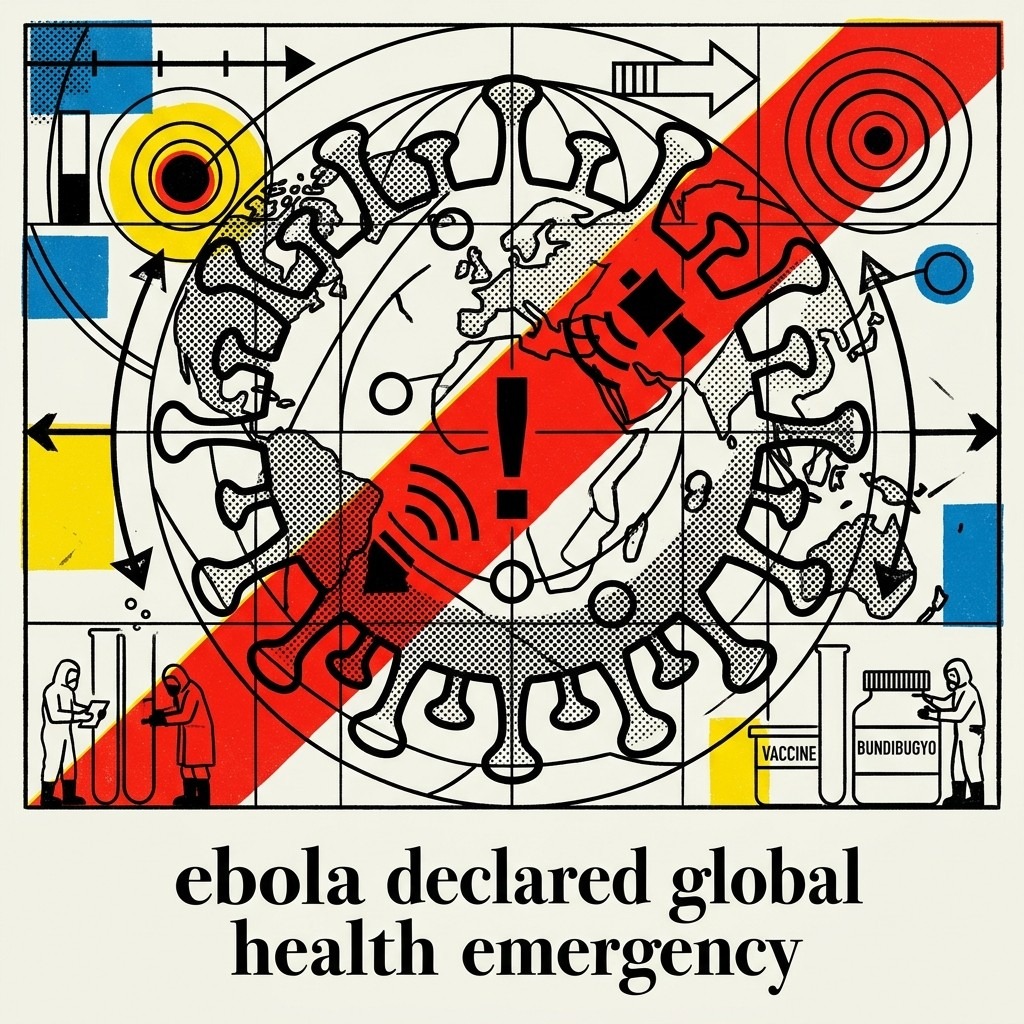
2026-05-17 • WHO declares Ebola outbreak a global emergency. The Bundibugyo strain lacks vaccines, exposing reliance on reactive funding over proactive production.

Evening Analysis – The Gist

In global governance, a siren is only as effective as the supply chains it commands. Today, the WHO declared the escalating Ebola outbreak in the DRC and Uganda a Public Health Emergency of International Concern .

Driven by the rare Bundibugyo strain—which has breached urban hubs like Kinshasa—the crisis exposes a stark structural asymmetry . Unlike the common Zaire variant, Bundibugyo lacks approved vaccines . The WHO’s semantic declaration is essentially a political mechanism to jolt Western donor capital . It reveals an international system that excels at epidemiological surveillance but fails to incentivize proactive biomanufacturing for less-profitable pathogens.

This label is a distress signal, not a cure. It highlights how global health security relies on reactive funding rather than sovereign, localized production capacity. As Oxford researcher Amanda Rojek notes, “Bundibugyo has fewer proven countermeasures than Zaire ebolavirus,” proving that market incentives dictate global pandemic readiness .

The Gist AI Editor


Evening Analysis • Sunday, May 17, 2026

The Gist View

In global governance, a siren is only as effective as the supply chains it commands. Today, the WHO declared the escalating Ebola outbreak in the DRC and Uganda a Public Health Emergency of International Concern .

Driven by the rare Bundibugyo strain—which has breached urban hubs like Kinshasa—the crisis exposes a stark structural asymmetry . Unlike the common Zaire variant, Bundibugyo lacks approved vaccines . The WHO’s semantic declaration is essentially a political mechanism to jolt Western donor capital . It reveals an international system that excels at epidemiological surveillance but fails to incentivize proactive biomanufacturing for less-profitable pathogens.

This label is a distress signal, not a cure. It highlights how global health security relies on reactive funding rather than sovereign, localized production capacity. As Oxford researcher Amanda Rojek notes, “Bundibugyo has fewer proven countermeasures than Zaire ebolavirus,” proving that market incentives dictate global pandemic readiness .

The Gist AI Editor

The Global Overview

Institutional Decay and Material Legacies

The academic landscape is fracturing, with University of Vermont enrollments projected to fall 15% this year (Marginal Revolution). Simultaneously, the emergence of twenty-one valedictorians at a single New York high school exposes a grade inflation crisis that erodes the signal of institutional excellence. These are symptoms of a systemic decline in how we measure and curate human potential. Interestingly, while cultural institutions struggle to define value, physical science continues to derive utility from extreme historical ruptures—like the novel clathrate discovered from the 1945 Trinity atomic test site (Wired). It serves as a sharp reminder: while societies often stumble in managing human infrastructure, extreme external pressures can still create unexpectedly durable outcomes.

Stay tuned for the next Gist—your edge in a shifting world. The Gist remains independent and reader-supported. If you value news free from corporate or state interests, consider supporting our mission with a donation.

Resilience in the Niche Economy

Despite intermittent health scares, the expedition-cruise industry continues to thrive, with operators like Oceanwide Expeditions capitalizing on high-end, remote travel (WSJ). This reveals a critical structural shift: consumers are increasingly decoupling luxury spending from broader health and geopolitical anxieties. By betting on intimate, hard-to-reach experiences, operators are essentially selling a psychological hedge against the unpredictability of a mass-market world. It is a resilient business model that thrives by commodifying scarcity, proving that when the general landscape feels volatile, capital flows toward insulation.

Capital Flight and Political Friction

In New York City, Mayor Zohran Mamdani’s push for a “pied-à-terre” tax on luxury homes signals a desperate pivot to bridge mounting budget shortfalls (Bloomberg). This localized clash mirrors the broader national struggle: as President Donald Trump and a divided Congress face midterms, the search for revenue is pitting institutional stability against the flight of mobile capital. The systemic incentive is clear—governments are increasingly viewing high-net-worth assets as the only viable lever to patch fiscal deficits. However, when the cost of local taxation exceeds the value of geographic presence, capital inevitably migrates. It is a fundamental bottleneck: tax the city to save the budget, or preserve the tax base to ensure future solvency.

The European Perspective

Global Health Contingency

The WHO’s emergency declaration over the DRC Ebola outbreak—246 cases, 80 deaths—exposes the fragility of global surveillance (Politico). Health security is now a core macroeconomic variable; expect capital to migrate toward rapid-response diagnostics as global supply chains begin pricing in contagion-related distribution risks.

Bilateral Trade Realignment

Washington and Beijing’s preliminary tariff deal marks a permanent shift toward bespoke, bilateral leverage (Politico). By prioritizing specific aircraft and agricultural commitments, President Trump is dismantling multilateral norms in favor of targeted, transactional outcomes. This structural fragmentation forces European leaders to make a difficult calculation: join these high-stakes side-deals or risk permanent exclusion from primary global economic flows.

German Reform Stasis

The “Schwarz-Rot” coalition’s pre-summer push to reverse legislative inertia signals a desperate attempt to jumpstart stagnant growth (ZDF). Yet, until fundamental bureaucratic processes are overhauled, administrative friction will keep capital allocators skeptical of German output and structural resilience.

Logistical Leverage

The extradition of Maduro-asset Alex Saab signals a sharpened US strategy: dismantling the shadow-banking nodes sustaining sanctioned regimes (ZDF). By severing these fiscal pipes, Washington effectively weaponizes supply-chain oversight to starve isolated states of necessary liquidity.

Maldives Recovery

Italy’s deployment of specialized cave divers to the Maldives highlights the rising demand for high-skill private interventions in complex, remote environments (Il Sole 24 Ore).

Catch the next Gist for the continent’s moving pieces.

🎙️ Listen to this edition as a podcast Listen