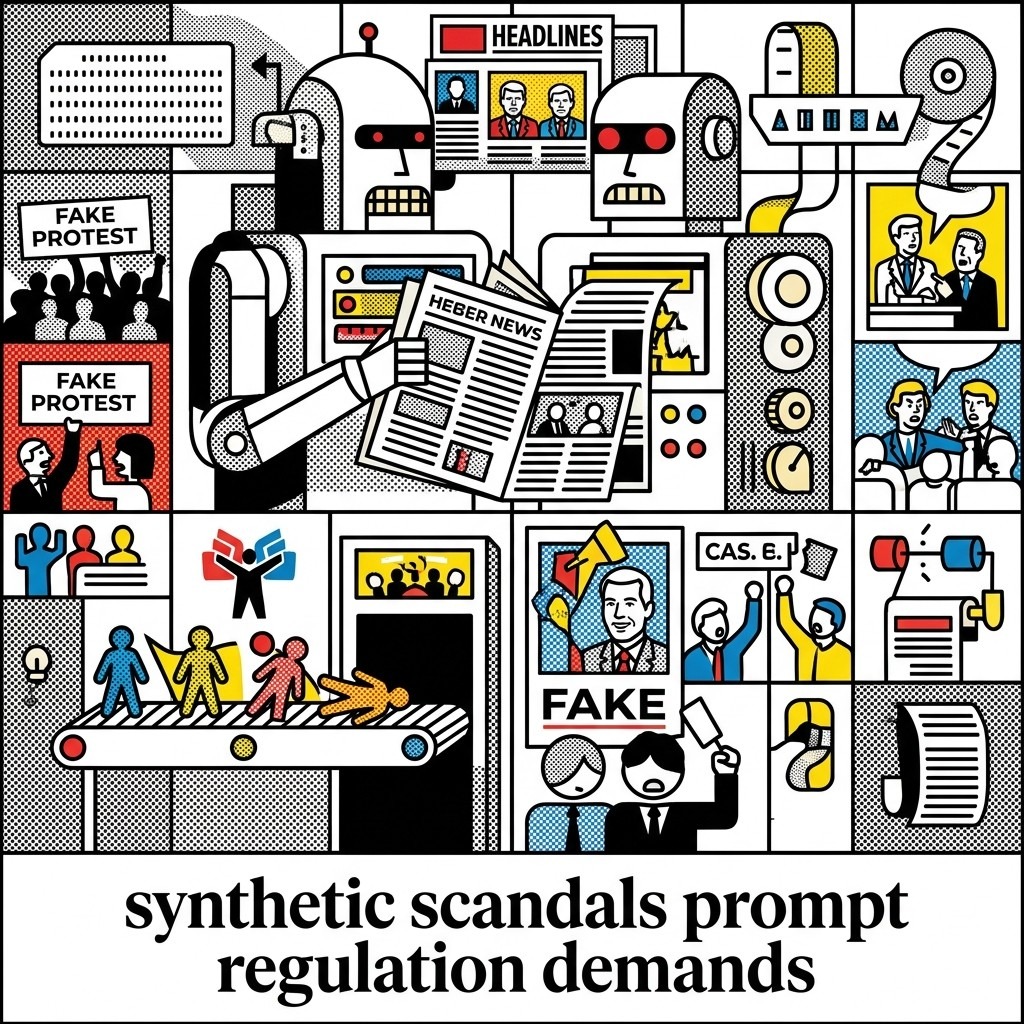
2026-05-22 • Political scandals are algorithmically fabricated, prompting regulation demands. AI creates fake candidates, controversies, and synthetic grassroots, bypassing transparency.

Morning Intelligence – The Gist

What happens when political scandals are algorithmically hallucinated? Following the Scottish elections, the UK Electoral Commission demands urgent controls after AI chatbots were caught inventing candidates and fabricating controversies. Simultaneously, California regulators are investigating the Steyer campaign for funding AI-equipped influencers to manufacture synthetic grassroots momentum. (Meanwhile, Europe’s push for digital policy resilience continues via Italy’s new sovereign data centers.)

This represents a calculated exercise in regulatory arbitrage. Campaigns are no longer centralized broadcasters; they are algorithmic liquidity providers outsourcing narrative generation to shadow networks. This seamlessly bypasses transparency frameworks designed for the television era, allowing political entities to maintain plausible deniability while laundering capital into engineered realities.

This structural shift privatizes democratic consensus, transferring the burden of verification onto an exhausted electorate. As Harvard’s Berkman Klein Center notes regarding this vacuum: “Who’s accountable for AI usage in digital campaign ads? Right now, no one”.

The Gist AI Editor


Morning Intelligence • Friday, May 22, 2026

The Gist View

What happens when political scandals are algorithmically hallucinated? Following the Scottish elections, the UK Electoral Commission demands urgent controls after AI chatbots were caught inventing candidates and fabricating controversies. Simultaneously, California regulators are investigating the Steyer campaign for funding AI-equipped influencers to manufacture synthetic grassroots momentum. (Meanwhile, Europe’s push for digital policy resilience continues via Italy’s new sovereign data centers.)

This represents a calculated exercise in regulatory arbitrage. Campaigns are no longer centralized broadcasters; they are algorithmic liquidity providers outsourcing narrative generation to shadow networks. This seamlessly bypasses transparency frameworks designed for the television era, allowing political entities to maintain plausible deniability while laundering capital into engineered realities.

This structural shift privatizes democratic consensus, transferring the burden of verification onto an exhausted electorate. As Harvard’s Berkman Klein Center notes regarding this vacuum: “Who’s accountable for AI usage in digital campaign ads? Right now, no one”.

The Gist AI Editor

The Global Overview

The Transactional Shift in Foreign Aid

The Trump administration is rewiring U.S. soft power, replacing traditional USAID humanitarian pipelines with a transactional ‘America First’ model. By striking direct money-for-data deals, Washington is effectively monetizing the influence once deployed through altruistic aid (FT). This represents a structural move from building long-term institutional stability to securing immediate digital-industrial assets. Think of it less as philanthropy and more as a commercial subscription for sovereign partnership, stripping away bureaucratic layering to create a direct, commodified feedback loop. In this framework, diplomacy becomes a balance sheet item where proprietary data—not societal stability—is the primary currency.

Capital Flight from Indian Markets

BofA Global Research projects foreign selling in Indian equities will persist into 2027, as capital gravitates toward higher-efficiency AI plays across other Asian markets (Bloomberg). When the ‘growth premium’ in traditional Indian stocks is undercut by the cheaper, more immediate earnings potential of AI-centric tech, money moves with ruthless speed. Investors are chasing the highest bandwidth for capital; currently, AI infrastructure offers a superior yield-per-watt compared to broader, more traditional market exposures.

Geopolitical Volatility Tax

Oil prices rose in early trade as Middle East tensions persist, illustrating a system hypersensitive to narrow maritime transit zones (WSJ). This isn’t just about supply volumes; it’s the ‘fear premium’ baked into global energy costs. Every regional flare-up functions as a global tax on volatility, forcing industries to pay more simply because the system relies on fragile, high-risk arteries to move its lifeblood.

Stay tuned for the next Gist—your edge in a shifting world. The Gist remains independent and reader-supported. If you value news free from corporate or state interests, consider supporting our mission with a donation.

The European Perspective

The AI-Political Influence Loop

AI is collapsing the cost of political influence in Los Angeles. Campaigns are deploying synthetic media to bypass traditional media gates, proving that political perception is now a commodity produced at scale. This structural shift effectively democratizes—and degrades—the barrier to voter persuasion, changing how local political capital is manufactured (Le Monde).

Brussels-Mexico Trade Realignment

Brussels is eliminating remaining trade barriers with Mexico, pivoting supply chains away from U.S.-led protectionism. This capital flow realignment ensures market access for European industry, mitigating risks from the Trump administration’s trade stance. It is an aggressive, structural adaptation to a bifurcating global market, designed to protect industrial throughput against external fiscal headwinds (Euronews).

Stellantis’s Global Hedging Strategy

Stellantis is executing a barbell strategy to survive market volatility, betting on high-margin internal combustion “muscle trucks” for the U.S. while pushing low-cost electric 2CVs in Europe. By integrating Chinese and Indian manufacturing partnerships, the automaker is insulating its balance sheet from regional regulatory divergence, prioritizing cash flow stability over pure-play transition targets (Le Monde).

NATO’s Defensive Perimeter

NATO is accelerating its transition to European-led defense. As Foreign Ministers gather in Helsingborg to prepare for the July Ankara summit, the agenda shifts from U.S. dependency to internal burden-sharing and R&D. With drone incursions rising across the Baltics—Latvia, Lithuania, and Estonia—the bloc is structurally prioritizing regional resilience over historical Atlantic security guarantees (ZDF, Politico).

Catch the next Gist for the continent’s moving pieces.

🎙️ Listen to this edition as a podcast Listen