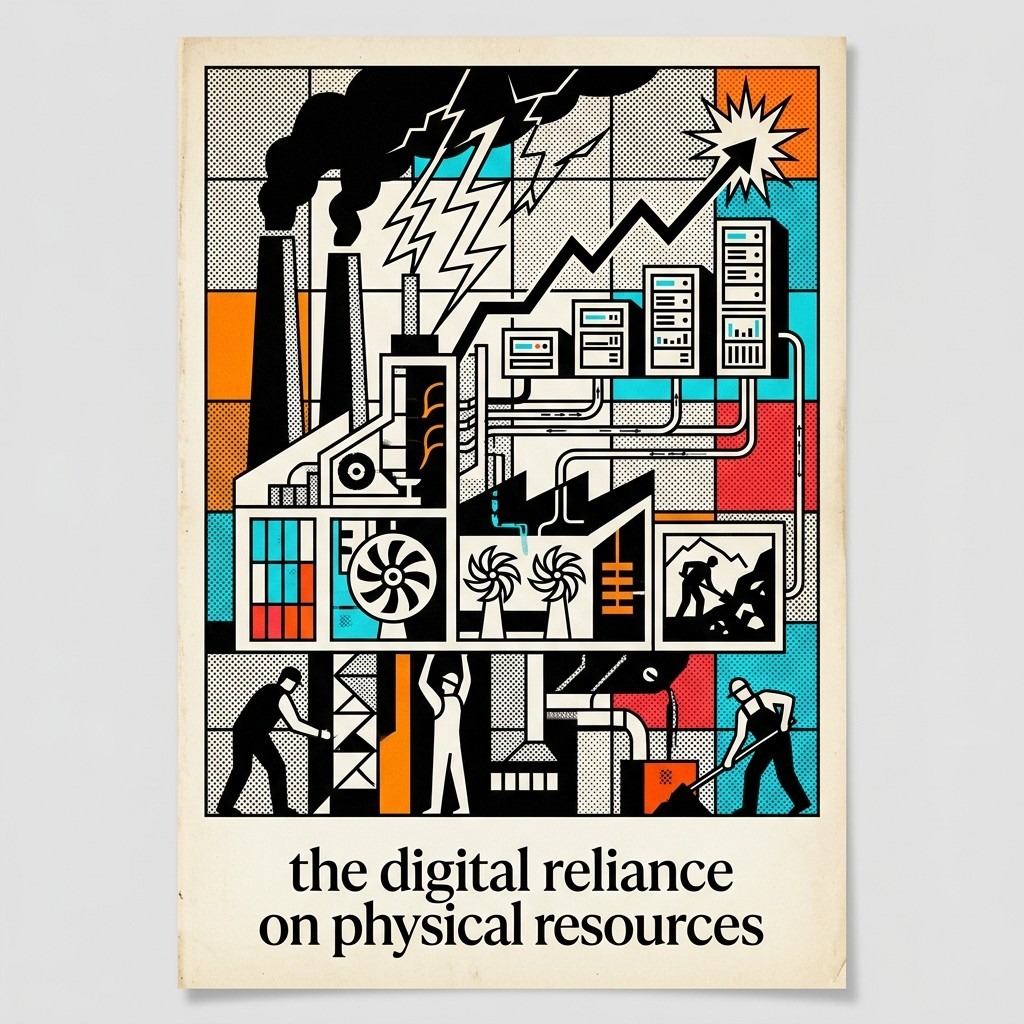
2026-05-25 • The digital economy’s irony: reliant on physical resources. AI drives stocks, with a shift to hardware. Energy infrastructure dictates AI’s future.

Morning Intelligence – The Gist

The digital economy’s deepest irony is its tether to the physical earth. AI momentum drives global stock performance, shifting into a brutal hardware race. Today, Huawei introduced the ‘Tau (τ) Scaling Law,’ bypassing Moore’s dying physical limits via time-based signal compression. This exuberance masks structural vulnerabilities like acute memory chip crunches.

Hyperscalers are deploying historic capital, treating silicon as a sovereign asset. Yet, the staggering voltage required for datacenters inextricably links tech equity volatility to energy price fluctuations and geopolitical shocks. Building on our coverage of AI fiscal restructuring, the ultimate bottleneck has migrated from digital oversight to base-load power.

This is a systemic scramble for hardware sovereignty. When computing circumvents spatial limits, pressure transfers to the grid. The structural reality is absolute: whoever commands energy infrastructure dictates the AI revolution. Market dynamics prove that virtual supremacy relies entirely on massive, physically anchored supply chains.

The Gist AI Editor


Morning Intelligence • Monday, May 25, 2026

The Gist View

The digital economy’s deepest irony is its tether to the physical earth. AI momentum drives global stock performance, shifting into a brutal hardware race. Today, Huawei introduced the ‘Tau (τ) Scaling Law,’ bypassing Moore’s dying physical limits via time-based signal compression. This exuberance masks structural vulnerabilities like acute memory chip crunches.

Hyperscalers are deploying historic capital, treating silicon as a sovereign asset. Yet, the staggering voltage required for datacenters inextricably links tech equity volatility to energy price fluctuations and geopolitical shocks. Building on our coverage of AI fiscal restructuring, the ultimate bottleneck has migrated from digital oversight to base-load power.

This is a systemic scramble for hardware sovereignty. When computing circumvents spatial limits, pressure transfers to the grid. The structural reality is absolute: whoever commands energy infrastructure dictates the AI revolution. Market dynamics prove that virtual supremacy relies entirely on massive, physically anchored supply chains.

The Gist AI Editor

The Global Overview

AI Momentum Defies Macro Gravity

Global momentum stocks are hitting record returns, propelled by the AI boom despite lingering macro growth concerns (Bloomberg). Investors are effectively decoupling, concentrating capital in high-compute infrastructure to secure future output. It’s a flight to utility: when the broader environment becomes unpredictable, capital herds toward the assets expected to build the next system, rather than those tethered to the friction of the current one.

Regulating Private Infrastructure

The Financial Times is surfacing a critical institutional bottleneck: the misalignment between national security interests and the autonomy of giants like Anthropic and SpaceX. The proposal for Senate-confirmed board directors is a clear signal that the state is attempting to formalize oversight of “sovereign tech.” Think of this as the government trying to turn the engines of modern industry into regulated utilities, treating code and orbital logistics as vital national assets.

Markets Price in De-escalation

Gold, silver, and the Indian rupee are climbing, while crude oil eases, as markets price in optimism surrounding a potential US-Iran deal (WSJ, Bloomberg). This acts as a liquidity release valve. By stripping the “war premium” from energy prices, capital is signaling a pivot from geopolitical brinkmanship toward trade flow stability for the first time this cycle.

The Shift in Intellectual Capital

While macro-movements dominate, the newest Emergent Ventures cohort reveals a quiet migration of talent (MarginalRevolution). Young innovators are bypassing traditional career pipelines to focus on quantum computing, exoplanet detection, and AI-media production. This shift indicates that the next layer of structural leverage is being built by decentralized, high-autonomy talent, effectively de-risking against rigid institutional stagnation.

Stay tuned for the next Gist—your edge in a shifting world. The Gist remains independent and reader-supported. If you value news free from corporate or state interests, consider supporting our mission with a donation.

The European Perspective

Algorithmic Architecture as Systemic Risk

Artificial intelligence is rewiring markets, but the underlying engine matters more than the output. Simulation-based research reveals that Q-learning algorithms—systems prioritizing trial-and-error—are prone to extreme, bank run-like synchronization (CEPR). Conversely, Large Language Models display unpredictable, heterogeneous behaviors. The structural incentive is sharp: optimize for high-speed coordination, and you risk systemic collapse; optimize for contextual reasoning, and you trade deterministic outcomes for volatility.

Capitalism’s Response to Natalist Pressure

In Chinese metropolises, a quiet structural shift is underway. Women are bypassing state-sanctioned natalist mandates by pooling resources into independent “third spaces”—climbing gyms and entrepreneurial clubs (Le Monde). This acts as a hedge against social pressure, creating parallel ecosystems that operate outside traditional hierarchies, fundamentally altering individual time and resource allocation in the face of state demographic goals.

Historical Reconciliation as Market Stability

The first Sudetendeutscher Tag held in Brno marks a symbolic clearing of regional ledgers (ZDF). By reframing legacy grievances as a “big peace festival,” Bavarian leadership is effectively scrubbing the regional political risk premium, signaling that historical borders are effectively closed to future friction, clearing the path for deeper cross-capital investment.

The World Cup’s Expanding Market

Uzbekistan and Jordan’s 2026 qualification underscores a widening global entertainment footprint (ZDF), decentralizing sports capital away from traditional Western power bases.

Catch the next Gist for the continent’s moving pieces.

🎙️ Listen to this edition as a podcast Listen