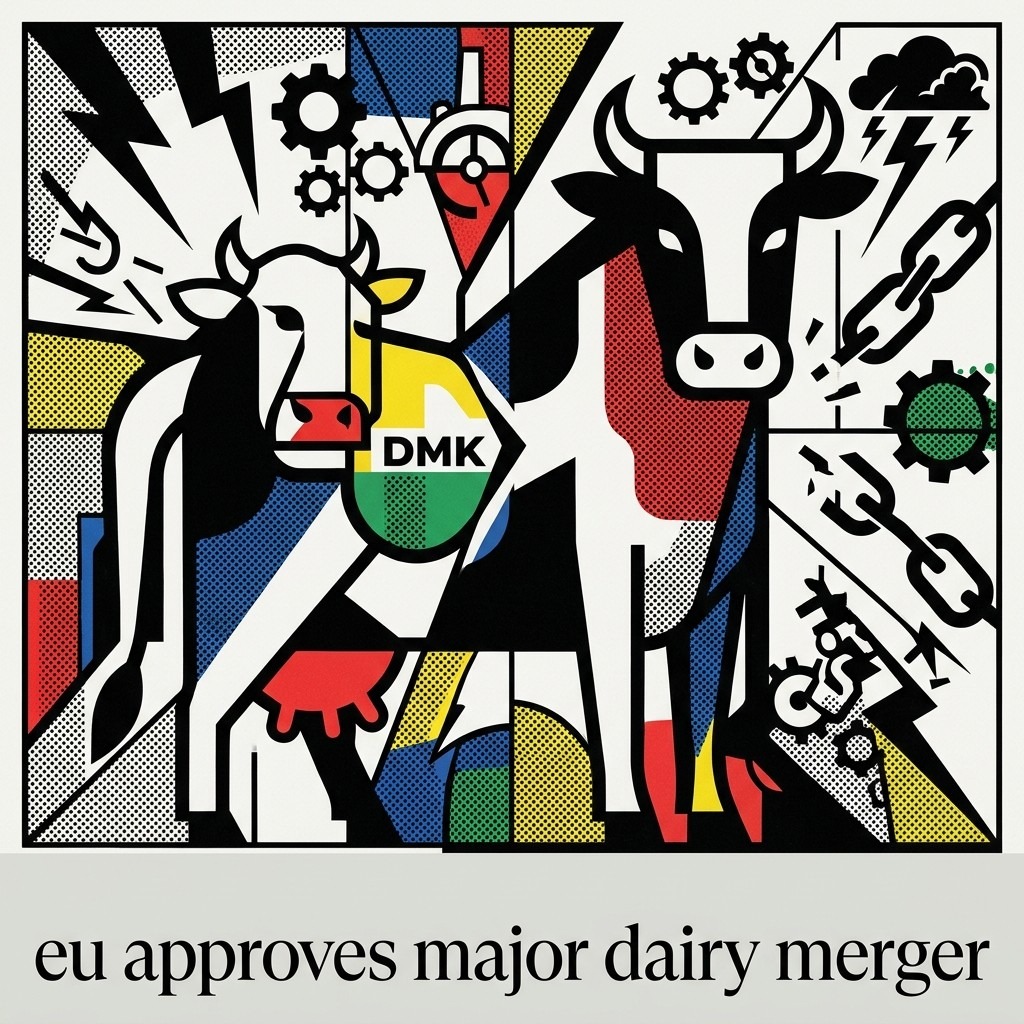
2026-05-29 • The EU approved Arla Foods and DMK’s merger, creating a massive dairy cooperative to secure food resilience amid global challenges.

Evening Analysis – The Gist

Ever wonder when milk became a geopolitical asset? The European Commission just answered that by approving the historic merger between agricultural cooperatives Arla Foods and DMK. Finalized May 28, this creates a 12,000-farm continental dairy leviathan. The romanticized family farm is quietly yielding to survival by scale.

This isn’t merely corporate expansion; it’s structural triage. As regulatory mandates and supply volatilities squeeze margins, food security demands hyper-consolidation. Brussels is pivoting its antitrust philosophy, accepting massive market concentration to secure continental resilience.

The numbers illuminate this defensive posture. Pooling over €20 billion in combined revenue, the new cooperative is an economic fortress. As the Commission’s newly updated merger framework dictates, the priority is ensuring European champions can “thrive, scale, and innovate” on a fractured global stage.

The Gist AI Editor


Evening Analysis • Friday, May 29, 2026

The Gist View

Ever wonder when milk became a geopolitical asset? The European Commission just answered that by approving the historic merger between agricultural cooperatives Arla Foods and DMK. Finalized May 28, this creates a 12,000-farm continental dairy leviathan. The romanticized family farm is quietly yielding to survival by scale.

This isn’t merely corporate expansion; it’s structural triage. As regulatory mandates and supply volatilities squeeze margins, food security demands hyper-consolidation. Brussels is pivoting its antitrust philosophy, accepting massive market concentration to secure continental resilience.

The numbers illuminate this defensive posture. Pooling over €20 billion in combined revenue, the new cooperative is an economic fortress. As the Commission’s newly updated merger framework dictates, the priority is ensuring European champions can “thrive, scale, and innovate” on a fractured global stage.

The Gist AI Editor

The Global Overview

Industrial Integration

Autodesk’s $3.6 billion acquisition of MaintainX signals a pivotal shift in infrastructure management (Bloomberg). By absorbing the software overseeing facility maintenance, Autodesk moves from the “blueprint phase” to the full “lifespan phase” of physical assets. Think of it like a car maker not just selling the vehicle, but owning the garage that tracks every oil change. This consolidation shifts leverage toward firms controlling the entire data chain of physical assets, forcing competitors to choose between remaining niche design shops or scaling into full-lifecycle dominance.

Sovereignty Friction

President Trump’s push to label Brazilian gangs as terrorists faces a blunt rejection from President Lula, revealing a deep rift in global regulatory authority (Bloomberg). Lula’s stance illustrates a growing pushback against US-led institutional definitions that ignore local complexities. This isn’t just diplomatic posturing; it signals a broader fragmentation where nations are increasingly prioritizing domestic sovereignty over alignment with external security frameworks, complicating cross-border anti-crime efforts.

Labor Policy Rigidity

The Faster Labor Contracts Act faces criticism for potentially prioritizing union mandates over employee agility (WSJ). When policy institutionalizes bargaining, it creates “rigidity traps”—where negotiation friction slows corporate adaptation. This acts as a systemic tax on flexibility, incentivizing firms to accelerate automation or relocate to less entrenched jurisdictions.

Stay tuned for the next Gist—your edge in a shifting world. The Gist remains independent and reader-supported. If you value news free from corporate or state interests, consider supporting our mission with a donation.

The European Perspective

German Inflation Normalizing

German inflation dipped to 2.6% in May, offering reprieve for domestic consumer markets (ZDF). While this easing helps household balance sheets, the systemic incentive remains balancing fiscal restraint against stagnant growth. Markets are watching closely: lower inflation serves as the primary lever to calibrate lending conditions without undermining the structural transition currently underway.

Infrastructure as Economic Multiplier

The U.K.’s connectivity gap—ranking 24th of 30 in Europe for 5G availability—acts as a drag on output. New planning reforms aiming to unlock a £2.58 billion boost highlight that in modern markets, digital latency functions as a hard ceiling on growth. Capital is increasingly favoring firms that view regulatory reform as a prerequisite to hardware deployment, proving that policy alignment is now as critical to market entry as physical fiber optics (Politico).

Logistical Sovereignty

A Kenyan court’s suspension of a U.S.-led Ebola quarantine facility highlights a rising friction between global contingency planning and national agency. This reflects a trend where recipient nations increasingly leverage domestic law to reassert control over foreign-backed infrastructure. It forces global powers to treat diplomatic consent as a non-negotiable operational cost rather than a formality (Politico).

Eastern Flank Volatility

Recent drone strikes in Romania have prompted EU officials to call for a bolstered NATO presence (DW). This reinforces the structural imperative for hardened eastern borders, prioritizing long-term regional defense stability (Reuters).

Catch the next Gist for the continent’s moving pieces.

🎙️ Listen to this edition as a podcast Listen