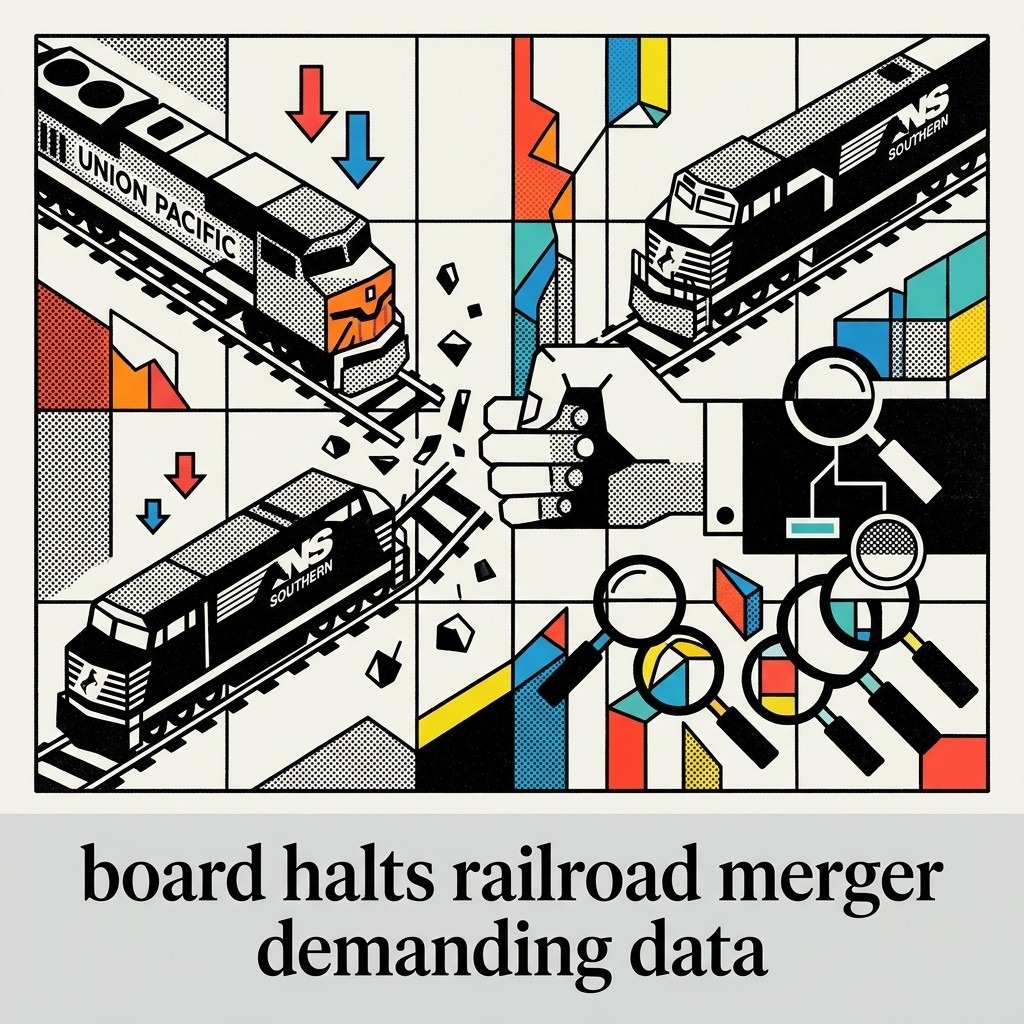
2026-05-30 • The U.S. Surface Transportation Board halted the Union Pacific and Norfolk Southern merger, demanding detailed competitive data, impacting stocks and highlighting regulatory limits.

Evening Analysis – The Gist

How does a niche federal agency stall a $250 billion transcontinental transit empire? Yesterday, the U.S. Surface Transportation Board abruptly halted its review of the $85 billion Union Pacific and Norfolk Southern merger—a deal designed to reshape North American global trade routes—demanding comprehensive competitive data.

This regulatory friction highlights a core structural tension: capital’s drive for frictionless, single-line supply chains colliding against the state’s mandate to prevent infrastructure monopolies. The STB’s intervention signals aggressive institutional scrutiny, immediately shaving 4.2% off Union Pacific’s stock and 5.4% off Norfolk Southern as markets priced in the regulatory delay.

We are witnessing the strict limits of corporate scaling in physical networks. As regulators explicitly demand granular data on “downstream merger impacts” and competitive pressures, it proves state apparatuses are firmly reasserting authority over primary logistical arteries.

The Gist AI Editor


Evening Analysis • Saturday, May 30, 2026

The Gist View

How does a niche federal agency stall a $250 billion transcontinental transit empire? Yesterday, the U.S. Surface Transportation Board abruptly halted its review of the $85 billion Union Pacific and Norfolk Southern merger—a deal designed to reshape North American global trade routes—demanding comprehensive competitive data.

This regulatory friction highlights a core structural tension: capital’s drive for frictionless, single-line supply chains colliding against the state’s mandate to prevent infrastructure monopolies. The STB’s intervention signals aggressive institutional scrutiny, immediately shaving 4.2% off Union Pacific’s stock and 5.4% off Norfolk Southern as markets priced in the regulatory delay.

We are witnessing the strict limits of corporate scaling in physical networks. As regulators explicitly demand granular data on “downstream merger impacts” and competitive pressures, it proves state apparatuses are firmly reasserting authority over primary logistical arteries.

The Gist AI Editor

The Global Overview

Texas Senate Shakeup

Ken Paxton’s primary victory over John Cornyn marks a decisive shift in GOP power structures, proving that grassroots populist energy now eclipses traditional establishment machinery. Backed by President Trump, Paxton’s win demonstrates the potency of brand-loyal voter bases over institutional incumbents. Despite over $100 million spent by the establishment to defend the status quo (Bloomberg), capital flow followed the culture, not the ledger. This realignment forces a new reality: political survivability now demands high-visibility ideological signaling rather than back-room institutional support.

The Crypto Credit Pivot

Institutional balance sheets are shifting as firms leverage crypto assets for “digital credit” (FT). By mimicking Michael Saylor’s strategy, companies are trading cash stability for the volatility of speculative assets, effectively treating them as corporate reserves. This reveals a desperate hunt for yield where firms prefer gambling on crypto appreciation over traditional bond markets. It is the corporate equivalent of betting company payroll on a lottery ticket—a high-risk attempt to engineer growth in a stagnant financial environment.

The Underground Infrastructure

Researchers recently discovered a 5.5 million-strong bee colony beneath a New York cemetery (Wired). This biological infrastructure, thriving for over a century, reveals the invisible dependencies supporting our food systems. Unlike human institutions currently fracturing under policy pressure, these underground networks thrive on decentralized, autonomous cooperation. It serves as a sharp reminder that true resilience often emerges from unmanaged, bottom-up systems rather than centralized, top-down governance.

Stay tuned for the next Gist—your edge in a shifting world. The Gist remains independent and reader-supported. If you value news free from corporate or state interests, consider supporting our mission with a donation.

The European Perspective

The Post-Macron Pivot

Gabriel Attal’s campaign launch signals a structural break from the 10-year Macron hegemony. By aggressively distancing himself from current administration policies, Attal is attempting to re-engineer the center, forcing rivals to abandon stale continuity for a new reformist framework. The incentive is clear: capture the fatigue within the French electorate to consolidate a new political coalition (Politico).

The Sanction-Monetization Gap

Researchers found a striking systemic flaw: social media accounts linked to EU-sanctioned figures maintained active monetization tools, effectively bypassing geopolitical barriers (Euronews). This exposes a disconnect where digital platform financial APIs operate independently of high-level policy. The result is unintended capital inflow to restricted actors, revealing that digital infrastructure currently lacks the “state-awareness” required to enforce economic mandates.

Health Infrastructure Stress Tests

With the DR Congo recording 1,077 suspected cases and 246 deaths in the Ituri province, the WHO’s localized intervention highlights the necessity of containing health externalities (DW). These efforts act as vital circuit breakers, preventing localized crises from evolving into systemic global capital and labor bottlenecks.

Managing Trade Volatility

President Trump’s pursuit of a new bilateral trade body with China signals a strategic shift toward institutionalizing, rather than merely taxing, commercial friction (Politico).

Palate Cleanser: Bundesliga Reshuffling

VfL Wolfsburg has promoted Dieter Hecking to Sporting Director through 2028, a structural play to stabilize administrative leadership following the club’s descent into the 2. Bundesliga (ZDF).

Catch the next Gist for the continent’s moving pieces.

🎙️ Listen to this edition as a podcast Listen