2026-06-02 • SoftBank’s €75B investment in AI data centers marks a shift to energy-heavy infrastructure, highlighting Big Tech’s climate impact and power dynamics.

Evening Analysis – The Gist

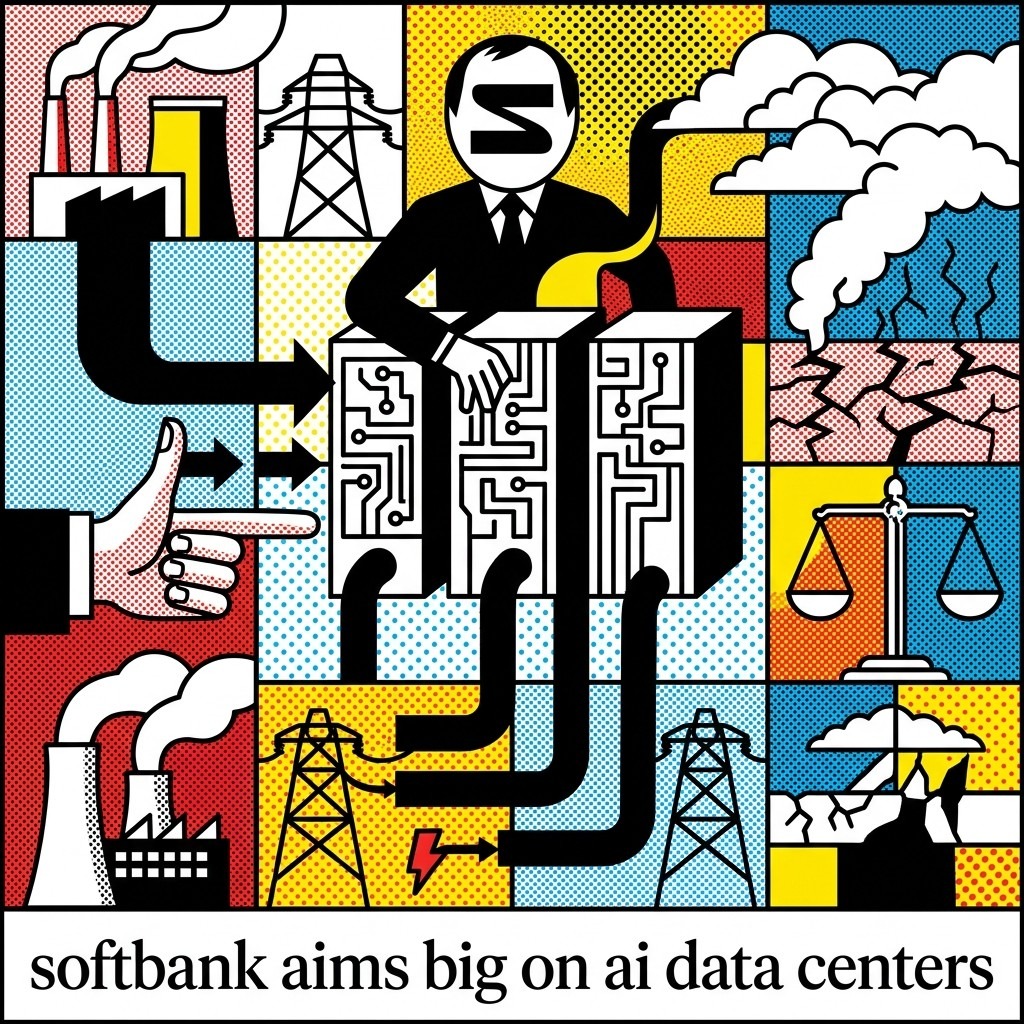
If you want the true cost of the intelligence era, look at where the smart money pours concrete. SoftBank’s €75 billion commitment to build 5 gigawatts of AI data centers in France signals a structural pivot. The venture giant that once chased software velocity is now locking up nuclear-powered real estate. AI is no longer an abstraction—it’s heavy industry.

These mega-facilities are colliding with an escalating climate crisis. Big Tech spent $130 billion on infrastructure in Q1 2026 alone. To manage public backlash over their grid footprint, Amazon, Google, Meta, and Microsoft just launched a joint initiative, deploying micro-grants to startups to somehow solve their systemic emissions.

This is peak power asymmetry. Billions are ring-fenced for compute supremacy, while ecological consequences are outsourced to underfunded founders. The digital architects are now energy-hungry landlords, proving that “the countries that build the infrastructure for this transformation will shape the future”.

The Gist AI Editor


Evening Analysis • Tuesday, June 02, 2026

The Gist View

If you want the true cost of the intelligence era, look at where the smart money pours concrete. SoftBank’s €75 billion commitment to build 5 gigawatts of AI data centers in France signals a structural pivot. The venture giant that once chased software velocity is now locking up nuclear-powered real estate. AI is no longer an abstraction—it’s heavy industry.

These mega-facilities are colliding with an escalating climate crisis. Big Tech spent $130 billion on infrastructure in Q1 2026 alone. To manage public backlash over their grid footprint, Amazon, Google, Meta, and Microsoft just launched a joint initiative, deploying micro-grants to startups to somehow solve their systemic emissions.

This is peak power asymmetry. Billions are ring-fenced for compute supremacy, while ecological consequences are outsourced to underfunded founders. The digital architects are now energy-hungry landlords, proving that “the countries that build the infrastructure for this transformation will shape the future”.

The Gist AI Editor

The Global Overview

The $80 Billion Moat

Google’s $80 billion capital raise is an assertion of industrial permanence (Bloomberg). In an era where AI spending is projected to exceed $1 trillion annually, Google is utilizing its balance sheet to preemptively exhaust the runway of potential disruptors like OpenAI. They aren’t just scaling technology; they are weaponizing capital to starve rivals of the institutional trust required for mass-scale deployment, effectively buying the market’s competitive floor.

Strait-Jacketed Strategy

ADNOC is building a bypass. The UAE’s state-run oil giant is constructing a pipeline to circumvent the Strait of Hormuz, the world’s most critical energy chokepoint (FT). This is pure structural risk management: by trading capital for sovereignty, the UAE is insulating its liquidity from regional conflict. They are essentially purchasing “conflict insurance” at the cost of massive infrastructure investment to ensure their output remains decouple-able from maritime instability.

Institutional Security

Norway’s $2.3 trillion sovereign wealth fund is doubling down on Big Tech because it now underpins national defense (Bloomberg). For massive state funds, holding equity in these giants is no longer about consumer software—it’s about owning the invisible “infrastructure security” of the West.

Urban Efficiency Export

The Dutch cycling model is shifting from a local quirk to a calculated global policy asset (WSJ). By redesigning urban geometry to boost mobility, the Netherlands is decoupling economic productivity from fuel dependency, strategically reducing the long-term drag of healthcare costs on GDP.

Stay tuned for the next Gist—your edge in a shifting world. The Gist remains independent and reader-supported. If you value news free from corporate or state interests, consider supporting our mission with a donation.

The European Perspective

Intelligence Leadership Shift

President Trump’s appointment of Bill Pulte as Director of National Intelligence signals a transition from career statecraft to asset-centric management (Politico). By moving the head of the Federal Housing Finance Agency into the top intelligence post, the administration is re-orienting national security around data-heavy asset valuation. The systemic incentive is clear: intelligence gathering will increasingly mirror private equity workflows, prioritizing the protection of proprietary real estate and capital flows over traditional geopolitical maneuvering.

The El Niño Tax

The WMO’s warning of an “exceptional” El Niño (Politico) functions as a macroeconomic destabilizer. As environmental volatility spikes, the system shifts from long-term mitigation to reactive, high-cost capital allocation. Expect insurance premiums in exposed sectors to surge, creating an implicit “climate tax” on logistics. When disaster costs consistently exceed 5% of regional GDP, the infrastructure gap becomes a structural bottleneck, favoring entities with the liquidity to self-insure or relocate assets.

Germany’s Pension Math

Germany’s proposal to include civil servants (Beamte) in the national pension pool highlights an acute fiscal solvency crunch (ZDF). This is a structural play to stabilize a system facing a severe dependency ratio imbalance by forcing state employees into the broader contributory framework. It is an effort to share the demographic burden before it necessitates a more radical, disruptive re-capitalization of the state apparatus.

Italy’s Cultural Economy

Italy’s Anteprima d’Estate fair drew 200,000 visitors (Il Sole 24 Ore). This cultural experience economy serves as a robust, decentralized capital driver—acting as a necessary hedge against the volatility defining current energy and intelligence markets.

Catch the next Gist for the continent’s moving pieces.

🎙️ Listen to this edition as a podcast Listen