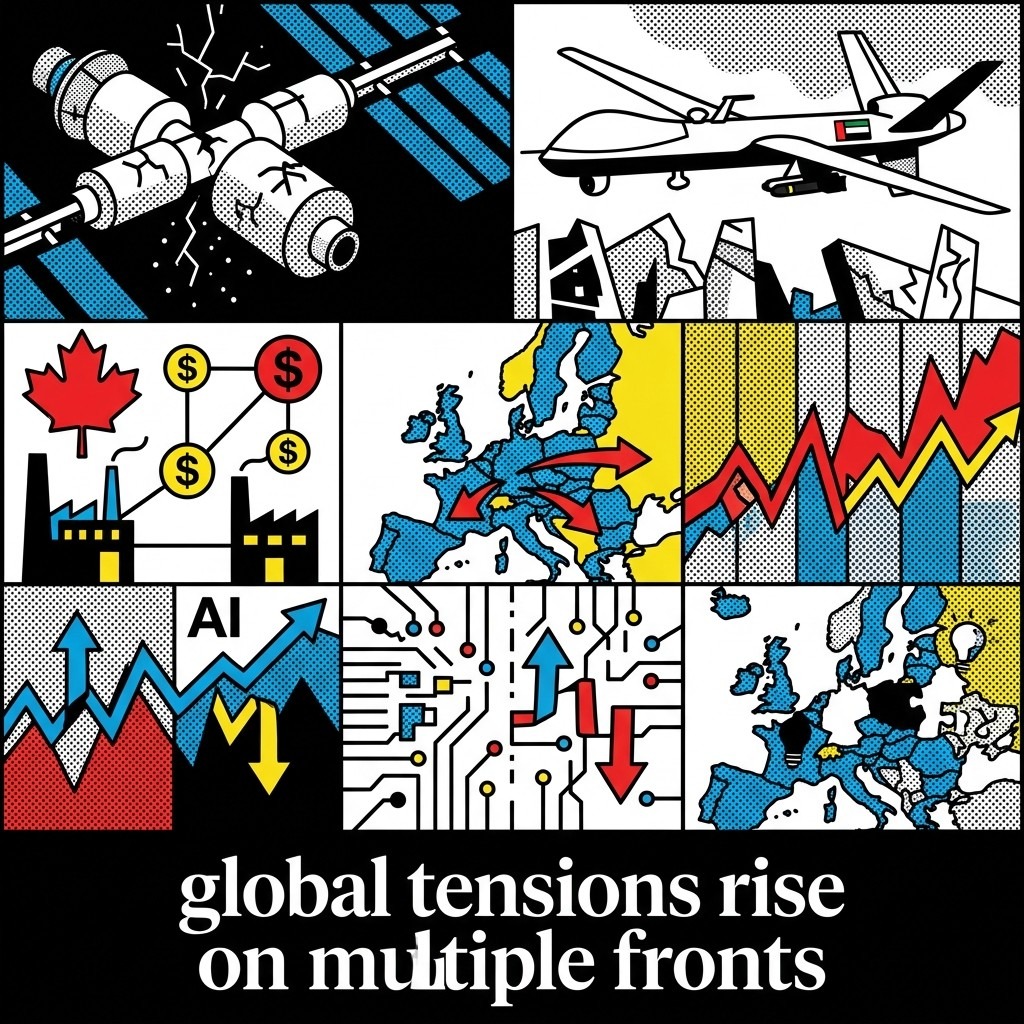
2026-06-05 • Global tensions rise: ISS leak, UAE drone strike, Canada subsidies. EU shifts trade focus, AI sector volatility hits markets, Europe lacks innovation.

Evening Analysis – The Gist

While an ISS leak forces astronauts to shelter , a drone targets the UAE’s Barakah nuclear plant , and Canada deploys emergency economic subsidies , global power engines are shifting.

The European Commission has branded its Beijing trade balance “unsustainable,” pivoting to aggressive industrial-defense mechanisms . Though Brussels officially calls this “de-risking,” momentum toward sectoral decoupling is permanently fragmenting supply chains . Simultaneously, the AI semiconductor sector—the bedrock of this geopolitical shift—is flashing red. Extreme algorithmic volatility just wiped 7% off South Korea’s Kospi index , exposing the profound fragility of markets tethered to hyperscaler expectations .

We are witnessing the raw friction of transition. As the Center for European Policy Analysis observes, Europe’s core vulnerability isn’t Chinese overcapacity, but its own “lack of innovation” . Capital now prioritizes structural resilience over speculative momentum.

The Gist AI Editor


Evening Analysis • Friday, June 05, 2026

The Gist View

While an ISS leak forces astronauts to shelter , a drone targets the UAE’s Barakah nuclear plant , and Canada deploys emergency economic subsidies , global power engines are shifting.

The European Commission has branded its Beijing trade balance “unsustainable,” pivoting to aggressive industrial-defense mechanisms . Though Brussels officially calls this “de-risking,” momentum toward sectoral decoupling is permanently fragmenting supply chains . Simultaneously, the AI semiconductor sector—the bedrock of this geopolitical shift—is flashing red. Extreme algorithmic volatility just wiped 7% off South Korea’s Kospi index , exposing the profound fragility of markets tethered to hyperscaler expectations .

We are witnessing the raw friction of transition. As the Center for European Policy Analysis observes, Europe’s core vulnerability isn’t Chinese overcapacity, but its own “lack of innovation” . Capital now prioritizes structural resilience over speculative momentum.

The Gist AI Editor

The Global Overview

Semiconductor Volatility

Broadcom’s results sparked a two-day tech slide, signaling the “infinite infrastructure” thesis is hitting a wall (FT). While Nvidia’s margins remain protected through 2030 due to hyperscaler dependency (Bloomberg), capital is pivoting. Investors now demand tangible ROI, not just promises of AI scale. The system is separating firms with genuine cash flow from those fueled by exuberance.

The Megacap Index Dilemma

SpaceX’s $75 billion IPO is oversubscribed, but the real story is index mechanics (Bloomberg). Providers are debating rule changes to force-feed megacaps into passive portfolios. This creates a “mandatory ownership” ecosystem where indexes curate market winners rather than tracking performance. It is the financial equivalent of a utility forcing you to buy the premium package just to access the grid.

Biological Engineering

Columbia University’s breakthrough in embryo DNA editing shifts investment horizons from digital to biological code (MR). As life becomes programmable, regulatory frameworks will fracture, creating massive arbitrage opportunities for early capital.

Public Accountability Gap

Taxpayer anger over purchasing-card waste is rising (WSJ). Markets ruthlessly cull excess; public institutions remain anchored by inertia. Simultaneously, Europe’s nationalist shift toward stricter border tactics signals a broader push to solidify institutional control (Context). This friction drives volatility, mandating institutional cuts.

Stay tuned for the next Gist—your edge in a shifting world. The Gist remains independent and reader-supported. If you value news free from corporate or state interests, consider supporting our mission with a donation.

The European Perspective

The Brussels Diversification Mandate

EU Trade Commissioner Maroš Šefčovič is pushing a “diversification instrument” to force firms out of single-source supply chains, specifically targeting China (Politico). This isn’t just risk management; it is a structural tax on industrial efficiency. By compelling companies to exit established, low-cost pathways, Brussels is prioritizing resilience over raw margin. The non-obvious angle: This policy admits that European manufacturing can no longer compete on price alone, effectively institutionalizing a “security premium” as a permanent cost of doing business.

Legislative Resistance in Washington

The US House has bucked President Trump’s foreign policy, passing a package that sustains military aid to Ukraine and reinforces NATO’s Article 5 (ZDF). This structural friction between the executive and legislative branches signals that US policy continuity cannot be assumed. For European leaders, this friction is the new baseline, forcing an acceleration of indigenous defense industrial bases to hedge against Washington’s domestic volatility.

Aviation’s Carbon Impasse

The European aviation sector is lobbying Brussels ahead of the July 15 revision of the Emissions Trading System, warning that aggressive climate targets could trigger international retaliation (Euronews). The industry faces a zero-sum constraint: adhere to mandates and lose cost competitiveness, or risk global backlash. Systemically, European carriers are effectively subsidizing the global green transition, creating an uneven playing field.

St. Pauli’s Tactical Pivot

In a reminder of the cyclical nature of Bundesliga management, FC St. Pauli has appointed Marcel Rapp as coach following their relegation (ZDF). It highlights the ruthless nature of sports capital, where structural success hinges on the volatility of the managerial market.

Catch the next Gist for the continent’s moving pieces.

🎙️ Listen to this edition as a podcast Listen