Institutional Capital Moves from Cloud to Space Investments

Evening Analysis – The Gist


Evening Analysis • Monday, June 08, 2026

The Gist View

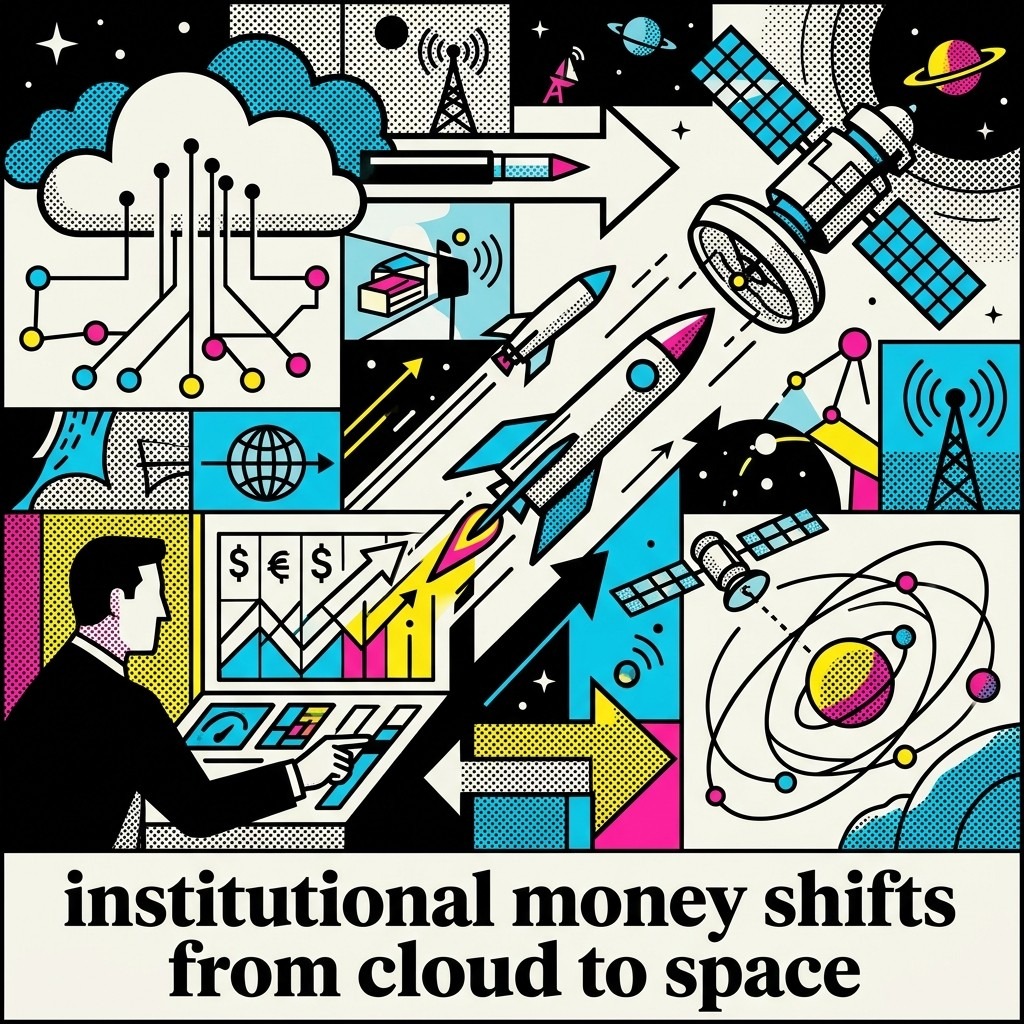
Have you noticed how institutional capital is quietly abandoning the cloud for the exosphere? As the Hormuz maritime standoff enters its fourth day, a parallel supply chain is being aggressively capitalized above our heads. Today, spacecraft manufacturer Apex secured another $200 million, hitting a $2.3 billion valuation, while AstroForge finalized its asteroid-bound DeepSpace-2 vehicle.

This reflects a profound systemic pivot. Fleeing saturated software markets, private equity is actively chasing the tangible, high-barrier moats of orbital hardware. Quantum Space’s newly announced SPAC merger explicitly commercializes in-space mobility for military needs, proving state defense apparatuses now rely heavily on agile, privately funded platforms rather than sovereign monopolies.

This is the calculated privatization of orbital mechanics. The state guarantees demand; private capital engineers the capacity, absorbing early risk to secure future infrastructural dominance. As analysts note, this pivot toward “high-value, specialized, longer-duration assets” reveals that capitalizing the void is less about scientific exploration and more about the ultimate structural hedge.

The Gist AI Editor

The Global Overview

The Space Economy’s Public Debut

SpaceX is days away from the largest IPO in Wall Street history, signaling a structural pivot in how capital views the cosmos (Bloomberg). The real significance lies in critical infrastructure—telemetry, agricultural mapping, and drug research—now embedded into terrestrial supply chains. With the offering well oversubscribed, the market is pricing space as an essential utility rather than a speculative frontier. This forces a recalibration of portfolios, where orbital assets are becoming a baseline for industrial efficiency.

Corporate Lean and Aerospace Realignment

Honeywell is backing its full-year guidance ahead of its aerospace spinoff (WSJ). This mirrors a trend of conglomerates shedding units to enhance capital agility. By isolating the aerospace arm, Honeywell creates a focused entity—a pure-play bet on global transit and aerospace logistics—attracting specialized rather than generalist capital. It is a clear instance of institutional simplification used to unlock valuation in a competitive industrial landscape.

Private Equity’s Liquidity Frictions

Blue Owl Capital, having previously capped investor withdrawals, is raising $500 million via an investment-grade bond sale to maintain operations (Bloomberg). This reveals a systemic incentive shift: firms are increasingly forced to tap public debt markets to bridge liquidity gaps caused by restricted redemptions. For the system, this highlights the fragility in niche financing; where the promise of high-yield credit creates an inflexible lock-in, liquidity becomes a variable dictating firm survival when the macro climate tightens.

Stay tuned for the next Gist—your edge in a shifting world. The Gist remains independent and reader-supported. If you value news free from corporate or state interests, consider supporting our mission with a donation.

The European Perspective

Luxury Real Estate Consolidation

Capital is rotating into tangible, high-barrier assets. In Italy, luxury mountain hubs like Courmayeur and Breuil-Cervinia are commanding premium valuations, as private equity and high-net-worth capital seek stable, yield-generating refuges (Il Sole 24 Ore). This underscores a broader systemic incentive: investors are decoupling asset growth from broader market volatility, betting on geographic scarcity as a hedge against inflation.

The Cost of Health Preparedness

Managing global events like the World Cup requires rigorous health screening, yet current frameworks rely on “Covid-era playbooks” lacking equivalent fiscal backing (Politico). Biosecurity is becoming a deferred liability. Without dedicated funding, the operational burden shifts from centralized institutional buffers to fragmented, ad-hoc mitigation, significantly increasing risk for international organizers.

Darwin in the City

Urban fauna—from rats to pigeons—are undergoing rapid behavioral shifts to survive in human-dense environments (Le Monde). This biological plasticity serves as an unintentional audit of urban quality; species survival patterns provide a non-obvious metric for how effectively city infrastructure manages waste and habitat fragmentation.

Briefs

The EU disbursed €2.8 billion to Ukraine, conditioning payments on continued reform milestones (ZDF). Simultaneously, Berlin convenes labor and employer syndicates this week to unlock gridlocked pension and market reforms (ZDF).

Catch the next Gist for the continent’s moving pieces.

🎙️ Listen to this edition as a podcast Listen


The Gist is an independent daily digest: AI-curated, human-directed, unapologetically liberal (how it’s made). Hundreds of sources, only what matters. Subscribe free or listen to the podcast.


Comments

Leave a Reply

Your email address will not be published. Required fields are marked *

This site uses Akismet to reduce spam. Learn how your comment data is processed.