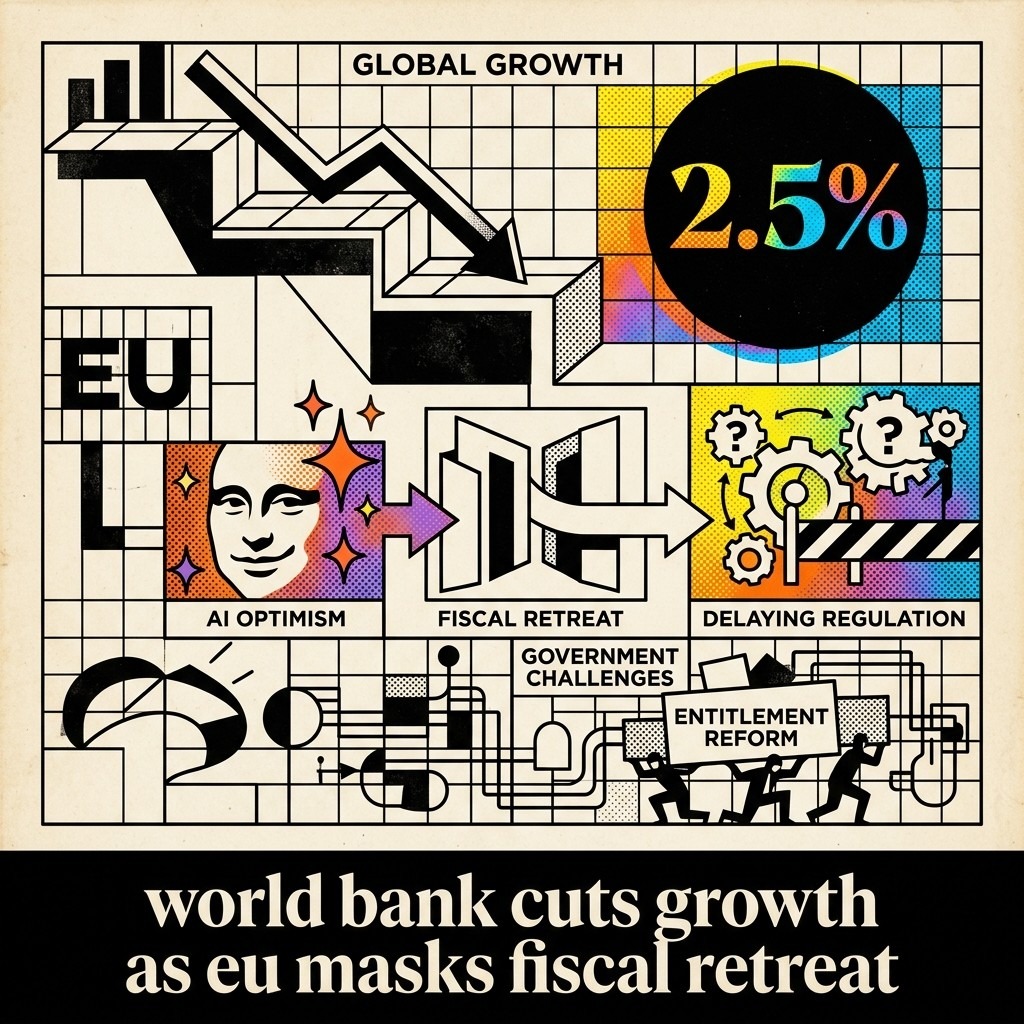
2026-06-11 • World Bank cuts global growth to 2.5%. EU uses AI optimism to mask fiscal retreat, delaying regulation as governments face entitlement reform challenges.

Evening Analysis – The Gist

When the World Bank downgrades global growth to a post-pandemic low of 2.5%, the macroeconomic shockwave hits European capitals as a political death sentence. Squeezed by energy inflation and the demographic debt of an aging populace, governments face a brutal reality: mathematically necessary but politically toxic entitlement reforms.

To mask this fiscal retreat, Brussels is weaponizing techno-optimism. Building on recent debates over AI’s role in salvaging social welfare, the EU is quietly unwinding its regulatory armor. The amended Digital Omnibus on AI delays compliance to rush algorithms into the workforce—a desperate bid to project forward-looking competence while actual public budgets shrink.

This isn’t an innovation strategy; it’s pure structural survival. With the ECB revising growth downward, artificial intelligence is being tasked with a political miracle. But algorithms cannot print the political capital needed to survive Europe’s demographic winter.

The Gist AI Editor


Evening Analysis • Thursday, June 11, 2026

The Gist View

When the World Bank downgrades global growth to a post-pandemic low of 2.5%, the macroeconomic shockwave hits European capitals as a political death sentence. Squeezed by energy inflation and the demographic debt of an aging populace, governments face a brutal reality: mathematically necessary but politically toxic entitlement reforms.

To mask this fiscal retreat, Brussels is weaponizing techno-optimism. Building on recent debates over AI’s role in salvaging social welfare, the EU is quietly unwinding its regulatory armor. The amended Digital Omnibus on AI delays compliance to rush algorithms into the workforce—a desperate bid to project forward-looking competence while actual public budgets shrink.

This isn’t an innovation strategy; it’s pure structural survival. With the ECB revising growth downward, artificial intelligence is being tasked with a political miracle. But algorithms cannot print the political capital needed to survive Europe’s demographic winter.

The Gist AI Editor

The Global Overview

The Triple Lock Reckoning

UK cost of living tsar Lord Richard Walker has flagged the nation’s pension triple lock as “mathematically unsustainable” (FT). By outsourcing this diagnosis to an external appointee, the Starmer government is securing the political cover necessary to unwind a policy that structurally functions as a regressive wealth transfer from tax-burdened young workers to insulated retirees. As the ECB holds rates at 2.25% amidst stagnant Eurozone growth, the collision of fiscal reality and demographic obligations is forcing a long-delayed reckoning: untouchable entitlements must inevitably face the guillotine to preserve systemic solvency.

Capital’s New Frontier

Gold prices have hit a 6-month low, as speculative capital flows pivot from traditional safe-haven hedging toward the impending SpaceX IPO (FT). As we have noted, the space sector is maturing from venture novelty into a foundational benchmark index component. This structural shift signals that institutional investors now view orbital assets not as exotic bets, but as essential infrastructure—a critical re-orientation as the Russian economy, per the Kiel Institute, enters its “end stage” of structural exhaustion.

The Competence Loop

The panic over AI displacement frequently misses the mechanical reality of productivity. In radiology, for instance, AI diagnostic tools have surged, yet demand for human specialists has grown by 17% since 2016 (Atlantic). AI tools act as leverage, not replacement; they allow high-skill labor to scale, effectively turning the question “Can AI do my job?” into “How can I compound my output?” Competence, not headcount, remains the primary asset in an automated economy.

Stay tuned for the next Gist—your edge in a shifting world. The Gist remains independent and reader-supported. If you value news free from corporate or state interests, consider supporting our mission with a donation.

The European Perspective

Fiscal Gravity Returns

The European Central Bank’s decision to hike interest rates to 2.25%, coupled with a growth downgrade, is forcing a cold arithmetic reckoning (Il Sole 24 Ore). As borrowing costs rise, fiscal space for entrenched welfare commitments is evaporating. European governments are now confronting the math of aging populations; untouchable entitlements like the UK’s pension triple lock are increasingly unsustainable as tax yields stagnate (ZDF).

The New Political Currency

In France, Artificial Intelligence is shifting from technical policy to the bedrock of 2027 presidential maneuvering. Gabriel Attal’s recent pivot—using AI legislation to signal alignment with tech giants—marks a structural break from traditional labor-focused politics. By positioning himself as the primary interlocutor for silicon capital, Attal signals a new era where digital industrial policy, rather than classic social negotiation, functions as the primary magnet for campaign legitimacy (Politico).

Moscow’s Diminishing Runway

The Kiel Institute (IfW) confirms the Russian economy is in its “end stage,” with state liquid assets plummeting from 6.5% of GDP at the war’s onset to 1.8% by April 2026 (ZDF). This exhaustion of capital validates our prior assessment: Moscow’s resilience was a short-term mirage.

Catch the next Gist for the continent’s moving pieces.

🎙️ Listen to this edition as a podcast Listen


Comments

Leave a Reply

Your email address will not be published. Required fields are marked *

This site uses Akismet to reduce spam. Learn how your comment data is processed.