AI Executives and G7 Collaborate on Threat Response

Evening Analysis – The Gist


Evening Analysis • Tuesday, June 16, 2026

The Gist View

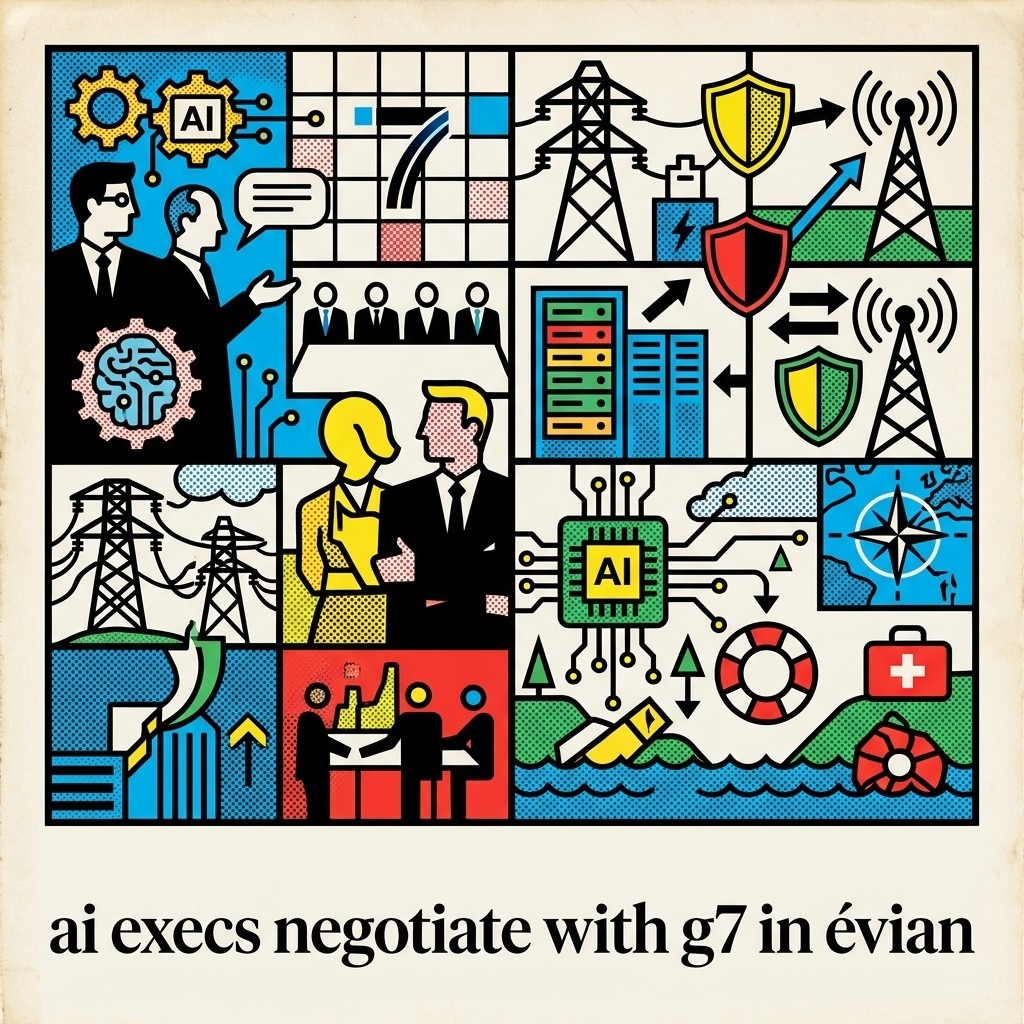
Four top AI executives bypassed Silicon Valley to negotiate directly with G7 leaders in Évian-les-Bains. As the June 15-17 summit hits its midpoint, democracies are upgrading institutional architecture to counter complex threats. France and the World Meteorological Organization formalized allied backing to embed predictive analytics into a centralized disaster response network.

Member states fund the intelligence pools, while national safety agencies dictate deployment. AI developers like Mistral and Anthropic surrender proprietary modeling because they gain regulatory shelter and locked-in sovereign contracts. Next, data-sharing mandates will legally bind the bloc to unified crisis forecasting.

This algorithmic centralization mirrors the 1949 creation of NATO, replacing reactive defense with computational foresight. Ultimately, “scaling AI in disaster risk management will depend on closer cooperation between public and private partners” (World Meteorological Organization).

The Gist AI Editor

The Global Overview

Algorithmic Statecraft

State capacity is undergoing a silent transformation. NASA and the National Weather Service are integrating TACLS predictive AI into disaster response, shifting bureaucratic infrastructure from reactive cleanup to proactive risk mitigation. This isn’t merely a technological upgrade; it is a structural pivot. Much like predictive maintenance in industrial manufacturing—where machines are serviced before they fail to avoid costly downtime—governments are redefining the nature of public goods. This integration fundamentally alters the legal and operational baseline for state competence; failing to foresee a disaster will soon be viewed by the public as a dereliction of systemic duty, rather than an unpredictable act of nature.

The G7’s Sovereignty Squeeze

The G7 summit in Evian is defined by the fallout from the US administration’s forced deactivation of Anthropic’s advanced AI models. This action has sent shockwaves through the alliance, revealing a painful dependency: global digital infrastructure is now subject to the domestic policy whims of a single regulator (Politico). Meanwhile, UK Prime Minister Keir Starmer’s “hard-edged” refusal to increase defense spending underscores a chronic institutional bottleneck. As the geopolitical risk premium remains embedded in energy markets despite a tenuous ceasefire in the Strait of Hormuz (Marginal Revolution), Western nations face a fiscal reality where security requirements are rapidly outpacing the capacity of legacy budgetary frameworks to fund them.

Stay tuned for the next Gist—your edge in a shifting world. The Gist remains independent and reader-supported. If you value news free from corporate or state interests, consider supporting our mission with a donation.

The European Perspective

Institutional Fortification in Berlin

Germany has launched its Joint Defense Center against Hybrid Threats, a structural upgrade designed to counter non-linear foreign sabotage. By embedding this mechanism within the Interior Ministry and domestic intelligence rather than the armed forces, Berlin frames foreign aggression as an internal security mandate. This preserves the separation of powers while militarizing domestic resilience, a strategic pivot from reactive crisis management to proactive, algorithmic mitigation. (ZDF)

G7 Strategic Calibration

The G7 is prioritizing hardened coordination to maximize Ukraine’s negotiating leverage, moving beyond diplomatic rhetoric to synchronized economic pressure. While the months-long US-Iran standoff in the Strait of Hormuz has produced a tentative ceasefire, energy markets remain volatile, pricing in structural risk despite President Trump’s recent diplomatic overtures. (ZDF), (Politico)

The Cost of Sovereignty

The G7 summit’s tech agenda hit a wall this week as the forced deactivation of Anthropic’s advanced models confirmed our assessment: US AI restrictions are effectively fracturing the global digital ecosystem. For European capitals, technological autonomy is shifting from an abstract ambition to a prerequisite for operational stability. (Politico)

Aesthetic Absolutes

Beyond the machinery of state, Anish Kapoor’s new exhibition at London’s Hayward Gallery explores the ‘sublime’ through void-like forms, offering a necessary visual respite from geopolitical noise. (Euronews)

Catch the next Gist for the continent’s moving pieces.

🎙️ Listen to this edition as a podcast Listen


The Gist is an independent daily digest: AI-curated, human-directed, unapologetically liberal (how it’s made). Hundreds of sources, only what matters. Subscribe free or listen to the podcast.


Comments

Leave a Reply

Your email address will not be published. Required fields are marked *

This site uses Akismet to reduce spam. Learn how your comment data is processed.